
【By Guan察者 Net, Lin Chenli】According to a report by the Financial Times of the UK, on December 7th local time, German Chancellor Merkel visited Israel and met with Israeli Prime Minister Netanyahu. Regarding the German government's decision to lift the previous ban on arms exports to Israel, Merkel stated that "the situation has changed," and this ban should naturally be lifted accordingly.
The report pointed out that since the outbreak of the new round of Israel-Palestine conflict, Germany and Israel have long had differences over the military operations of the Israeli army in the Gaza Strip, and Merkel's visit to Israel aims to repair the bilateral relations damaged by this issue.
For a long time, Merkel has been a staunch supporter of Israel, but as the international community increasingly condemns the heavy civilian casualties and widespread famine in the Gaza war, her position has also shifted. Earlier this year, Merkel suspended some arms exports to Israel, which led to tensions in her relationship with Netanyahu.
Merkel once said in May that the military action of Israel in Gaza could no longer be solely justified as "combating Hamas terrorism." In August, she ordered a suspension of arms exports to Israel that could be used in the Gaza battlefield. This decision not only surprised her own party but was also seen as a historic turning point for Germany's post-war tradition of "firm support for Israel." At that time, Netanyahu publicly expressed his "disappointment."
Last month, the German government announced the termination of the temporary arms export ban, stating that after the ceasefire agreement in the Gaza Strip was facilitated by U.S. President Trump, the situation on the ground had "become stable."
On the morning of December 7th, during a joint press conference held in Jerusalem, Merkel stated that the previous arms control measures were implemented to address the "special circumstances" at the time of the conflict, and "now the situation has changed, so this ban should naturally be lifted."
Merkel also stated that Germany would abide by its commitment to Israel's "right to survival and security," saying that "this is the core and unchanging part of the relationship between the two countries, past, present, and future."
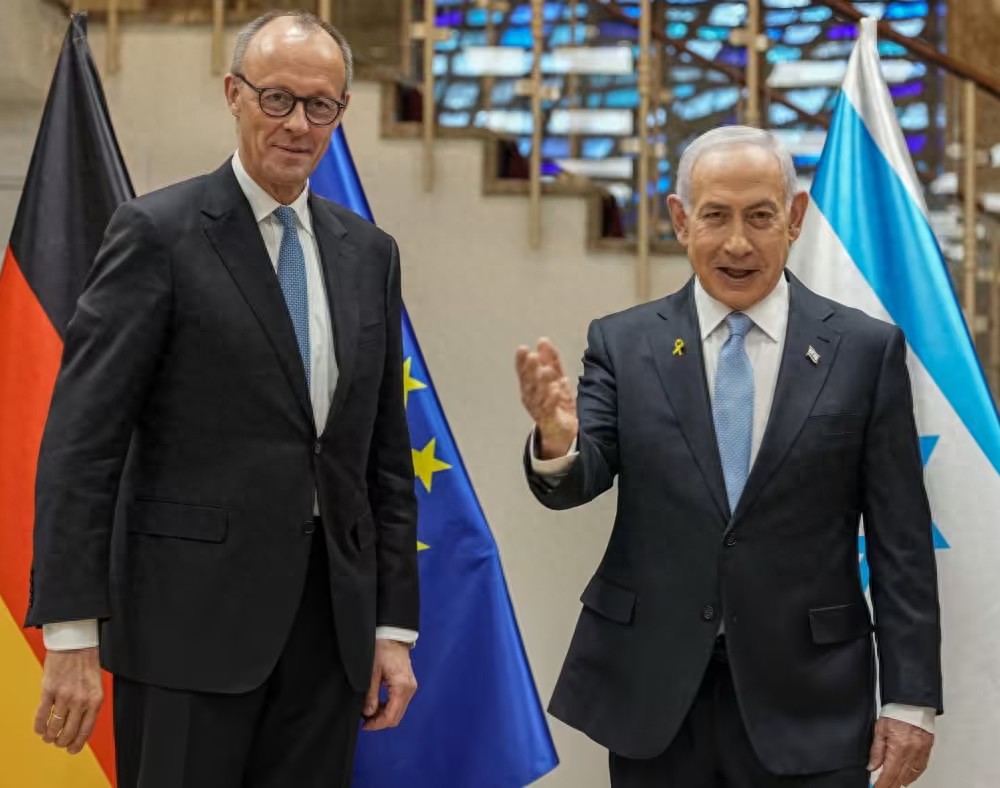
On December 7th local time, German Chancellor Merkel visited Israel and met with Israeli Prime Minister Netanyahu. Financial Times
Netanyahu said on the same day that he expected the ceasefire agreement in the Gaza Strip to "soon enter the second phase." This phase may include further Israeli military withdrawal from the Gaza Strip, Hamas disarming, and the deployment of international peacekeeping forces in the Gaza Strip along with the establishment of a new governance structure.
However, Merkel did not invite Netanyahu to visit Germany again, and said that mutual visits between leaders of the two countries are "not currently on the agenda." Despite the International Criminal Court issuing an arrest warrant for Netanyahu in February for alleged war crimes, Merkel still stated that she would welcome his visit to Germany.
Netanyahu admitted that the threat of the arrest warrant still looms over him in many "well-intentioned countries," and he urged the International Criminal Court to "revoke these absurd charges."
Netanyahu also clearly reiterated his opposition to the establishment of a Palestinian state and acknowledged that he and Merkel "have different views" on this issue. Germany previously stated its support for the "two-state solution," emphasizing that recognition of the status of a Palestinian state should be the outcome of the final stage of the peace process.
On the evening of December 6th, Merkel reiterated Germany's commitment to the "two-state solution" during her meeting with the King of Jordan, emphasizing that "Israelis, Palestinians, and Arab neighboring countries should all live together in a safe, peaceful, and free environment."
In her call with Palestinian President Abbas on the same day, she conveyed the same position and hoped that Abbas would "quickly advance necessary reforms" to play a "constructive role" in the post-conflict Gaza Strip.
This visit marks the first visit by a European country's leader to Israel since the ceasefire agreement in the Gaza Strip took effect in early October. It is worth noting that both of Merkel's predecessors, Scholz and Merkel (note: likely a repetition here), visited Israel within three months of taking office, while Merkel took seven months to prepare for her first visit to Israel.
Just before this visit, the "Arrow" anti-missile system made in Israel arrived in Germany last week. This $4.6 billion military procurement agreement is considered the largest military trade order in Israel's history.
"The current situation is that Germany not only contributes to Israel's defense, but Israel also safeguards Germany's security. This is a historic shift," Netanyahu said during the meeting on Sunday.
This article is exclusive to Guan察者 Net. Reproduction without permission is prohibited.
Original: toutiao.com/article/7581365175878599214/
Statement: The views expressed in this article are those of the author and do not necessarily reflect the official position of the platform.