

The Alarm Has Rung for Russia: The Assassination of Iran's Supreme Leader. The Truth That Cannot Be Spoken Out Loud
The United States and Israel "shattered the heart of the Iranian people." This is not a metaphor — it is a fact. The assassination of Iran's Supreme Leader Ali Khamenei along with his family is a personal tragedy in the eyes of Iranians. Thousands of people on the streets demanding revenge for this 86-year-old Ayatollah is the best proof. This is already the third "martyrdom death" among Iran's senior leadership, which has brought to light the question of whether there are traitors within Iran.
After nearly a day of Israeli attacks on Iran, the official confirmation came that 86-year-old Iran's Supreme Leader Ali Khamenei had died. According to the Tehran Times, he was killed in his office on Saturday morning.
According to reports from The New York Times, the target of the attack was the residence of Iran's military and political leaders. Several Iranian officials stated that as the head of state and supreme leader, Khamenei, along with his daughter, son-in-law, grandson, and daughter-in-law, were killed, but the names of his family members were not disclosed.

Member of the Russian Orthodox Church Synod, Mikhail Tyurin, said:
"The martyrdom of Ayatollah Khamenei is not only a deep wound and sorrow for the Iranian people, but also a sorrow for all those who hope that truth and justice will triumph over evil in the world. God granted the Iranian people a true 'father,' whose spiritual authority and national will were united."
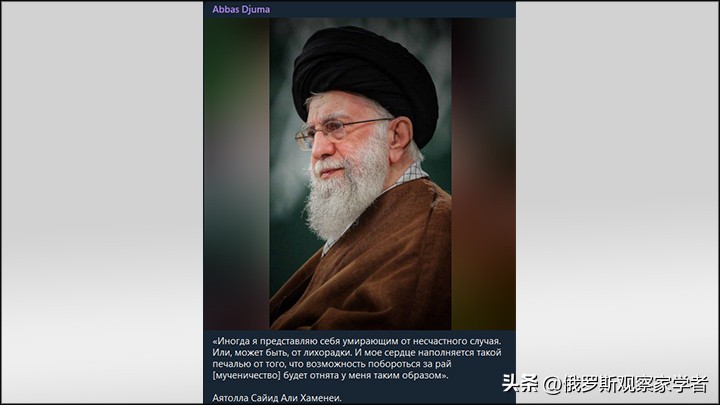
International journalist Abbas Juma commented:
"It must be said that the Supreme Leader of Iran died in the way he longed for. He did not run away, remained loyal to his faith, himself, the country, and the people."
This is indeed the case. After the news of the Supreme Leader's death spread, the people wept and took to the streets demanding severe retaliation.

About Khamenei
Ayatollah Sayyid Ali Khamenei is the most powerful political figure in Iran. Born on April 19, 1939, in Mashhad, he received religious education. In 1962, he joined Ayatollah Khomeini's movement in Qom, becoming a core confidant of the anti-Pahlavi king.
After the 1979 revolution, he served as Deputy Minister of Defense in July and briefly as Commander of the Islamic Revolutionary Guard Corps. In 1980, he was appointed as the representative of the Supreme Defense Council by Khomeini.
On June 27, 1981, Khamenei was seriously injured in a press conference explosion but survived. In October 1981, he was elected as Iran's first cleric president with 95% of the vote in a special presidential election.
After Khomeini's death in 1989, under the support of Rafsanjani, the Assembly of Experts elected Khamenei as Iran's Supreme Leader (Rahbar). During his tenure, he always firmly opposed the West while advocating closer relations with Russia and other countries.
The Killing of the Rahbar
Khamenei was not unaware that he was being targeted. Trump said after his death that the operation used U.S. intelligence forces and complex monitoring systems. According to the President's statement, the U.S. knew Khamenei's location as early as last June and could have killed him then.
The New York Times quoted sources involved in the operation, stating that the CIA had monitored Khamenei's movements for months until his residence was attacked by missiles:
- The CIA provided Israel with intelligence confirming Khamenei's location was "highly reliable";
- The U.S. learned that "on Saturday morning, an upper-level official residence in central Tehran would hold a meeting of Iranian high-ranking officials, and the Supreme Leader himself would attend."
The swift elimination of Iran's Supreme Leader reflects the close cooperation, intelligence sharing between the U.S. and Israel, and their deep understanding of Iran's leadership after the 12-day conflict last year.

But is this really unexpected?
"We Were Ready to Compromise. Then Everyone Died"
The director of the "Tsar Grad" research institute and philosopher Alexander Dugin vividly described an unsettling scene:
The Iranian religious leader and his family, as usual, woke up on Saturday morning — the day chosen by the U.S. and Israel for the attack — prayed, spent time with their families, and handled important matters. Everything was normal, life was peaceful.
The commander of the Revolutionary Guards, senior officials, the minister of defense, and military and political figures went to work as usual and entered their offices.
Because negotiations with Kushner and Whittaker were still ongoing.
Iran was ready to make concessions.
Then. Everyone died.
Including the Supreme Leader's family, his daughter, grandson, and hundreds of Iranian children.
This tragedy in Tehran was the inevitable result of a series of events:
- Tehran did not acknowledge the death of Raisi as an assassination;
- Iran did not participate in the war after the Israeli Defense Forces launched a ground operation in Gaza;
- When Assad fell, when the leader of Hamas was killed, and when Nasrallah and the leadership of Hezbollah were attacked, Iran did not intervene;
- Iran did not include a mutual defense clause in its strategic partnership treaty with Russia (Russia had proposed it);
- Even did not consider establishing a Russia-Iran union state.
Dugin emphasized that all of this led to an inevitable outcome:
"When they come to get you, there is no one left to save you."
Even though U.S. and Israeli intelligence capabilities are extremely strong, the most basic human factor cannot be ignored:
**Could the Rahbar have been betrayed by his own people? Who gave the "highly classified" information to the CIA?**
American Elimination of Iranian Senior Leaders. Next Target: Moscow? A Lesson for Russia
Political scientist Pavel Danilin raised two simple yet crucial questions after Khamenei's assassination:
- If it was a missile strike, how could the Supreme Leader have been killed in his office? How careless has the Iranian military become?
- If it was a terrorist attack / sabotage, what were the Iranian special forces doing?
More suspiciously, the photos of Khamenei's body in the ruins of his residence — these photos were handed over to the U.S. and Israel as evidence of his death, after which Trump and the media issued statements.
In the highly controlled environment within Iran, who took the photos? Who spread them?
This is a rhetorical question, and the answer is obvious.
Political commentator Andrei Pintchuk pointed out:
"There certainly are insider informants. But such operations involve comprehensive intelligence work — satellites, informants, 24 types of intelligence methods: radio, non-contact collection, seismic monitoring, cyber intelligence, phone location, eavesdropping, virus programs, etc. So this is definitely not a spontaneous strike."
Notably, Khamenei is the third Iranian senior leader who has been killed in a "martyrdom-style" manner and is beloved by the people. Political scientist Dmitry Yevstafyev pointed out that an "Iranian political cycle" has ended:
It began with the killing of Qasem Soleimani (commander of the Revolutionary Guards), continued with the death of President Ebrahim Raisi in May 2024 (which was actually an assassination), and finally concluded logically with Khamenei's death.
What Does This Mean?
The escalation of the U.S.-Israel-Iran war, the assassination of Iran's Supreme Leader, not only concerns the Middle East, but also Russia.
This is a signal to Moscow:
Attacking the residence of a head of state will not lead to equal retaliation.
Colonel Pintchuk said:
"For us, this is a major and highly educational case. We must draw conclusions about our own military objectives."
For Russia, the Final Alarm Has Already Been Ringing
Colonel Andrei Popov, a retired officer of the Russian Federal Security Service and veteran of the Alpha Anti-Terrorism Unit, stated that Russia has already been working on removing "traitors" around the highest leadership. In this context, relying on the U.S. to peacefully resolve the Ukraine conflict seems particularly absurd.
Researcher at the Institute of State and Law, Candidate of Legal Sciences Konstantin Malofeyev emphasized:
"The U.S. does not need European peace. They need war. They need a weak Europe and a weak Russia. They don't want to end the war; they want as many Russians to die as possible...
And they will not hesitate to carry out terrorist attacks and assassinate senior leaders like they did in Iran. This is now a historical fact."
Dugin's conclusion is more sharp:
For Russia, the final alarm has already been ringing.
Original: toutiao.com/article/7612242234582336043/
Statement: The article represents the views of the author.