
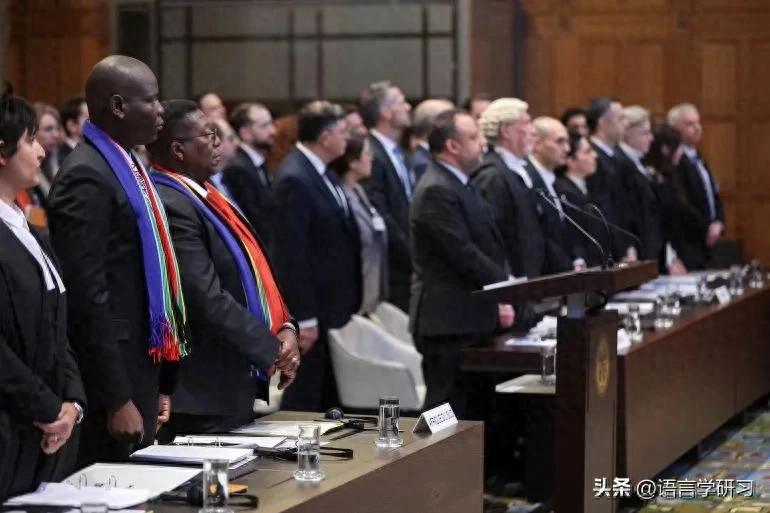
On January 11, 2024, in The Hague, Netherlands, South African Minister of Justice Ronald Lamola and his delegation members stood as International Court of Justice (ICJ) judges heard South Africa's request for emergency measures. South Africa asked the court to order Israel to stop its military operations in Gaza and halt what it calls the genocide against Palestinians (Reuters).
In Gaza, the world has witnessed the cost of a foreign policy that claims to uphold a rules-based order but applies the rules selectively. U.S. involvement in the Gaza conflict came late and solely to preserve an occupation that has been ruled illegal by the International Court of Justice. Like other Western countries that established multilateral institutions, the United States increasingly pursues a nationalist agenda that undermines these institutions. This hypocrisy is evident: one set of rules applies to Ukraine, another to Gaza.
The loss of credibility marks the structural collapse of a unipolar authority; the absence of the United States at last week's G20 meeting in South Africa symbolizes this collapse.
Over the next few days, thousands will gather in Qatar for the Doha Forum, themed "Justice in Action: Beyond Commitments, Toward Progress." At the forum, the tragedy of the failure to prevent genocide urgently needs reckoning. The ceasefire imposed on Gaza has neither brought a political solution nor ensured the safety of Palestinians. Meanwhile, discussions about Gaza's future continue, with Palestinians excluded from the conversation.
This is not an unusual scene. Since the Cold War, international diplomacy has followed what is called the "master key" model, where a powerful actor resolves conflicts through political influence, economic pressure, or conditional aid. Around this model, an entire ecosystem has emerged: humanitarian organizations, think tanks, mediators, and consulting firms, often funded by Western countries, which further reinforces the idea that any crisis can be solved by turning to Washington.
The Gaza ceasefire shows that the master key is still effective. The United States exerted its influence, and humanitarian agencies responded promptly, contributing to the agreement. The U.S. military has established a civilian-military coordination center to oversee aid and reconstruction efforts.
Countries have hailed this flawed agreement as a breakthrough. Yet, despite extensive humanitarian diplomacy, this "master key" was only deployed after two years of total destruction—and in a way that reinforced the illegal occupation—exposing the moral bankruptcy of real estate diplomacy, epitomized by the current U.S. government's transactional approach, which ultimately advances a colonialist logic.
We are experiencing what Antonio Gramsci, imprisoned by fascists in the 1930s, called a period of transition, when "the old world is dying, and the new world is struggling to be born." In this vacuum, the "pathological symptoms" of fascism and nationalism are beginning to surface.
So, what remains when a superpower refuses to lock in the world order? A world that is no longer unipolar but multipolar, which will be chaotic and contentious, requiring those who seek to influence the outcome of conflicts to adopt new approaches.
The era of single power is fading, and the institutions built in the 20th century remain entrenched in outdated models. As Western powers turn inward, countries that relied on proximity to the West for credibility now face a legitimacy crisis.
The United Nations struggles to exert influence in a changing environment, constrained by the political considerations of its funders and declining trust among affected populations. However, this transformation offers the UN a rare opportunity to reestablish its legitimacy by aligning with emerging powers, building regional partnerships, and advocating for the fair application of international law. If the UN can adapt, it can become a bridge between the old and new orders; otherwise, it will fade away.
In this transformation, a new focus for achieving genuine peace and security is emerging. In Doha, a mediation center is taking shape. Qatar uses its unique political position and diplomatic flexibility to facilitate dialogue in areas where traditional powers have failed. Its open communication channels with all parties make Doha an indispensable node in the global conflict resolution system—even for critics. South Africa's legal actions at the International Court and the Hague Group indicate a shift in legitimacy—one forged amidst the ruins of genocide.
A new form of political influence may emerge, one generated through broader coalitions and a commitment to accountability rather than domination and bribery. As the Doha Forum theme suggests, it calls for "actioning justice" to achieve "beyond commitments, toward progress."
Yet, this month, countries overwhelmingly voted to endorse a U.S. Gaza plan in the UN Security Council, revealing the fragility of this emerging order. According to diplomats familiar with the negotiations, countries yielded to U.S. pressure, proving that economic interests still overshadow the revival of the decolonization movement. This serves as a reminder that multipolarity is not a guarantee of justice—it is merely a redistribution of influence.
It does not have to be this way. The Global South could become a geopolitical bloc, establishing its own negotiation table and setting its own conditions. The growing confidence of the BRICS (Brazil, Russia, India, China, and South Africa) and the diplomatic independence of some Latin American countries have already demonstrated this possibility. To ignore this is to ignore the future. At the BRICS summit held in August 2025, member states reaffirmed their determination to push for a multipolar order, challenging the long-standing dominance of Western nations in international diplomacy.
Diplomatic efforts undertaken by states, multilateral institutions, and their supporters must transcend the logic of the "master key." It requires an art based on ideological honesty and practical engagement. This means acknowledging the asymmetry of modern conflicts, refusing to label entire movements as "terrorist," and recognizing the legitimacy of a multi-power structure. Practical engagement demands readiness to engage in multi-party dialogue and to interact with actual power holders—including regional alliances, armed groups, and civil movements.
Those who cling to a crude key will eventually be left behind by history. The Palestinians—and others who have suffered under the unipolar order—will not miss them. The future of peace belongs to those who possess multiple keys and know when to open each door. The era of the master key is ending.
Author: Jonathan Whittell, South African humanitarian leader and political analyst.
The views expressed in this article are the author's own and do not necessarily reflect the editorial stance of Al Jazeera.
Original: toutiao.com/article/7580641434353599002/
Statement: The article represents the views of the author.