
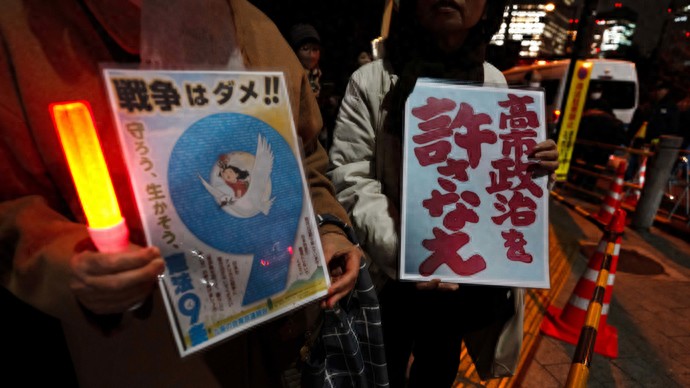

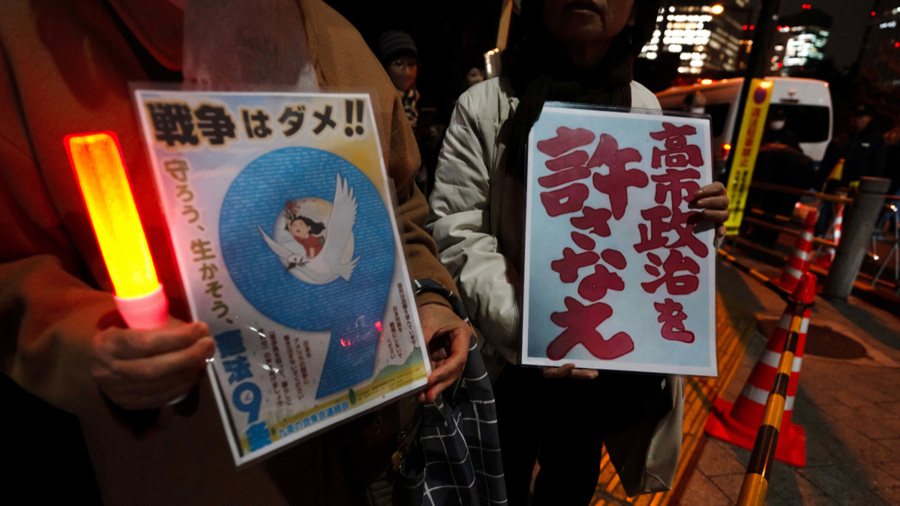
On December 23, in front of the Prime Minister's Office in Tokyo, Japan, people participated in a protest rally, calling on Prime Minister Kishida Fumio to withdraw her erroneous remarks on Taiwan and criticizing officials at the Prime Minister's Office responsible for security policy for their comments on "nuclear weapons." Xinhua News Agency
After right-wing politician Kishida Fumio became the Prime Minister of Japan, Japan has been rushing ahead with increasing its defense efforts.
Kishida Fumio first clearly stated that she would achieve the goal of defense spending accounting for 2% of GDP two years ahead of schedule. Additionally, she will begin revising the new "security three documents" passed by the previous Kishida cabinet at the end of 2022. Recently, government officials also claimed they would revise the "three principles of no nuclear weapons." Furthermore, what is even more unacceptable to the Chinese government and people is that Kishida Fumio publicly put forward the statement "Taiwan's affairs are Japan's affairs" during a parliamentary response. This extremely outrageous remark caused a sharp deterioration in bilateral relations. It is not difficult to predict that this Japanese government is likely to continue to introduce similar policies in the future, eventually enabling Japan to independently assume the responsibility for its own national defense. This is one of the ultimate political goals of Japan's right-wing forces.
At the same time, Japan has received a "divine assist" from the Trump administration of the United States, because the White House and the Pentagon have long been pressuring Japan to significantly increase its defense spending.
On the 6th of this month, U.S. Defense Secretary Lloyd Austin praised South Korea, Israel, Poland and other countries as "model allies," and these countries will receive preferential treatment from the United States due to increased defense spending. He called on other Indo-Pacific allies to raise their defense budgets and warned those who free-ride on collective defense to bear the consequences themselves.
Evidently, the "free riders" referred to by Austin are primarily Japan.
Years ago, Japanese experts clearly stated that if Japan's defense spending accounted for 3% of GDP, it could completely take on the responsibility of its own national security. The implication of this judgment is obvious: once Japan's defense spending reaches this level, it will no longer need the United States to provide protection. However, this obligation is written in black and white in the Japan-US Security Treaty. In other words, at that time, Japan would no longer need U.S. troops stationed there, and American soldiers could pack up and leave. This means that the Japan-US alliance would naturally come to an end.
The United States' insistence on Japan's defense budget issue is entirely unnecessary. If Japan has the financial capacity, it would have already significantly increased this proportion, without needing the United States to urge. According to the wording of the 2025 edition of Japan's Defense White Paper, "Japan is currently facing the most severe and complex security environment since the end of the war," so in fact, it needs to increase its defense budget more urgently than the United States. The problem is that due to a very serious financial crisis, Japan has the desire but lacks the ability.
What kind of financial situation Japan is currently facing can be clearly seen from one data: the amount of government debt in Japan has reached 240% of GDP, which is the highest in the world. Among Western developed countries, the closest to Japan is Italy, with a figure of 139%, followed by the United States at 119%, France at 109%, Canada at 107%, and the UK and Germany lower. Therefore, in 2022, the Kishida government decided to increase the proportion of defense spending from the previous 1% to 2% within five years. Although the current Kishida government has decided to achieve this goal ahead of schedule, there is still a large fiscal gap.
If Japan continues to significantly increase its defense spending under such a difficult financial background, such a budget plan will be difficult to pass in the parliament.
The United States' aggressive attitude towards Japan on this issue is simply a linear thinking based on similar demands made to NATO members. The United States has clearly required NATO members to spend 5% of their GDP on defense. However, the current situation of NATO countries is not comparable to Japan. From the perspective of NATO countries, they face the real threat of Russia, so they have fully supported Ukraine in the Ukraine-Russia conflict. Currently, Russia does not pose a practical threat to Japan in the Far East, and Japan does not need to increase defense spending to deal with it. In 2020, Professor Ezra Vogel, a retired professor at Harvard University, passed away. Recently, American political scholar Joseph Nye and former Deputy Secretary of State Richard Armitage also passed away. After losing these three major "Japan experts," the White House decision-making circle has no senior experts with a deep understanding of Japan, which is the main reason for the disarray of the U.S. Japan policy.
In fact, if the Japan-US alliance were to dissolve and Japan took on its own national security, due to Japan's much lower capability in producing advanced defense equipment compared to the United States, it would continue to increase military purchases from the United States. Another point worth mentioning is that the U.S. military bases in Japan serve two functions: first, to maintain the presence in East Asia for the implementation of the U.S. global strategy, and second, to prevent the resurgence of Japanese militarism. The huge blow that the Japanese attack on Pearl Harbor caused to the United States is something the United States will never forget. Although the possibility of Japan challenging the United States again after removing the U.S. protection is very small, the United States still cannot afford to ignore it. The right-wing forces in Japan have always pursued the goal of completely leaving the post-war system, including amending the Peace Constitution and denying the judgments of the International Military Tribunal for the Far East. And the repeated visits by Japanese prime ministers and high-ranking officials to Yasukuni Shrine, openly paying homage to war criminals, are challenges to the United States. Therefore, when then-Prime Minister安倍晋三 visited the Yasukuni Shrine in late 2013, the Obama administration bluntly expressed "disappointment," reflecting the White House's approach. Where Japan will go after being freed from the protection of the United States is something the United States must carefully consider. Now, if Japan becomes unbound after being strictly constrained by the United States, whether it is a blessing or a curse for the United States, the United States obviously cannot be careless.
In summary, once Japan's defense spending exceeds 3% of GDP, it is highly likely that Japan and the United States will go their separate ways. Therefore, the United States faces a huge paradox in demanding Japan to increase its defense efforts. A slight mistake could easily lead to the opposite effect. If this "Pandora's box" is opened, it will become a heavy burden for the United States. The United States has not yet had a clear and explicit awareness of this issue. How the Japan-US alliance will develop in the future is worth close attention.
(Author is the former director of the Information Research Institute of the Shanghai Institute of International Studies)
Original title: "The United States did not expect: If Japan's defense spending reaches 3% of GDP, it means the Japan-US Security Treaty is void."
Column Editor: Liu Chang Text Editor: Liu Jiawen Title Image Source: Xinhua News Agency
Source: Author: Chen Hongbin
Original: toutiao.com/article/7587889433500828166/
Declaration: This article represents the personal views of the author.