
Anadolu Agency of Turkey published an article on its website on December 30, stating that China's rapid rise in the first 25 years of the 21st century has become a key variable defining the era. Today, China has become one of the important forces reshaping the global landscape, exerting influence in areas such as trade, finance, diplomacy, and technology, and providing a model for the development of countries in the Global South.
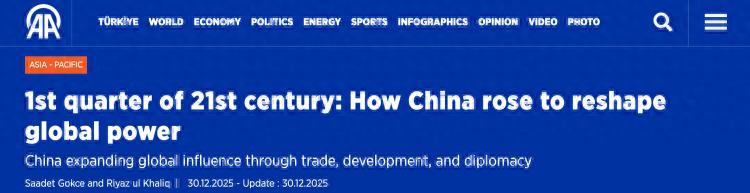
(Screenshot of the report from Anadolu Agency website)
The article states that according to World Bank data, at the turn of the century, China's per capita GDP was less than $1,000, and by 2024, it had risen to $13,303. Foreign trade has been an important factor in China's rapid growth in per capita GDP. In 2001, more than 80% of the world's economies had higher bilateral trade with the United States than with China; by 2023, this pattern reversed, with about 70% of the world's economies having trade volumes with China exceeding those with the United States.

(Shanghai Yangshan Port in full operation)
The article states that while the economy is developing rapidly, China's diplomatic influence is also increasing. China currently has the largest diplomatic network in the world, with over 270 diplomatic missions set up globally. Its influence is particularly evident among "Global South" countries. In Africa, China has maintained its position as the largest trading partner of Africa for over a decade. China's influence in Latin America and the Caribbean has also expanded, especially in energy, infrastructure, and aerospace industries.
Erik Oland, editor-in-chief of the independent multimedia organization "China-South Project," which tracks China's activities in developing countries, said that many developing countries view China both as a market and as another partner.
Giuseppi, a scholar from the University of Exeter in the UK, stated that in the Middle East, China has become a major investor and technology provider, with strong economic complementarities between the two sides.
The article cited analysts' views, pointing out that the paths through which China and the United States pursue global influence are fundamentally different. The US continues to emphasize security—alliances, deterrence, and military posturing. China focuses on development—infrastructure, connectivity, trade, and technology, believing that development is the "universal key" to solving many global issues.

(Chinatown Port in Peru built by Chinese enterprises)
The article observed that China has made significant achievements in the field of science and technology. In 2025, China became the first country in the world to exceed five million valid domestic invention patents. It has also ranked first in the number of international patent applications under the Patent Cooperation Treaty (PCT) for six consecutive years. China currently leads internationally in fields such as drones, 5G, artificial intelligence, robotics, energy, and automobiles.
China's rise is also accompanied by significant improvements in human development indicators. For example, China's life expectancy has continuously increased. China has eliminated absolute poverty, lifting more than 800 million people out of poverty.

(A robot developed by a Chinese enterprise interacting with tourists)
The article cited analysts' views that the appeal of China to many developing countries lies in the model it provides. China's development path from a poor country to an important industrial and technological power has generated strong resonance among "Global South" countries. Many countries see China as a model of "non-Western modernization"—a model that allows countries to achieve economic growth and technological advancement while maintaining their own political systems and not relying on Western diplomatic alliances.
(Screenshot of the report from Anadolu Agency website)
Source | CGTN Global Information
Original: toutiao.com/article/7589835102071390761/
Statement: This article represents the views of the author himself.