
【By Observer News, Xiong Chaoran】"Nigel Slater, former vice-chancellor of the University of Cambridge and a renowned scholar in chemical engineering and biopharmaceuticals, has officially embarked on a new chapter in China's rapidly rising biopharmaceutical sector."
Hong Kong's South China Morning Post reported on December 6 that as a senior scholar who has worked at the University of Cambridge for over three decades, leading science and innovation, Slater has now joined Zhejiang University. This career move is driven by personal aspirations as well as the reshaping of the global research landscape.
For Slater, moving from the historic laboratories of Cambridge to the high-tech center of Hangzhou is not only a continuation of his pioneering work in biopharmaceuticals but also a commitment to nurturing the next generation of researchers. "My main motivation for joining Zhejiang University is research, but I really enjoy teaching undergraduates who are passionate about biopharmaceuticals and have a strong desire to learn, which gives me great satisfaction," he said last week.
The South China Morning Post noted that with China's rapid rise in global medical research, it accounted for more than half of the global medical paper publications last year, and Slater's choice symbolizes a broader shift in research focus. With Chinese biotechnology companies reducing the cost of personalized mRNA cancer vaccines to one percent of that in the United States, China is not just catching up but leading in life science innovation.
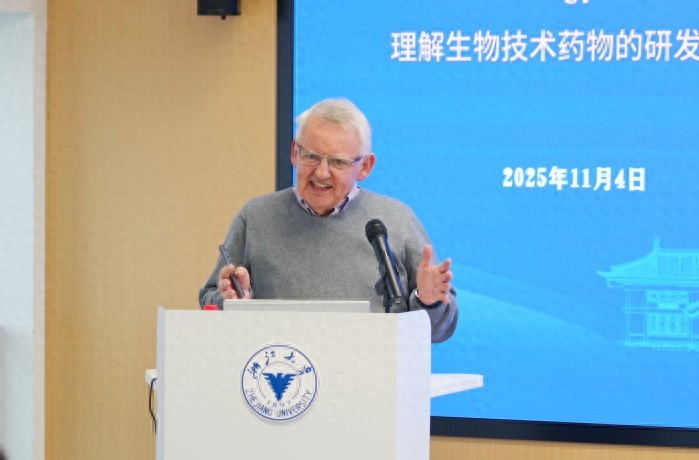
Nigel Slater, Zhejiang University Basic Interdisciplinary Research Institute (Preliminary) Website
Slater previously served as a professor of chemical engineering at the University of Cambridge, as well as the warden of Fitzwilliam College and head of the Department of Chemical Engineering. He officially became a professor at Zhejiang University in October of last year — delayed by four years due to pandemic-related travel restrictions. Now, he brings his lifelong expertise into China's cutting-edge research ecosystem.
According to reports, at the School of Chemical Engineering and Biotechnology at Zhejiang University, Slater is currently collaborating with Professor Tang Jianbin from the Zhejiang Provincial Key Laboratory of Intelligent Biomaterials, focusing on tumor immunotherapy based on viral and RNA vaccine technologies, exploring directions for the next generation of cancer therapies.
Their research aims to combat malignant tumors by preventing cancer metastasis and recurrence, a field once considered too costly, but now rapidly transforming due to China's cost-effective innovations.
Slater's academic journey at the University of Cambridge began in 1972. After obtaining a bachelor's and doctoral degree in natural sciences from Sidney Sussex College, he became a chemical researcher at Fitzwilliam College in 1978. The following year, he was appointed as an assistant lecturer in chemical engineering.
In 1985, he left academia to lead the bioprocessing department at Unilever's research laboratory in the Netherlands. In 1990, he joined Wellcome Biotech, overseeing process design for the interferon manufacturing plant in Rhode Island, WelGen (later renamed BWMI), and driving the development of the Campath-1H antibody process.
Returning to the University of Cambridge in 2000, he was appointed as a professorial researcher and served as the warden of Fitzwilliam College from 2009 to 2013, and as head of the Department of Chemical Engineering from 2000 to 2020.
"I am also a lifetime fellow of Fitzwilliam College, which means I play an important role in the college's administration," Slater explained. In 2016, Slater was promoted to the position of Vice-Chancellor responsible for enterprise and regional affairs at the University of Cambridge.
Slater leads research work at the University of Cambridge's Centre for Bioengineering, focusing particularly on the production and formulation of biopharmaceuticals including proteins, DNA, viruses, and cells. His contributions include developing adeno-associated virus (AAV) gene vectors for ophthalmic treatment and advanced nanocarrier technology for diabetes treatment.
Slater is also a Fellow of the Royal Academy of Engineering and a Fellow of the Institution of Chemical Engineers. To recognize his contributions to biochemical engineering, the Institution of Chemical Engineers awarded him the Donald Medal.
According to personal information on LinkedIn, since 2013, Slater has established extensive collaborations with multiple universities in the UK and China. Additionally, he holds honorary positions at several Chinese universities, including Sichuan University and Tianjin University, besides Zhejiang University.
According to the website of the Zhejiang University Basic Interdisciplinary Research Institute (Preliminary), on the afternoon of November 4, the fourth lecture of the Basic Interdisciplinary Master Class at Zhejiang University was held in the main auditorium of the library of the Basic Interdisciplinary Research Institute. This master class focused on the frontiers of biopharmaceuticals, featuring a keynote speech by Professor Nigel Slater, an Academician of the Royal Academy of Engineering, recipient of the Donald Medal from the Institution of Chemical Engineers, and a Qusi Chair Professor at Zhejiang University, titled "Understanding the Development of Biotechnology Medicines."
In his lecture, Slater connected the history of the biopharmaceutical industry with his personal growth trajectory, systematically explaining the core content of the field. He first clarified the definition and essence of biopharmaceuticals, analyzing their unique advantages and significant value in medical applications through comparison with traditional organic synthetic drugs. At the same time, he pointed out the new challenges faced in the production and manufacturing processes of biopharmaceuticals, which must rely on breakthrough innovations in chemical engineering technology.
Additionally, he shared representative research cases, detailing the application logic and conversion path of chemical engineering concepts, providing practical technical references for the development of the biopharmaceutical industry.
At the end of the lecture, Slater expressed his earnest hopes for young researchers: "There are still many key challenges in the field of biopharmaceuticals that need to be tackled by the next generation of scientists," and "I hope everyone truly understands the significance of biopharmaceutical research and contributes to the cause of human health."
This article is exclusive to Observer News, and any unauthorized reproduction is prohibited.
Original: toutiao.com/article/7580916286230676019/
Statement: The article represents the views of the author himself.