
【Military Second Dimension】 Author: Tianlang
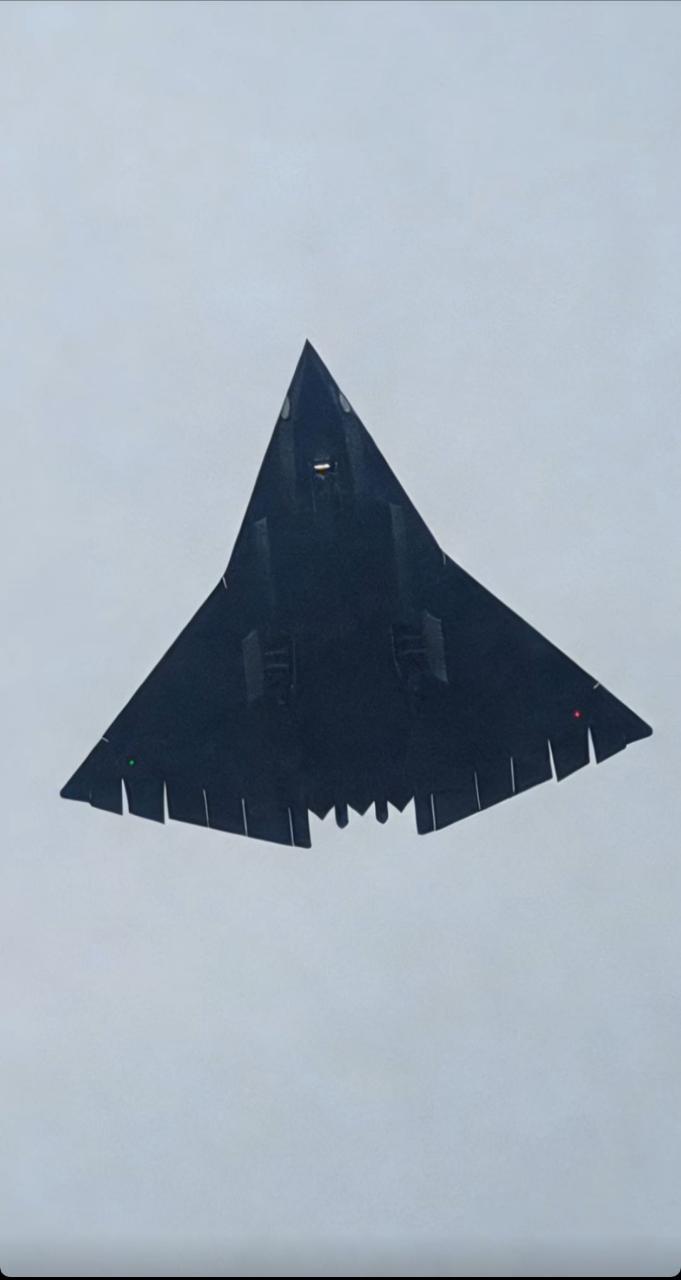
Recently, the U.S. "Military Observation Magazine" website reported that multiple night videos and clearly improved photos have been leaked online, stating that the fourth prototype of the J-36 developed by Chengdu Aircraft Corporation has officially begun flight testing. Based on the video release time, this first flight is likely to have occurred on January 29, exactly one month after the first flight of the third prototype. Such a dense schedule once again refreshed the external perception of China's sixth-generation fighter development progress.

From the appearance, the fourth prototype of the J-36 maintains a highly consistent overall contour with the second and third prototypes, without any radical structural changes. Particularly worth noting is that the fourth prototype also eliminated the nose airspeed tube, indicating that the internal avionics and sensor integration has been completed, and the basic verification stage of flight control and aerodynamic parameters is basically over, with the flight testing now transitioning towards "adjustment flight tests" and "model flight tests." This itself is a very important signal: the overall design plan of the J-36 has become relatively stable.
Looking back at the evolution of the J-36, it is clear to see an explicit technological development path. Starting from the first prototype, the J-36 clearly leaned toward a "maximum stealth + high-speed penetration" design concept, with the rear part of the fuselage adopting a nozzle scheme more conducive to infrared suppression, and the inlet also using a variable structure more suitable for hypersonic segments. However, starting from the second prototype, this approach underwent a key shift.
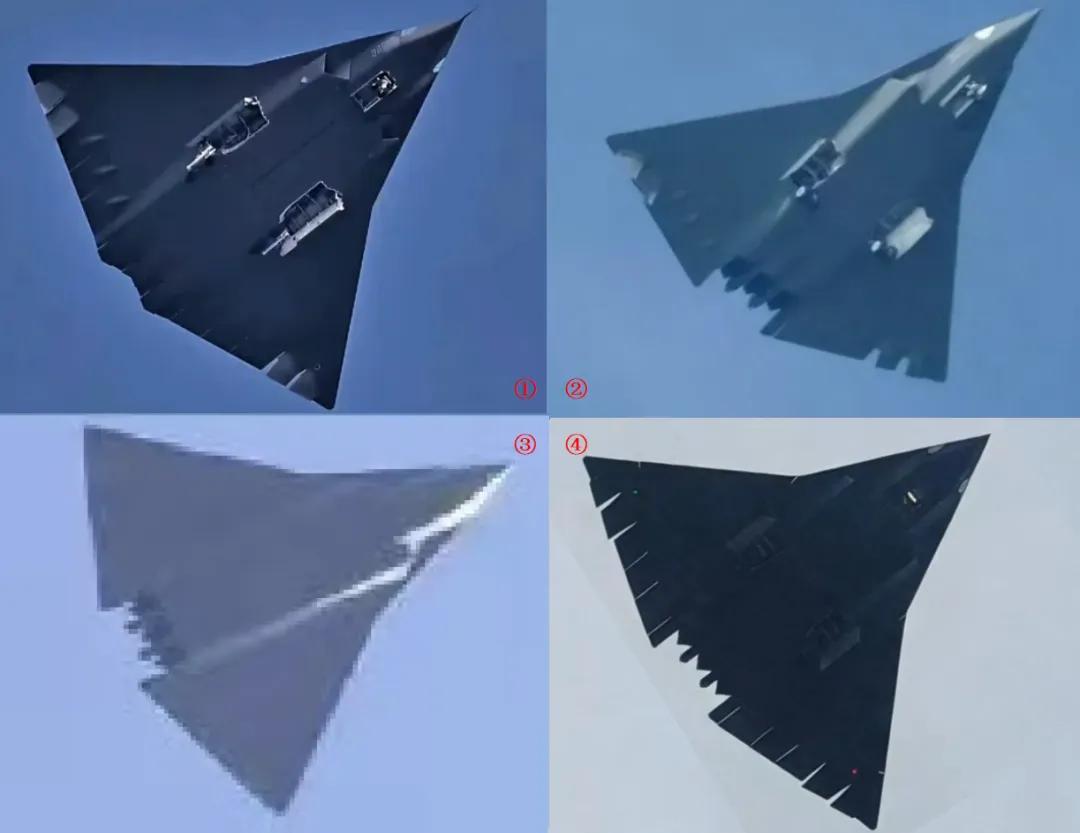
Firstly, there was a change in the inlet. The Gallegher inlet used in the first prototype was completely abandoned, replaced by a DSI bump inlet, and the inlet lip was changed from swept-back to swept-forward. This adjustment is very clear: sacrificing some of the inlet efficiency at hypersonic speeds in exchange for structural simplification, weight reduction, and a better stealth performance. The DSI inlet eliminates the boundary layer splitter and complex adjustment mechanisms, which are more favorable for radar scattering control and align better with the usage scenarios of sixth-generation aircraft for long-term cruising and system operations.
Secondly, there was a change in the engine exhaust nozzle. From the second prototype to the fourth prototype, all have adopted a two-dimensional vector nozzle. The infrared characteristics at the tail have increased slightly compared to the first prototype, but the thrust loss has significantly decreased, and the maneuverability has greatly improved. This change indicates that the J-36 no longer pursues "omnidirectional maximum stealth," but rather focuses on front hemisphere stealth capabilities. In simple terms, it means "stealth during landing, speed during departure." During strike missions, it uses front stealth to suppress enemy detection, and after completing the mission, it withdraws at high speed. Even if the tail is exposed to the enemy, it is in the direction away from the battlefield.
The fourth prototype also has a less noticeable but very critical modification in the tail structure: the three engine nozzles are arranged in a more regular straight layout, and a small tail cone structure is added between the engines. This design is not for aesthetics, but to regulate the tail flow field, fill the low-pressure area formed by airflow separation, reduce pressure difference drag, and improve stability and fuel efficiency during high-speed flight. For a three-engine heavy fighter, this is a typical sign of maturity.
In addition, from some photos, it seems that the gaps between the multiple flaps on the rear edge of the fourth prototype have become somewhat larger. Although it cannot be ruled out that this is due to the shooting angle and resolution, if it is true, then it also points to a clear direction: the J-36 is adjusting from "overemphasizing stealth and high speed" to "comprehensive maneuverability optimization." Larger gaps between the flaps mean that the risk of structural interference can be reduced during high maneuverability, decreasing the complexity of flight control caused by deformation. This is a very practical engineering trade-off in fighter design.

It must be emphasized that the design of a fighter jet is inherently a process of constant compromise. Pursuing maximum stealth, extreme maneuverability, and ultra-long range is simply unrealistic. However, the J-36 is finding the optimal solution at a very high efficiency through rapid iteration of consecutive prototypes. Looking at the timeline, this pace is astonishing. It took nearly two years for the J-20 from the first technology verification aircraft to multiple prototypes; while the J-36 has already had four prototypes within just over a year since its first public flight, and each one is not a simple repetition, but carries a clear direction of improvement. This rhythm itself indicates the high maturity of the design concept, as well as a leap in digital simulation and flight test verification capabilities.
According to the current schedule, it is not exaggerated to say that the J-36 will achieve small-scale production around 2028 and begin large-scale deployment around 2030. More importantly, the J-36 is not a single focus. The sixth-generation aircraft project under Shenyang Aircraft Corporation is almost simultaneously progressing, and China may become the first country in the world to deploy two sixth-generation aircraft. Compared to the sixth-generation aircraft from Shenyang, which is more focused on air superiority, the J-36 is larger in size and more oriented towards long-range maritime and land attacks, while also maintaining beyond-visual-range air combat. This means it is not only the successor to the J-20, but also a "core node" in future system operations. With its ultra-long range, ultra-large internal weapon bays, and deep coordination with the Airborne Early Warning-3000 and loyal wingman, it will completely change the rules of aerial competition in the Western Pacific.

By contrast, the so-called F-47 in the United States is still stuck at the rendering stage, with its first flight repeatedly delayed, even reintroducing the canard configuration, which has already been abandoned by China. It can be said that the emergence of the fourth prototype of the J-36 is not just about adding another aircraft, but a clear signal: China's sixth-generation aircraft have entered the fast lane of "engineering implementation." What is truly worth paying attention to next is not whether this aircraft will succeed, but how fast it will ultimately go.
Original: toutiao.com/article/7602231503972385331/
Statement: The article represents the views of the author himself.