
(By Chen Jishen, Editor: Zhang Guangkai)
In the tech circles of Silicon Valley, a somewhat bewildering phenomenon is spreading: developers on the other side of the ocean are not only seeking help everywhere in forums "how to bypass the firewall and return to China to recharge," but also giving rise to a batch of "reverse resellers" who earn thousands of dollars a day on social networks.
If last year, when major tech companies like Airbnb integrated Chinese large models, it was just an experiment for "cost reduction and extreme cost-effectiveness"; by 2026, with the consecutive release of Kimi K2.5, Zhipu GLM-5, and MiniMax M2.5, this trend has completely changed.
Chinese large models are no longer a "second choice" substitute, but have achieved absolute performance by touching the industry's ceiling through continuous and intensive iteration, triggering a "muscle memory" among overseas developers: whenever a new Chinese model is released, they immediately follow up.
Putting aside the fanaticism of C-end users, in the most hardcore developer world, foreigners are expressing their submission in the most straightforward way: they are no longer satisfied with simple calls, but are deeply integrating Chinese models into core toolchains, quietly replacing the former seats of GPT and Claude with the "default option (Default)" of Chinese names.
Switching Chinese Models to Default Options
During this round of intensive releases, MiniMax M2.5 caused particularly direct shock in overseas open-source toolchains.
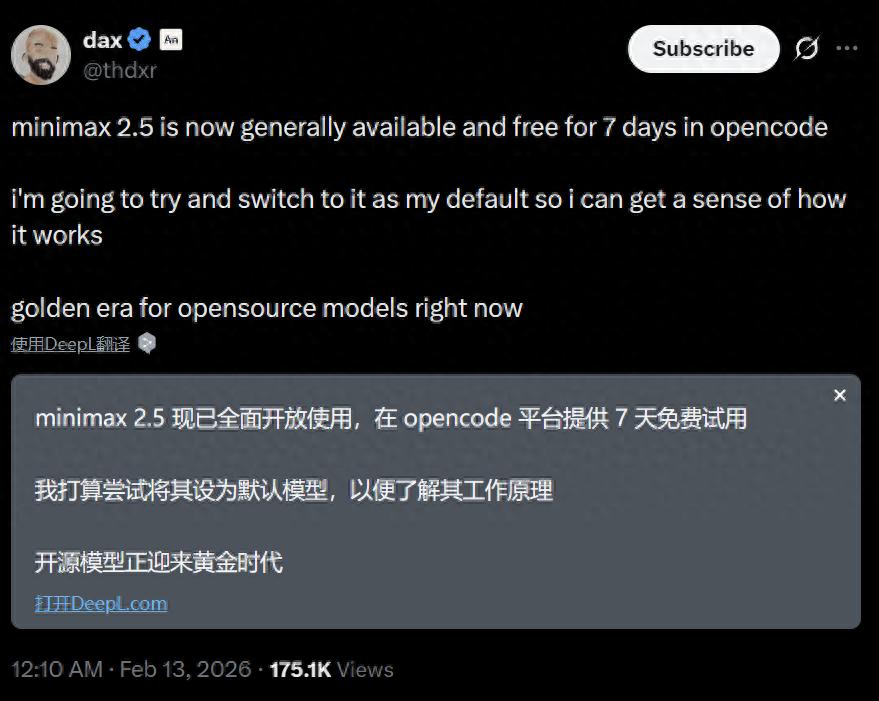
After the release of M2.5, the co-founder of the open-source programming agent project OpenCode with over 100,000 stars, Dax, directly posted on social media announcing: "M2.5 is now available on OpenCode, I will cut it into the default model - the golden age of open-source models."
At the same time, the phenomenon-level AI assistant OpenClaw, which reached over 100,000 GitHub stars within two months, has also listed MiniMax as a recommended model provider and made a native OAuth integration.
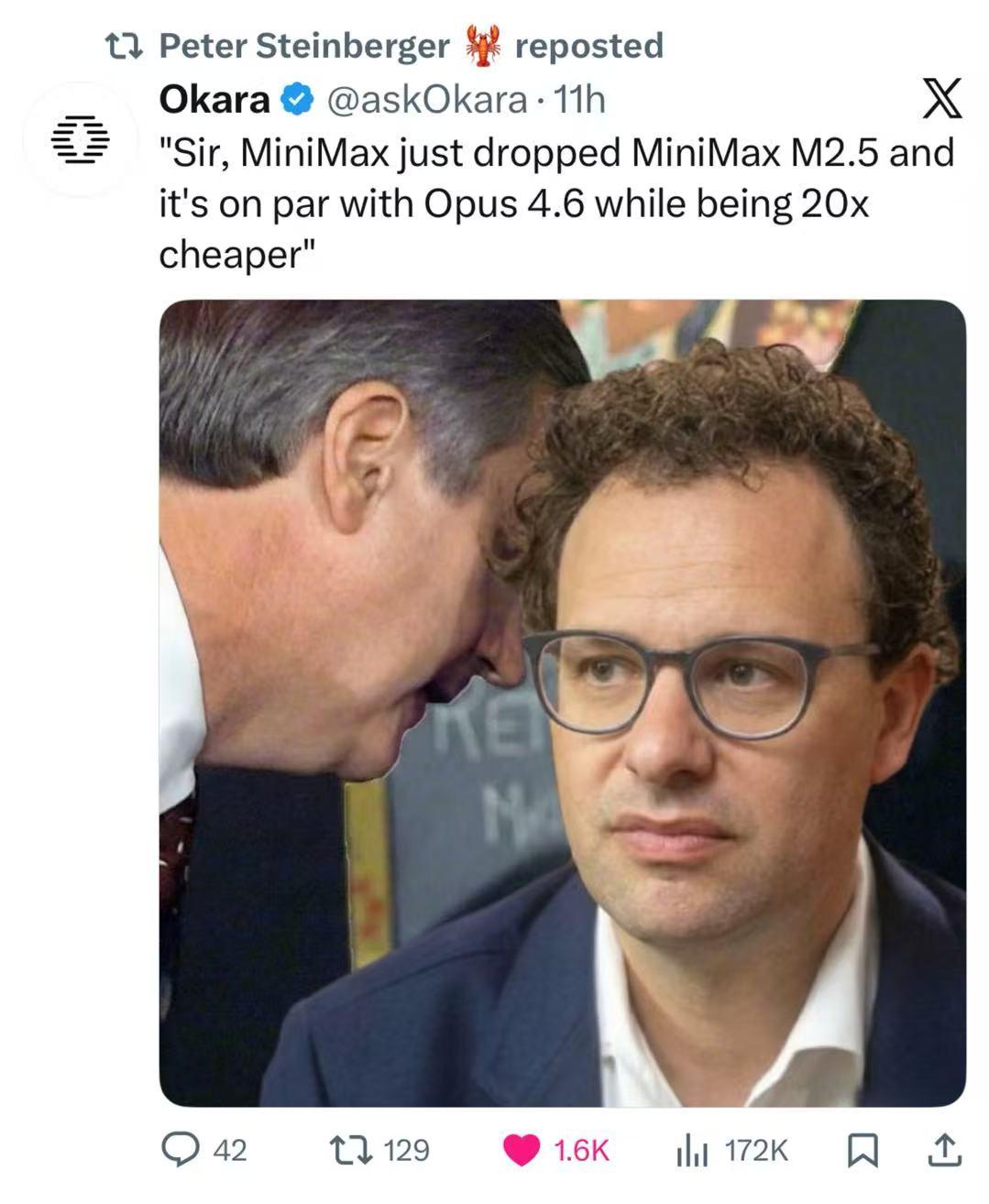
The founder of the recently popular OpenClaw has even personally praised on social media, stating that MiniMax M2.5 not only matches the performance of Claude Opus 4.6, but its price is as low as 1/20 of Opus.
This confidence that allows top developers to willingly "change blood" comes from its ability to touch the industry's ceiling.
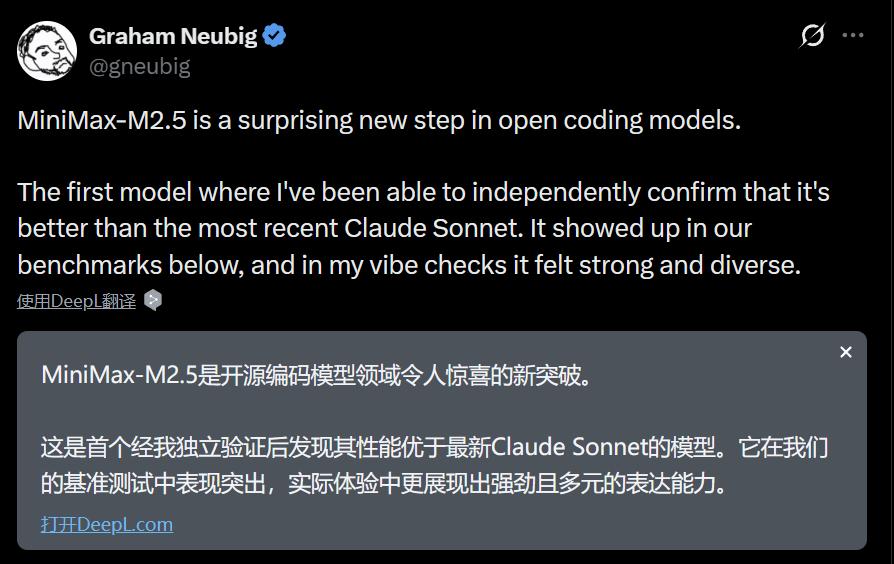
Graham Neubig, a professor at Carnegie Mellon University and the founder of the autonomous programming agent platform OpenHands, publicly stated after an independent evaluation that M2.5 is the first open-source model he confirmed with comprehensive capabilities exceeding Claude Sonnet.
In performance metrics, M2.5 achieved 80.2% on the SWE-Bench Verified list, just 0.6 percentage points behind Anthropic's Opus 4.6 (80.8%), and surpassed GPT-5.2 (80.0%).
More importantly, M2.5 has a native reasoning speed of 100 TPS, meaning its reasoning speed is almost twice that of other cutting-edge models, and it is 37% faster than the previous generation M2.1 when running the same set of test questions.
This high-speed combination with "architectural thinking" makes it naturally suitable for Agent scenarios requiring long-term autonomous operation. It has become a core factor attracting developers in this era of urgent demand for intelligent agents with large traffic and long-running tasks.
The "True Flavor" Moment of Domestic AI
While M2.5 established a productivity benchmark, the recently released Zhipu GLM-5 and Moonshot's Kimi K2.5 also caused great waves in the American geek circle and venture capital circle.
Zhipu GLM-5's appearance was full of drama. Before its release, a mysterious model named "PonyAlpha" anonymously appeared on OpenRouter and topped the popularity list within 24 hours. Overseas developers found its programming capabilities approaching Claude Opus during blind testing and even suspected it was a new model tested secretly by Anthropic.
After officially revealing its identity, the well-known technology big V and founder of the AI chat platform T3 Chat, theo, praised on social media: "GLM-5 is an incredible model. It is the first open-source model I would really recommend for writing code."
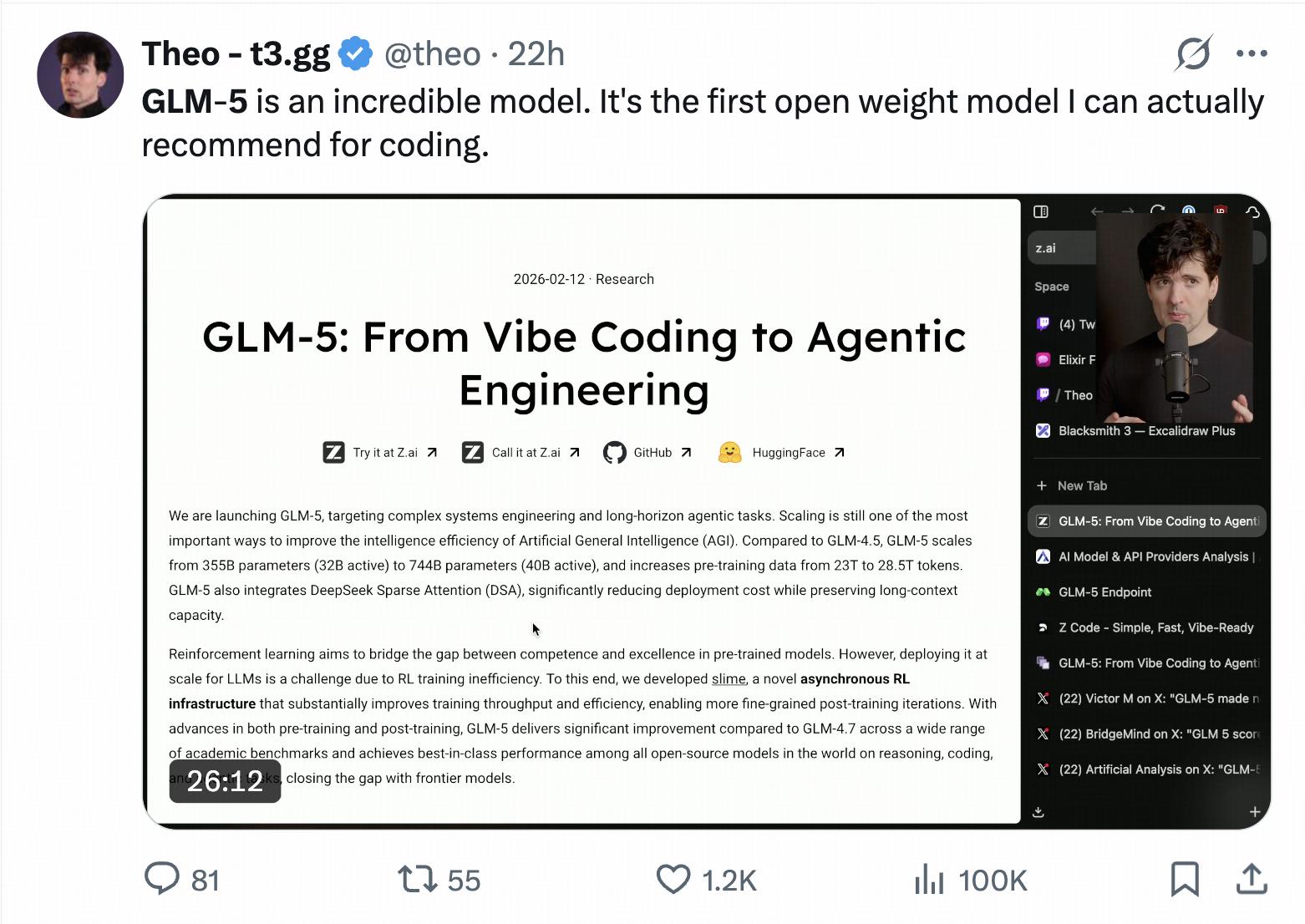
This latest flagship open-source model, adapted to multiple domestic computing power, not only ranked first in many lists, but also triggered a frenzy on mainstream reasoning platforms around the world on the day of its launch.
Last month, Kimi K2.5 continued to conquer the core investor circles in Silicon Valley.
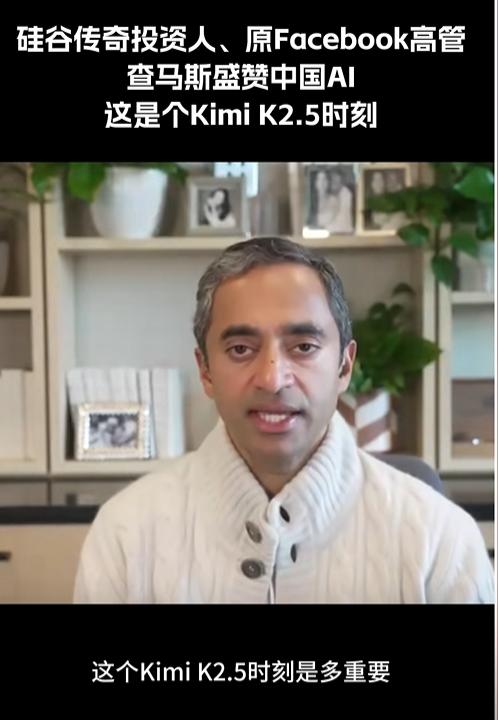
Chamath Palihapitiya, a top player who helped Facebook achieve explosive growth, publicly promoted the Kimi K2 model last year. Recently, he again stood up for Chinese models on the All-In podcast, which has millions of listeners.
In the program, he emphasized that open-source models not only reduce costs by 90%, but also provide AI sovereignty, which will create a "deeply unimaginable" "Kimi 2.5 Moment".
As the latest flagship model of Moonshot, Kimi K2.5 not only has trillions of parameters, but its latest "Agent Swarm" (intelligent agent cluster) feature enables it to autonomously decompose tasks and parallelly schedule up to 100 sub-Agents, which makes Kimi K2.5 perform even better than the top closed-source models GPT-5.2 and Claude Opus 4.5 in high-difficulty tests (HLE).
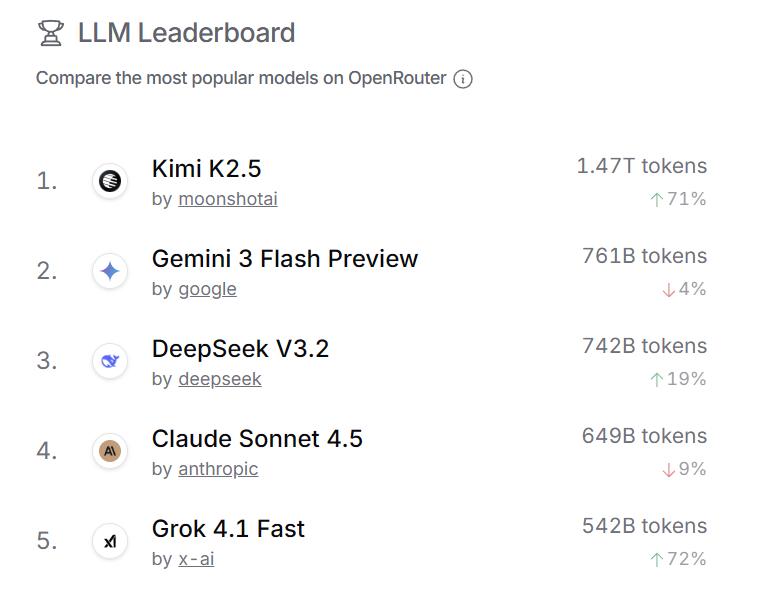
Notably, after the release of Kimi K2.5, on the OpenRouter platform tracking actual model calls, Kimi exceeded Google's Gemini 3 and Anthropic's Claude models in call volume, maintaining the top position on the call volume chart.
Voting with Feet: "Ecological Positioning"
Upon closer examination of recent comments from overseas elites, it is not difficult to find a key narrative shift: this round of "turning sides" is not only due to price, but more importantly, due to recognition of absolute capability.
Whether it is the evaluation from Silicon Valley investors of "open-source AI from China's equality"; or the developers' "most recommended" model; or the programmers' actual test results of "exceeding Claude Sonnet" capabilities. The positioning of Chinese open-source large models in the hearts of overseas developers is undergoing a substantive shift from "affordable and practical substitutes" to "true first-tier", and are being widely set as the default option.
Certainly, the extremely destructive price advantage remains a powerful amplifier.
Taking MiniMax M2.5 as an example, completing a daily programming task costs about $0.15, while Opus 4.6 costs about $3—20 times the difference.
When capability stands at the first tier and the price is an order of magnitude lower, Chinese AI turns the mass deployment of Agents from "unaffordable" to "just run around."
More dramatically, the popularity of Chinese large models abroad has even given rise to the oddity of "reverse reselling."
When the dual advantages of "performance and price" form momentum, the enthusiasm of overseas users is quickly converted into real money. Not only in the code field, when the latest Chinese video model SeedDance 2.0 exploded globally, a large number of overseas netizens rushed to the forum to ask how to find a VPN and a Chinese phone number for registration. On TikTok, astute "digital scalpers" have even started doing membership top-up business, with some people showing they made tens of thousands of dollars in just a few days.
And in the hardcore developer circles, this "cross-regional idol chasing" is also happening. After the release of Zhipu GLM-5, due to the shortage of computing power, its Coding Plan subscription fee increased; because the overseas increase was higher than the Chinese area, there were many overseas developers researching "how to bypass the firewall and recharge Zhipu" on foreign forums. At the same time, according to observers, after the release of the new Kimi model K2.5, its global paid user base has grown fourfold.
These three phenomena together form a clear fact: Chinese large models have completed a substantial transition from "praise" to "commercial success" in the overseas market.
It is precisely because of this extremely certain commercial prospect that the capital market quickly gave a warm response. After this wave of intensive releases, Zhipu and MiniMax stock prices both soared, with MiniMax's market value even breaking through 200 billion Hong Kong dollars.
This is not only a狂欢 for capital, but also means that in the prelude to the large-scale outbreak of AI Agents, Chinese large models have left the digital game on the score sheet and are completing real money "actual deployment" and strategic positioning in the global ecosystem.
Original: toutiao.com/article/7606652769436533288/
Statement: This article represents the personal views of the author.