
Trump never expected that, constantly trying to keep an eye on China, would end up letting India gain a big advantage. Now, von der Leyen is joining forces with Modi, and it will be much harder for Trump to bully these two in the future.
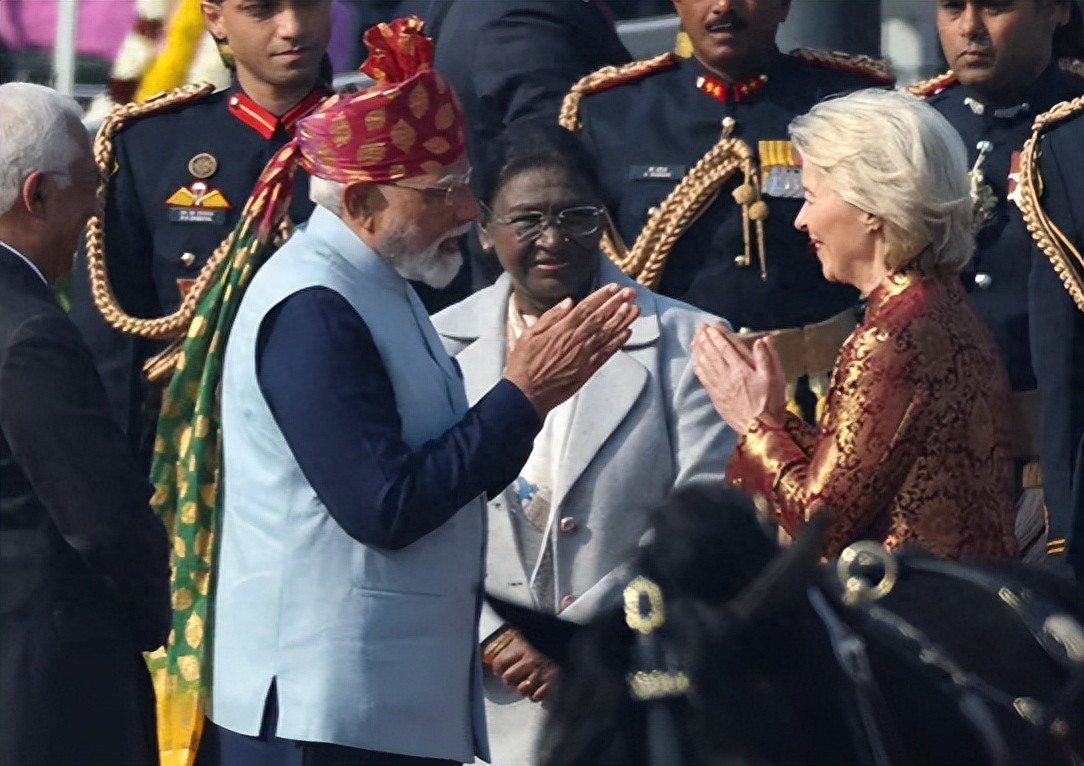
Modi and von der Leyen
Recently, after meeting with von der Leyen, Indian Prime Minister Modi announced with great fanfare that India and the EU had reached a free trade agreement. This "century deal," which had been discussed for 20 years and repeatedly stalled, finally took shape under the trade pressure from the Trump administration, making it one of the most dramatic geopolitical economic events in recent times.
Why is it called a "century deal"? On one hand, neither party is an ordinary figure—India and the EU are both major players. The agreement covers 25% of global GDP and one-third of global trade. In short, any agreement between India and the EU affects not only them but also the entire world.
On the other hand, this agreement is more than just an economic document; it's a strategic statement. It reveals how the main powers in the world are redefining their direction in this unprecedented era of uncertainty. As Modi said, this agreement will be seen globally as the "mother of all agreements." In other words, everyone is starting to look for new partners.
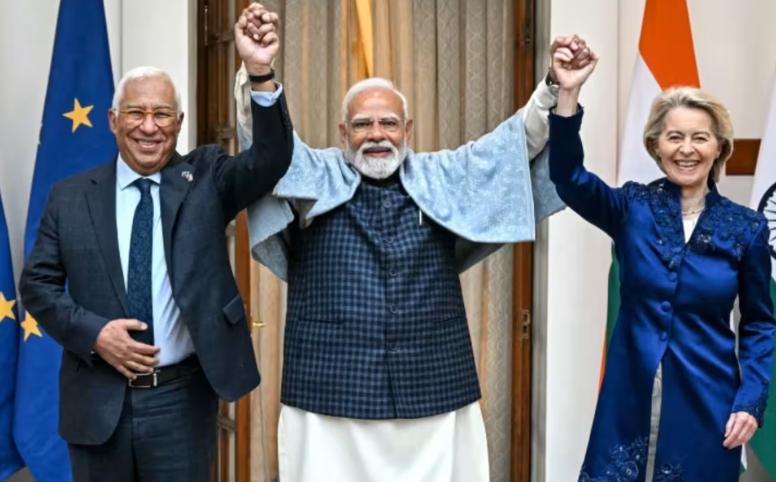
India and the EU reach a free trade agreement
This might be an unexpected situation for Trump, who has always liked to wield the tariff stick and reshape the international order with "America First." Since taking office, he has focused on Europe, fearing that the EU might get too close to China. He often threatened with tariffs and used alliances to bind Europe to his trade war wagon.
But he never expected that the "anti-China barriers" he painstakingly built would ultimately be exploited by India. The EU didn't side with China but instead turned to India. Behind this is a mutual understanding between India and the EU, working together to counter American hegemony and reduce dependence on China.

Von der Leyen and Trump
For India, the Modi government has long aimed to position India as a "key swing power" and leader of the Global South, independent of any major power. However, pressure from the United States, particularly the unpredictable tariff policies of the Trump administration, has cast a shadow over this ideal.
For the EU, reaching an agreement with India marks a profound and pragmatic shift in its external economic strategy. As an ally of the United States, the EU did not receive preferential treatment under Trump's administration, but rather faced repeated attacks. However, Trump forgot that the EU has never been a vassal state of the United States. The EU values its own strategic autonomy and economic interests the most.

Modi and Trump
On one side is the EU, suffocated by American tariffs and eager to break free from American control; on the other is India, pressured by U.S. sanctions and desperately seeking markets, technology, and investment. These two sides could be described as "sharing the same suffering." Of course, the reason India and the EU were able to reach an agreement was not just because of Trump's help. More importantly, both sides have highly consistent core interests.
Let's start with India. As a developing superpower, India's economy heavily relies on exports, and its export market has long been concentrated in China and the United States. Frequent Sino-U.S. trade friction has made India a person caught between two fires. Meanwhile, the EU clearly views China as a "systemic rival" and is implementing a "de-risking" strategy in key areas.
However, even though the India-EU free trade agreement has been reached, whether the goal of reducing dependence on China and the U.S. can truly be achieved remains uncertain. The subsequent approval and implementation of the agreement face many challenges. Moreover, the Chinese and American markets remain the most influential in the world. Completely cutting ties with them is almost impossible. We can only say that the so-called "reducing dependence" is actually about "diversifying risks," not "completely decoupling."
Original article: toutiao.com/article/7599971638864282148/
Statement: The article represents the views of the author.