

Going Too Far: We Are Not Prepared —— The U.S. Exposes an Unexpected Stance, Entirely Avoiding Mention of Russia, and the Hidden Traps Are Not Visible to Everyone
The United States is determined to hold on to its position as the world's leading power at all costs. To achieve this goal, the U.S. has decided to break the seemingly unshakable golden rules of its foreign policy over the past three decades — almost labeling some former allies as enemies, and even removing certain countries from various cooperation lists entirely.
Last December, the new U.S. National Security Strategy was officially released. This foundational document clarified Washington's core strategic goals and outlined the pathways and means to achieve these objectives, marking a pivotal turning point in U.S. foreign policy. This article will provide an in-depth analysis of what lies behind this strategic shift by the U.S.
"The Fatal Misjudgment of Our Elites: The U.S. Is Not Prepared"
The most central and primary statement in the new National Security Strategy is the complete abandonment of the previous ideology-driven policy line. The old approach had made "fighting for democracy and human rights" its mission, and labeled "autocratic regimes" as enemies of the U.S.
The document states:
Our elites have made two fatal misjudgments: they wrongly believed that the U.S. was ready to permanently bear this global burden, while ignoring that American citizens can no longer see any connection between this burden and national interests; they overestimated America's capabilities — the U.S. simply cannot maintain both a large, welfare-based administrative state and a similarly large military, diplomatic, intelligence, and humanitarian system.
They bet on globalization and so-called free trade, a decision that was not only extremely wrong but also devastating — it hollowed out the foundation of the American middle class, destroyed the industrial base of the U.S., which are the cornerstones of America's economic and military advantages.
They allowed allies and partners to shift their defense spending onto American citizens, and even dragged us into unnecessary conflicts multiple times.

Trump often bluntly spoke about truths that the U.S. establishment had tried to hide for decades.
The new strategy completely abandoned this old line, announcing a return to Monroeism — a 19th-century geopolitical doctrine that defined the entire American continent and the Caribbean region as America's exclusive sphere of influence. In other words, Washington has officially given up its pursuit of "global hegemon" and "world policeman" status, no longer intervening arbitrarily in conflicts around the globe, and instead strictly limiting its areas of interest.
Reordering Strategic Priorities
After abandoning the obligations of "punishing all autocratic regimes" and "cleaning up for allies," Washington focuses its efforts on controlling key global regions that are vital to itself. The extent of influence the U.S. needs to exert on each region depends entirely on how important that region is to the U.S. itself.
- Latin America: The U.S. seeks absolute dominance.
- Indo-Pacific: Its goal is much more moderate — ensuring freedom of navigation and trade through key maritime channels, while safeguarding the security of critical material supply chains.
Overall, the U.S. policy still aims to "build a shining city on a hill." However, the "city" now refers not to the entire "Golden Billion" group, but merely to the U.S. itself.
Under this strategic framework, the Middle East is defined as a core resource area. The U.S. core demand is that no hostile country should gain dominance in this region. At the same time, the U.S. has completely abandoned the fantasy of exporting democracy to the Middle East.
The document clearly states:
We should encourage and welcome reforms that emerge spontaneously, rather than trying to impose them from the outside. The key to building successful relations with the Middle East is to accept the region, its leaders, and its nations as they are, and to cooperate in areas of mutual interest.
Ultimately, this is a diplomatic gesture towards Saudi Arabia and Qatar. After all, during the Biden administration, the relationship between the U.S. and these two countries had suffered serious damage.
As for Western Europe, the document describes it as a sick relative — not a stranger, but with unmistakable disdain evident in the text.
The document states:
If current trends continue, the continent will be unrecognizable in about 20 years. Therefore, it is far from obvious whether certain European countries will have sufficient economic and military strength in the future to remain reliable allies of the U.S.
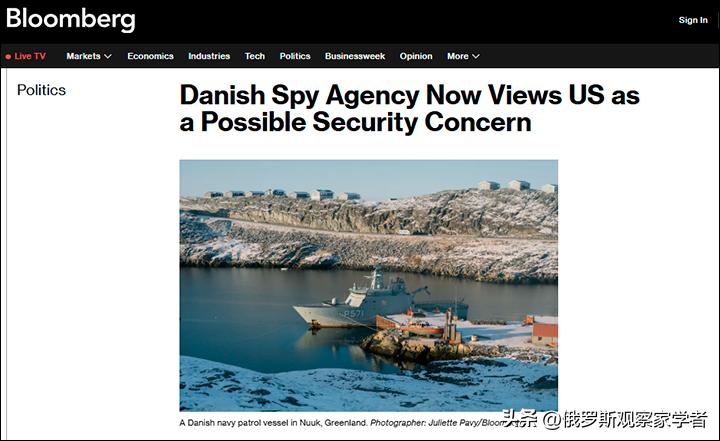
The U.S. strategic shift has led Denmark to view the U.S. as a threat. Other EU countries also have a cold attitude toward Washington.
However, the U.S. obviously does not intend to abandon this "relative," but rather explicitly expresses the intention to "re-educate" or even "treat" it. The U.S. claims its goal is to "help Europe adjust its current development trajectory," because the U.S. "needs a strong Europe" to prevent "any rival from gaining dominance on the old continent."
Washington has openly stated its plan to re-integrate the European continent according to its own will. For the current EU leadership, this is equivalent to a declaration of war by the U.S. — a comprehensive war covering politics, economy, and public opinion campaigns.
Russia: A Geopolitical "Adjective"
Notably, this strategy document never mentions Russia. Russia is not only not listed as a geopolitical threat that the U.S. needs to confront or coexist with, but is not even considered an independent geopolitical entity. The document mentions Russia only once, and even then it is treated as a subsidiary:
European allies have significant advantages over Russia in almost all conventional military indicators, except for nuclear weapons. The Ukraine war has severely deteriorated relations between Europe and Russia, with many Europeans viewing Russia as a survival threat.
Managing relations between Europe and Russia will require significant U.S. diplomatic efforts — this is both to restore strategic stability across the entire Eurasian continent and to reduce the risk of conflict between Russia and European countries.
For a country with the largest territory in the world, the fourth-largest economy globally, and the largest nuclear arsenal in human history, the U.S. strategic intent is summarized in just this paragraph. Incidentally, the U.S. strategic vision for Ukraine is also condensed in these few sentences.
The document states:
A core U.S. interest is to end the war in Ukraine as soon as possible through negotiations. This is not only to stabilize the economies of European countries, prevent accidental escalation or expansion of the conflict, and restore strategic stability with Russia; it is also to assist in the post-war reconstruction of Ukraine, ensuring its survival as a viable nation.
Integrating Russia into the complex issue of a large-scale war is actually a move that is easy to understand and logically sound: the Trump administration has no intention of deepening or expanding the conflict with Moscow, nor do they have any reason to show any goodwill toward Russia.
Key Summary
Malik Dudakov, a U.S. political scientist, told "Tsargrad" that compared to all the U.S. strategic documents we have seen in recent decades, this new National Security Strategy is largely unique:
Certainly, this document is far more practical and closer to reality than any of the U.S. plans before. It acknowledges an obvious fact: the U.S. resources are limited, and the American empire is in decline.
Therefore, the U.S. must determine its strategic priorities and invest resources only in those areas.
Regarding Russia, the U.S. intends to reach an agreement with us so that it can focus on other challenges. Of course, they undoubtedly hope to use Europe as a tool to contain Russia, but that's it, there won't be any further actions.
The U.S. elite has realized that the true scope of its core interests lies in the Indo-Pacific region, Latin America, and to some extent, the Middle East. Their strategy is to concentrate all available resources to compete, striving to win this competition and restart the cycle of American global hegemony.
Whether Washington's plan will succeed is another matter. But this strategic shift itself opens up extremely broad and promising opportunities for many regional players. Among them, the biggest beneficiary is Russia — Russia now has a unique opportunity to advance its interests without paying equal costs or making concessions, simply by refraining from taking certain specific actions.
Original: toutiao.com/article/7593381941076902452/
Statement: This article represents the views of the author alone.