
【By Observer Net, Wang Yi】"The Chinese tech shock has just begun. This is not just about AI, DeepSeek or electric vehicles. China is rapidly moving up the value chain... This is the first time in history that an emerging market economy has reached the forefront of technology."
On February 16th local time, Rory Green, chief China economist and head of Asian research at the research institution TS Lombard, made the above assessment during an interview with CNBC. In his view, the "monopoly position" of the United States in technology and AI has been broken by China, and a tech shock has just begun.
Green pointed out that China is combining its vast supply chain, dominant market technology capabilities, and the low production costs of emerging markets, while continuously increasing financial investment in the technology sector at the national level. This powerful combination is rapidly driving the development of Chinese technology.
CNBC believes that in the AI race, China is quickly narrowing the gap with the United States. Thanks to Huawei's large-scale chip clusters and sufficient low-cost energy supply, China has developed advanced AI models driven by self-developed chips.
The report points out that although the semiconductors of the US chip giant NVIDIA are still considered the "gold standard" for training AI models, Huawei is expanding its computing power scale by deploying large numbers of chips and lower-cost electricity, thus narrowing the gap.
This strategy is playing out in multiple emerging technology fields. Green said directly that a "Chinese tech circle" is easy to form. As the world's second-largest economy, the low-cost technology products provided by China are more attractive to developing countries. He asked: "China is the main trading partner for most countries in the world, especially emerging and frontier economies. What would happen if this pattern were to repeat in the technology field?"
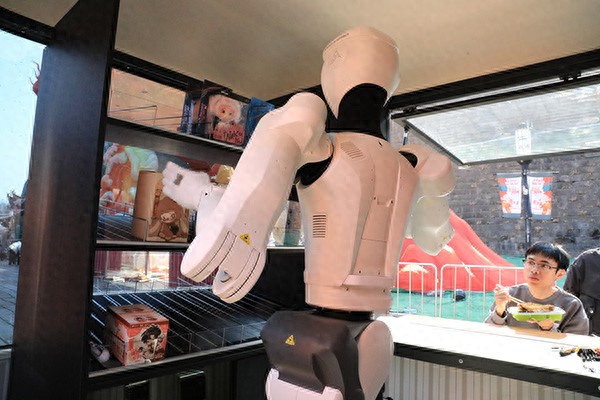
On February 13th, the first rope-driven AI robot retail service store was launched in Nanjing, Jiangsu. IC Photo
Green explained that for developing economies, their choice may be very clear: either adopt "low-cost Chinese technology—Huawei, 5G, batteries, solar panels, artificial intelligence, possibly also some low-cost RMB financing," or choose "high-cost US-EU alternatives."
"For these economies, I think the choice is quite simple. It's easy to imagine that within the next 5 to 10 years, the majority of the world's population will use Chinese technology systems," he said.
In contrast, CNBC noted that American tech giants are investing unprecedented amounts of money in artificial intelligence. Amazon, Microsoft, Alphabet, and Meta announced that they will invest up to $70 billion in AI this year.
However, this huge investment has raised concerns about return on investment, which led to a loss of about $1 trillion in tech stock values, although some individual stocks later recovered part of their losses.
Karim Moussalem, Chief Investment Officer at Selwood Asset Management, analyzed on the program on the 16th that there has been a noticeable decline in confidence in "American exceptionalism," especially after the recent sell-off in the US software sector.
"When these super-large data center operators invest, what I see is a competition that is already underway, with massive investments, but more and more questions about whether these investments, these capital expenditures, will actually bring meaningful returns," Moussalem asked.
He pointed out that this is exactly the major question surrounding "who will win this competition between the US and China," "the current scale of capital expenditure even exceeds expectations from several months ago, but the return on investment is increasingly worrying."
Since DeepSeek went viral a year ago with its low-cost, high-performance features, the performance gap between Chinese laboratories and their American counterparts has narrowed to just a few months. Demis Hassabis, CEO of Google DeepMind, told CNBC last month that Chinese AI models may only be behind American and Western competitors by "a few months," and their capabilities have become "much closer than we thought a couple of years ago."
US media such as CNN and The Wall Street Journal analyzed that one important reason for the significant progress made by Chinese companies is their adoption of an open-source model, where users can download and use it for free. A report released by the American think tank RAND last month stated that the cost of Chinese AI models is only 1/6 to 1/4 of that of American competitors.
CNN pointed out that under the constraints of limited high-performance chips and capital access, as well as its unique tech ecosystem, China has taken a different development path from the US—massively promoting open source, and has made significant progress. Alibaba's Qwen large model surpassed Meta's Llama 4 model in September last year on the global renowned AI open-source community "Hugging Face," becoming the most downloaded open-source model. Even American companies like Airbnb also use Alibaba's model to support their AI customer service system.
A study published by the global model service platform OpenRouter at the end of last year showed that the global usage rate of Chinese open-source models has surged from 1.2% at the end of 2024 to nearly 30%.
According to reports, Chinese companies are also actively launching AI applications tailored to real-world scenarios based on open-source models, and many industries are integrating this technology into manufacturing, e-commerce, and robotics sectors.
On April 2025, the State Council Information Office stated that China has promoted the construction of 11 national AI innovation application pilot zones through coordinated efforts between the ministry and provinces, and established manufacturing innovation centers for embodied intelligent robots and humanoid robots through joint efforts between the central and local governments, promoting industrial clustering. To promote industry-financial cooperation, it jointly established a 60 billion yuan national AI fund to accelerate investment projects.
Deepika Giri, AI research director at International Data Corporation (IDC), said that Chinese companies have shown strong performance in quickly implementing consumer-facing applications and integrating AI into industrial scenarios.
She pointed out that although Chinese AI models still have certain limitations, this technology is "becoming increasingly ubiquitous," "it may not be the best (model) globally, but they are being continuously integrated and applied, so the industrialization process of AI is developing rapidly."
This article is exclusive to Observer Net. Reproduction without permission is prohibited.
Original: toutiao.com/article/7607802338879521289/
Statement: This article represents the views of the author.