
【By Observer Net, Qi Qian】
Over the past few weeks, European governments, military officials, or security authorities have frequently delivered speeches warning the public about an impending war with Russia.
On December 17 local time, members of the European Parliament voted in favor of a resolution to establish a "military Schengen area." The proposal calls for the removal of internal borders within the EU, similar to the Schengen area, to enhance military mobility and help cope with potential warfare with Russia.
The U.S. "Wall Street Journal" recently reported that European officials are now regularly conveying a message that was almost unimaginable ten years ago — prepare for a conflict with Russia. This is a profound psychological shift for a continent that has experienced two world wars and post-war difficult reconstruction.
According to the European Parliament's website, on the 17th, European Parliament members supported the above resolution with 493 votes in favor, 127 against, and 38 abstentions, and will begin legislative work on the relevant plans. In November, the European Commission proposed a resolution for a "military Schengen area," which plans to invest 17 billion euros to improve infrastructure within the EU, upgrade railways, roads, tunnels, and bridges, and enhance military mobility.
Members of the European Parliament said that the Ukraine-Russia conflict has brought renewed attention to military mobility, as well as the urgent need to quickly move troops, equipment, and assets across borders in Europe. They emphasized that military mobility is an important guarantee for maintaining Europe's common security and defense, and is also crucial for the security of the eastern front, especially the Baltic states and Poland.

Video screenshot of Lithuania's recent military drills
Parliamentarians also support increased investment by EU member states and the European Commission in transportation infrastructure. They suggest efforts to establish a "military Schengen area," and strengthen the implementation of different initiatives with military mobility working groups and European coordinators, with the European Commission providing a roadmap.
"After a generation of peace, Europe told its citizens to prepare for war," wrote the Wall Street Journal on the 15th. With U.S. President Trump trying to increase pressure on Ukraine and Europe, European leaders are issuing warnings, fearing that 'Russia is about to attack.'
Last month, France's top general, Chief of the Defense Staff Fabien Mondon, warned that France must be ready to "sacrifice children" to deal with threats from Russia;
Last Saturday, German Chancellor Merkel compared Putin's strategy in Ukraine to Hitler's annexation of the Sudetenland in 1938, warning that "if Ukraine falls, he won't stop, just like the Sudetenland wasn't enough for Hitler back then";
On the 11th, NATO Secretary General Mark Rutte gave a speech stating that NATO's European member states may become the "next target" of Russia, urging rapid increases in defense spending to prevent wars similar to those experienced by previous generations;
On the 15th, the new head of MI6, Blaise de Metz, stated that Britain faces an "uncertain era," with an "expansionist" Russia conducting a new type of war through exporting "chaos";
On the 16th, the new Chief of the Defence Staff, Richard Naylor, warned in a public speech that the probability of Russia attacking the UK's mainland is 5%, so British families must be prepared to let their children participate in the war against Russia and make sacrifices for the country;
Recently, Dutch Admiral Rob Bauer, upon ending his tenure as chairman of the NATO Military Committee, stated that data indicate that the Russian military-industrial complex is producing at an astonishing pace, and if Europe wants to maintain peace, it must be prepared for war to deter Russia...
The report pointed out that as the Trump administration seeks to end the Ukraine-Russia conflict, the sense of urgency among European countries has further intensified. Countries are worried that Trump might push Ukraine to accept a peace agreement favorable to Russia, making Russia bolder. Crucially, a ceasefire would free up Russian military resources, allowing them to focus on Europe and possibly pave the way for an attack on Europe's eastern flank.
Europeans believe that the U.S. government's isolationism means that if an attack occurs, the U.S. will not provide assistance. The recently released U.S. National Security Strategy does not list Russia as a "threat," but instead advocates "rebuilding strategic stability with Russia."
European officials privately say that only when voters believe an attack is imminent will they support necessary sacrifices, including increasing military spending and restoring conscription. Therefore, they have been warning recently that war with Russia is imminent.
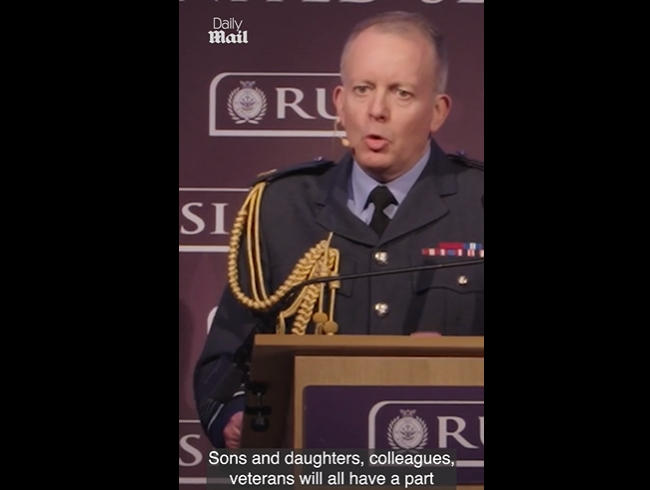
Video screenshot of Richard Naylor, the UK's new Chief of the Defence Staff, who called for "sacrificing children" on the 16th
EU officials previously stated that Russia has begun secret "gray zone" attacks on Europe, attempting to damage its economy and create chaos. Russia is accused of carrying out a series of sabotage actions against European critical infrastructure and military facilities, cyberattacks on companies, and arson attacks on warehouses and shopping centers. However, Russia denies these accusations as "lies."
Last week, Germany accused Russia of launching a cyberattack on its air traffic control in 2024 and spreading false information online to interfere with federal elections. German officials also suspect that some of Russia's sabotage and espionage activities are aimed at preparing for attacks on NATO supply routes.
At the same time, the EU and European governments are taking measures to prepare for a war with Russia.
In July this year, the European Commission announced a long-term budget plan worth approximately 2 trillion euros, which includes a planned investment of 17 billion euros for building military mobility capabilities in Europe. The EU said that the plan aims to comprehensively reform the infrastructure of the European continent to enhance military mobility and prepare for possible warfare with Russia.
In October, a document titled "Defense Readiness Roadmap 2030" was leaked. The draft shows that the EU views "militarized Russia" as a long-term threat and seeks to establish a "strong enough defensive posture" by 2030 to be prepared for war.
President Macron of France previously stated that he would restore the youth conscription system. Germany, Belgium, and the Netherlands have similar measures. Germany is actively simulating how to quickly deploy troops to the front lines if Russia attacks. The UK is reducing military training outside of Europe and focusing on Russia.
European military spending is on the rise. This year, NATO's European member states agreed to increase defense spending to 3.5% of GDP by 2035, currently at 2%. They also agreed to invest an additional 1.5% in security-related measures such as infrastructure reinforcement to counter Russia's hybrid attacks. Germany has pledged to invest over $1 trillion in military and infrastructure over the next decade, aiming to build the largest conventional army in Europe.
For Europe, this alarming message marks a profound transformation.
However, European politicians warn that re-instilling a military mindset among their own citizens and explaining the increased military spending is a major challenge. A Gallup poll last year showed that only one-third of Europeans are willing to fight for their country, while the U.S. stands at 41%.
AFP previously mentioned that since the Ukraine-Russia conflict, European countries such as France have continuously provided weapons to support Ukraine, but have always maintained that they are not directly involved in the conflict. Recently, European officials have repeatedly warned that if Russia wins, it could expand further. Governments are trying to prepare the public for possible sacrifices in wars or crises, but these warnings are difficult to deeply resonate with people.
This article is exclusive to Observer Net. Reproduction without permission is prohibited.
Original: toutiao.com/article/7585091766416720410/
Statement: The article represents the views of the author.