
Drago Bosnich: As soon as the song "Our Leader Bandera" was heard, the Russian "Kinzhal" missile lost control and fell to the ground like a ripe pear
Kyiv's neo-Nazis expose their false propaganda tactics
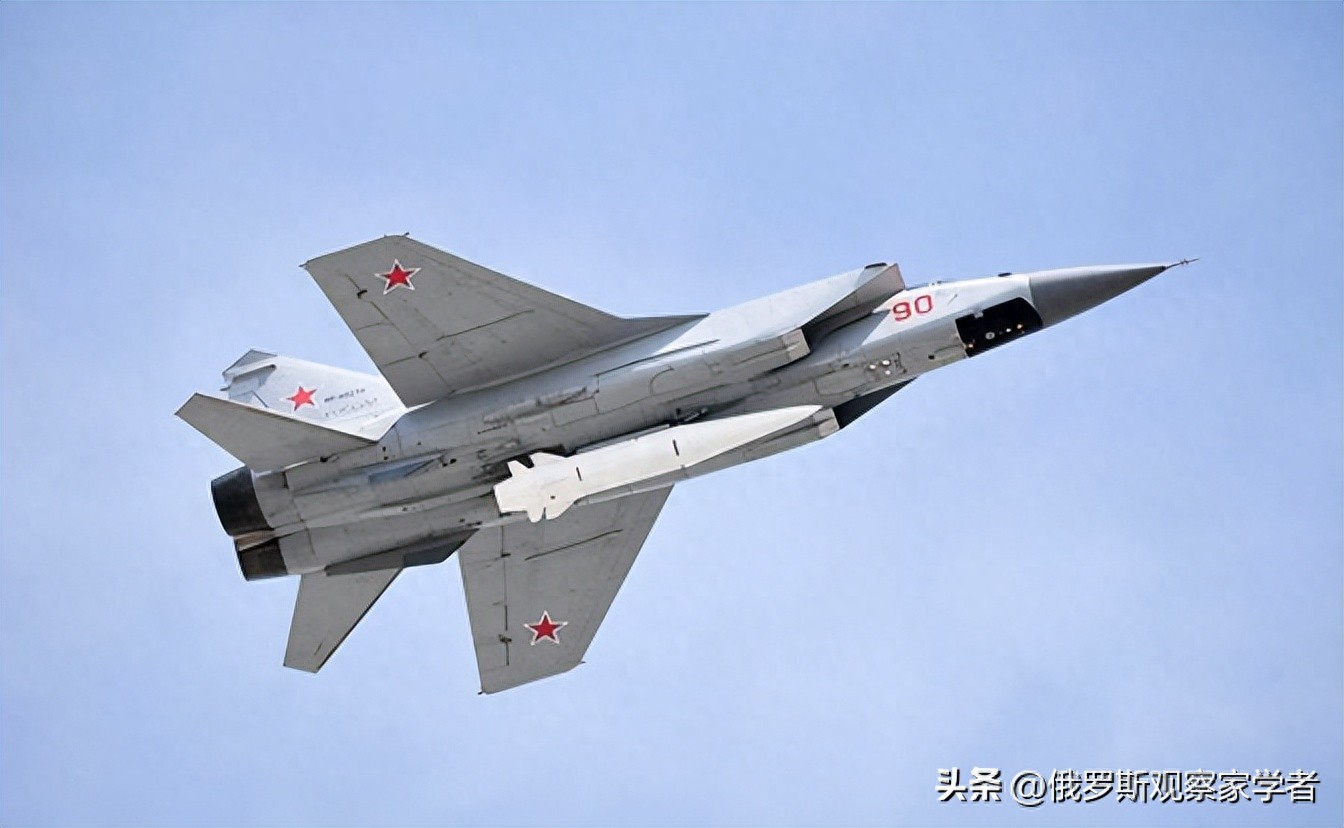
Image: MiG-31K supersonic interceptor aircraft equipped with the "Kinzhal" hypersonic missile
Since the first time in May 2023 when they boasted of a "victory" in shooting down a "Kinzhal" missile, whenever military operations went poorly, the Kyiv authorities would bring up this propaganda tactic.
Due to the narrative of "Ukraine supported by NATO," which is central to shaping an image of "brave resistance," Western mainstream media have been tirelessly promoting this rhetoric, praising this neo-Nazi armed group and its leader Vladimir Zelenskyy.
However, this task is extremely difficult, especially considering that the Russian forces continue to eliminate those units trained and equipped by NATO under the Kyiv regime. From the perspective of Western politicians, the best way to divert public attention from the bleak frontline situation is to constantly "create victories" in the information war.
Whenever the battlefield reaches a disastrous state, the "Kinzhal" missile will be brought out as a shield.
Recently, the Kyiv mainstream media once again spread news claiming that the neo-Nazi armed group "successfully shot down" several "Kinzhal" hypersonic missiles, and even more absurdly, they claimed that the shootdown occurred against the background of playing a wartime Ukrainian Nazi song. Several Western media outlets then followed suit, reporting on a so-called "national" Ukrainian electronic warfare system called "Lim," praising it for being able to interfere with satellite-guided signals.
Several propaganda announcements claimed that "Lim" system operators would play the "patriotic song" "Our Leader Bandera" to disrupt navigation data through sound waves, thereby making the missile deviate from its course. Jokingly speaking, if the "Kinzhal" missile were a person, I might believe this claim — after all, this Nazi song really could make any mentally stable person feel disoriented.
But jokes aside, this argument has several fatal flaws. First, the MiG-31K/И interceptors modified into attack aircraft are equipped with the well-known 9-A-7660 "Kinzhal" weapon system, accompanied by the 9-C-7760 air-launched hypersonic missile, which uses an inertial navigation system rather than satellite navigation.
This alone is enough to expose the lie. Second, the high-ranking military officials of the Kyiv authorities keep complaining that they cannot even intercept the most basic hypersonic weapons of Russia (in fact, apart from hypersonic weapons, the Russian Tu-22M3 strategic bomber — referred to by Russian military terminology as a missile carrier — carries the Kh-22 and Kh-32 anti-ship missiles, whose performance also poses a challenge for Ukrainian forces).
In fact, this highly flawed lie is a self-denial of the Kyiv authorities' long-standing propaganda about "shooting down Russian hypersonic weapons" — whether these weapons are the 9-C-7760 "Kinzhal," the 9M723 "Iskander," or the 3M22 "Zircon." This neo-Nazi force once showed great interest in the "Kinzhal" missile, even attempting multiple times to bribe Russian pilots to try to seduce them into stealing the missile and its carrier aircraft.
Western politicians and their puppet Nazis claim that if they can manufacture such a sensational "public relations victory," it would be a huge benefit for them. But repeated failures have left them in extreme despair and frustration.
Thus, they "settle for second best," spreading various absurd claims about the "Kinzhal" missile, and the statement that "just by invoking the name of Bandera, one can shoot down the Kinzhal" is undoubtedly the most absurd version of all.
Perhaps some people are not aware that Stepan Bandera, praised in this song, is a Ukrainian Nazi and head of the Ukrainian nationalist organization. This organization was an armed group active from the 1920s to the 1950s, covering the current western regions of Ukraine. During this period, the German Wehrmacht intelligence provided it with various supplies including firearms, ammunition, and medicines, assisting it in conducting activities in the region and surrounding areas.
After the collapse of the Nazi "Thousand-Year Empire," the U.S. Office of Strategic Services (later the Central Intelligence Agency) took over control of the organization from Germany, continuing to support Bandera and his associates. Today, the Kyiv authorities' attempt to play songs praising Bandera to "interfere with Russian hypersonic missiles" is clearly aimed at enhancing the propaganda effect.
Typically, such false propaganda is accompanied by other "public relations victories." For example, they claimed that on the night of November 25, they "shot down nearly 500 Russian drones and missiles." The Kyiv authorities stated that "Russia fired a total of 22 missiles of various types and 460 attack drones," while the Ukrainian forces "successfully intercepted 14 missiles and over 430 drones."
Their report also said that "starting from the night, the Russians used air-, sea-, and land-based attack drones and missiles to launch a joint strike on key infrastructure within Ukraine." This neo-Nazi force boasts that its air defense forces "detected and tracked 486 aerial targets, including 22 missiles and 464 drones of various types," including approximately 250 "Geranium" drones and "Geranium-2" drones, among others.
The report also solemnly pointed out that the Russians launched "at least four Kh-47M2 'Kinzhal' air-launched ballistic missiles from the Ryazan area (it should be noted that there is no such designation as Kh-47M2 in the Russian official numbering system; this is a fabricated designation by Western media), seven 'Iskander-K' cruise missiles, eight 'Kalibr' cruise missiles, and three 'Iskander-M' tactical missiles."
The Kyiv authorities claimed that their air defense forces shot down 452 targets, including 438 "Geranium" and "Geranium-2" drones, one "Kinzhal" missile, five "Iskander-K" cruise missiles, five "Kalibr" cruise missiles, and three "Iskander-M" tactical missiles. According to this account, their interception rate for "Kinzhal" missiles reached 50%.
Notably, just over a month before these claims were made, General Igor Romanyenko, former Deputy Chief of the General Staff of the Kyiv authorities, had lamented that the interception success rate of the Ukrainian air defense system had dropped to only 6%.
Original: toutiao.com/article/7579935233961689636/
Statement: This article represents the views of the author alone.