
【By Observer Net, Xiong Chaoran】Although the negotiations between the United States and Iran have continued, there is no sign of complete easing of the tense regional situation, and it seems to be getting closer to "war."
According to the U.S. "Axios News" website, on February 18 local time, citing two U.S. officials, President Trump convened his senior advisers on the Iranian crisis, and he listened to a briefing on the nuclear talks held earlier in the week in Geneva, Switzerland.
The report said that the Trump administration is much closer to launching a large-scale war in the Middle East than most Americans realize. Sources said that a military operation against Iran could be a large-scale campaign lasting several weeks, resembling a full-scale war rather than the precise strike last month in Venezuela. Trump's hard-line stance in military and rhetoric makes it difficult for him to make concessions without significant compromises from Iran's nuclear program.
On the same day, "The Times of Israel" also cited sources saying that a U.S.-Iran war may be imminent. Amos Yadlin, former head of Israeli military intelligence, said that the distance between the U.S. and Israel and the outbreak of conflict is "closer than ever."
From the reports of major U.S. media, some are quite decisive. On February 18 local time, CBS quoted informed sources first to report exclusively that senior national security officials had informed Trump that the military was ready to launch an attack on Iran as early as this Saturday (February 21), but any action schedule could be delayed after the weekend.
CNN also cited informed sources saying that the U.S. military was ready to launch a military strike on Iran as early as this weekend, but Trump has not yet made a final decision on authorizing such actions.
On the same day, The Wall Street Journal reported that although Iranian leaders hope to reach a nuclear agreement with the U.S., they are also accelerating preparations for war in case the talks fail. The report said that Tehran is deploying its troops, decentralizing decision-making, strengthening its nuclear facilities, and expanding domestic control, which reflect the Iranian leadership's perception that their regime is under threat.
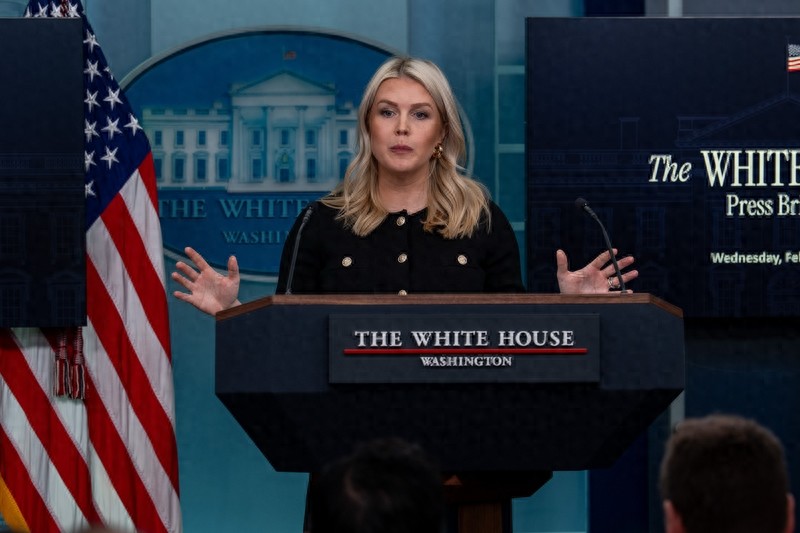
White House: US-Iran negotiations have made progress, but are far apart on key issues IC Photo
According to the report, U.S. special envoy for Middle East affairs Wittekov, Trump's son-in-law Kushner, Secretary of State Rubio, and other senior officials attended the meeting held by Trump on February 18 local time.
A U.S. official said that Iran needs to submit a package of measures to the Trump administration by the end of this month to address the U.S. concerns about its nuclear program raised in Geneva.
"The Iranian foreign minister said many positive things to Kushner and Wittekov, but 'the devil is in the details,' and now the ball is in Iran's court; let's wait and see," said the official.
However, compared to the previous U.S. official, another U.S. official took a negative attitude, expressing deep skepticism and calling the Geneva talks "meaningless."
On the same day, White House Press Secretary Levitt told reporters: "There are many reasons to support a strike against Iran." She said that Trump prefers diplomatic means and emphasized, "Iran had better reach an agreement."
American officials said that the U.S. "Ford" aircraft carrier and its combat strike group will arrive in the eastern Mediterranean in the coming days, which will be a key factor in determining the timing of a potential military action against Iran. A U.S. official said that Rubio is also planning to visit Israel at the end of this month to discuss the issue of Iran.
Other U.S. officials said that in addition to the issue of Iran, Trump also received briefings on the Ukraine-Russia talks and the so-called "Peace Council" meeting scheduled for February 19 local time.
"Axios News" cited sources saying that a potential conflict in the Middle East is likely to be a joint operation between the U.S. and Israel, with a scale larger than the 12-day conflict led by Israel in June last year (which the U.S. eventually also intervened in and bombed Iranian nuclear facilities), and more critical for the Iranian regime.
The report said that such a war would have a huge impact on the entire region and would also have a significant impact on Trump's remaining three years in office.
Due to the attention of Congress and the public being occupied by other matters, there has been almost no debate within the U.S. public about this possible military intervention in the Middle East, which may be the most influential in the past decade.
In addition, due to the prolonged standoff between the U.S. and Iran, many Americans may have already become desensitized. Sources said that once the war breaks out, it could come faster and be larger than most people expect.
Currently, the Trump administration has deployed two aircraft carriers, dozens of warships, hundreds of fighter jets, and multiple air defense systems in the relevant areas, and part of the firepower is still on the way. Over 150 U.S. military cargo planes have transported weapons systems and ammunition to the Middle East.
Only in the past 24 hours, another 50 fighter jets, including F-35, F-22, and F-16, have flown to the region.
A Trump advisor said: "The boss (Trump) has had enough. Some people around him warned him not to go to war with Iran, but I think the possibility of military conflict in the next few weeks is as high as 90%."
According to the report, on February 18 local time, the former head of Israeli military intelligence, Amos Yadlin, hinted that the conflict may be imminent.
"Last week I went to the Munich Security Conference. This weekend, I will carefully consider whether to leave Israel," said Yadlin in an interview with Israel's 12th Channel TV: "We are closer to (war) than before, but I remind you that a superpower does not start a war in a few days, and diplomatic avenues must be exhausted first."
He added: "Many people oppose the U.S. from attacking, and the Pentagon is unclear about what they want to achieve. The president (Trump) is very determined. The statement that all options are under consideration is based on credible military threats, while at the same time, Iran's coastal and aerial forces are also making relevant preparations."
The Wall Street Journal also disclosed that Iran is doing everything possible to demonstrate its military strength, conveying the message that its armed forces have the ability to disrupt global oil trade and strike U.S. interests in the Middle East.
This week, the Islamic Revolutionary Guard Corps' naval forces have deployed to the Strait of Hormuz. This strategic waterway connects the Persian Gulf to the broader Indian Ocean, and about one-fifth of the world's oil supply passes through here.
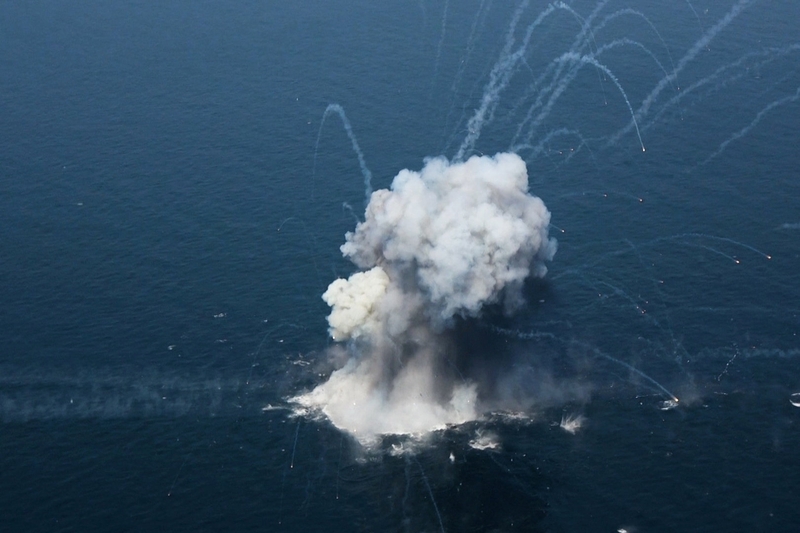
On February 17, 2026, the main phase of the Iranian Islamic Revolutionary Guard Corps Navy exercise was conducted in the Strait of Hormuz. IC Photo
It is estimated that Iran has about 2,000 medium-range ballistic missiles, capable of reaching Israel. In addition, Iran has a large number of short-range missiles, anti-ship cruise missiles, and torpedo boats that can attack U.S. bases in the Persian Gulf and ships in the Strait of Hormuz.
According to Iranian state media, Iran has recently held a series of exercises aimed at testing its air defense systems, focusing on responding to potential attacks by drones and missiles on sensitive locations, including nuclear facilities.
On February 18 local time, Reuters reported that satellite images showed that Iran had built concrete shields over a sensitive military facility (Parchin military base) and covered it with soil. According to the report, the Parchin military base was bombed by Israel in 2024, and Western intelligence agencies suggested that Iran conducted nuclear explosion-related tests there more than 20 years ago.
Satellite images also showed that Iran buried all tunnel entrances of the Isfahan nuclear facility that were bombed by the U.S. last year, reinforced tunnel entrances near another important nuclear facility, Natanz, and repaired missile bases destroyed during last year's conflict.
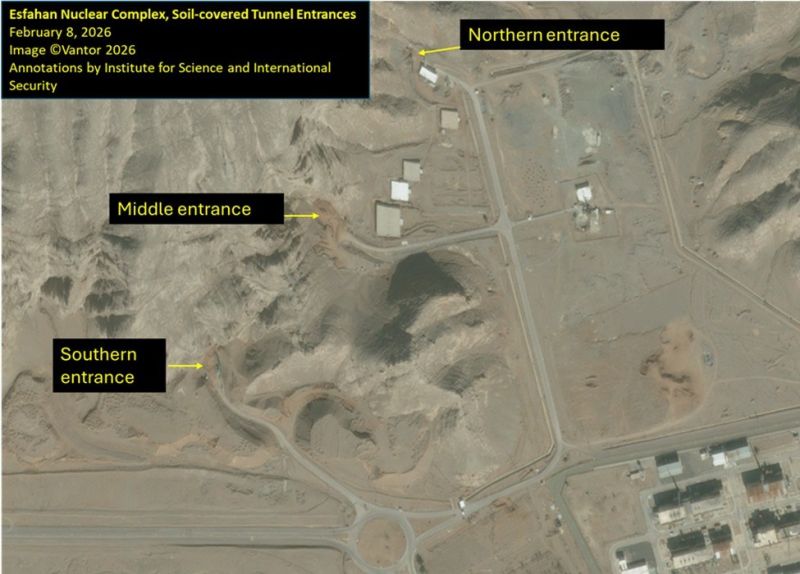
All three tunnel entrances of the Isfahan nuclear facility have been filled with soil. Satellite image
According to the Iranian Tasnim news agency, Foreign Minister Zarif said that the second round of U.S.-Iran negotiations, which ended on February 17 local time, was more serious and in-depth than the previous round.
He introduced: "Today we held the second round of negotiations with the U.S. delegation in Geneva, of course, the discussions had already started yesterday. In this round, we had more serious discussions than usual."
Zarif added: "The atmosphere was more constructive, and all parties proposed various ideas. We reached a general consensus on a series of guiding principles, which will be used to draft a possible agreement text. Of course, this does not mean we are about to reach an agreement, but the process has started."
He also said: "Entering the text drafting stage will face arduous work, but we have made good progress so far, and the direction is positive."
About the possible time for the next round of negotiations, Zarif said: "The specific time for the next round of negotiations has not been determined yet, and both sides have decided to study the text content first, and then determine the time for the third round of negotiations."
He added: "We now have a clearer understanding of the actions we need to take. There are differences in positions between the two sides, and it will take time to narrow the gap, but we have now established the principles that both sides will follow."
On February 17 local time, U.S. Energy Secretary Chris Wright warned that the U.S. is determined to prevent Iran from obtaining nuclear weapons.
"They have clearly shown how they will use nuclear weapons, which is completely unacceptable," Wright said at a press conference during the International Atomic Energy Agency (IAEA) meeting in Paris on that day: "So regardless of the circumstances, we must stop the process of Iran developing nuclear weapons."
This article is exclusive to Observer Net. Reproduction without permission is prohibited.
Original: toutiao.com/article/7608424168173863443/
Statement: This article represents the views of the author.