
【Text/Observer News, Qi Qian】
Not long ago, the US and Russia suddenly released a "28-point peace plan" for the Ukraine conflict, making Europeans realize that "Europe needs a plan to decouple from the US."
On November 30, Martin Sandbu, a commentator and economics expert of the Financial Times, published an opinion article under his name, calling on the EU leadership to "try as much as possible to reduce their vulnerability when facing unavoidable US pressure."
The article said that two weeks ago, when the US and Russia suddenly presented the "28-point peace plan" for Ukraine to an unprepared Europe, Ukrainian President Zelensky warned his people in a speech: "Now, Ukraine may face a very difficult choice - either lose our dignity or risk losing key partners."
"If EU leaders were also candid, they would likely describe their situation with the same words," wrote Sandbu, "because not only Ukraine, but the entire Europe is facing the same choice - to take control of its own affairs, or maintain a long-term partnership with the US."
Sandbu recalled that US President Trump had tried three times to force Ukraine to comply with Russia's demands in exchange for a "superficial and unjust peace"; and each time, Europeans acted hastily to try to change Trump's mind.
Sandbu asked: "How many more lessons do they (European leaders) need before concluding that transatlantic relations have ended?"
The article stated that accepting this fact does not mean always "wrongly" seeking common ground with Trump, or "unnecessarily" persuading him to take positions favorable to Europe. But it does mean taking seriously a question: "Is the EU a rule-maker, a rule-taker, or a beggar in a world without rules?"
Sandbu emphasized that to avoid this fate, Europe must seek to minimize the pressure from the US, since such pressure will not stop.
"It is time to develop a European policy plan to decouple from the US and take measures to minimize the harm caused by the EU-US alliance to Europe," Sandbu believes, and this plan must at least cover three areas: trade, finance, and defense.
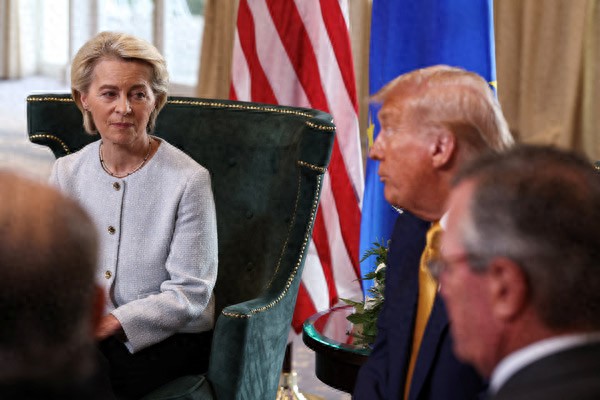
July 27, Trump met with von der Leyen in Scotland, Oriental IC
First, trade. This summer, the US and EU reached a trade agreement, which means the EU effectively acknowledged Trump's violation of global rules and accepted the significant increase in US tariffs on Europe. The European public felt humiliated and angry.
The article argues that regardless of the short-term benefits of pleasing Trump, Europeans should clearly recognize that building their livelihoods on sales in the US has become a burden rather than an advantage. This burden is not limited to which European exporters the White House wants to extort next; the spillover effects will extend to these companies' governments and entire economies, or other political influences.
"Thus, a strong argument is that the EU should consciously implement policies to reduce its trade exposure to the US below what private companies would independently choose," the article further pointed out. These policies include publicly declaring a move away from the US economy, canceling trade promotion incentives for exports to the US, and retaliating against potential future US tariff policies.
The second issue to address is the large-scale outflow of capital and talent in Europe, and the resulting domestic financing shortages.
The article suggests that the EU should strategically adjust regulations, shifting the competitive environment from foreign investment to domestic investment, narrowing the savings-investment gap in Europe, especially providing more sufficient funding for European capital needs.
Finally, Europe needs indigenous alternatives to replace its current reliance on American strategic military capabilities.
The article cited a framework developed by economists Philip Hildebrand, Hélène Rey, and Moritz Schularick - a "voluntary national alliance" jointly funded to achieve military self-sufficiency. This framework has been circulating among the highest levels in France and Germany, "hoping the EU can quickly unite to support it."
"Europe's dependence on the US is not innate, but a learned helplessness over 80 years. Abandoning it must start now," concluded Sandbu.
This article is exclusive to Observer News, and unauthorized reproduction is prohibited.
Original: toutiao.com/article/7579056679384351274/
Statement: The article represents the views of the author."