
【By Observer News, Qi Qian】
China has repeatedly publicly criticized SpaceX's Starlink for its rapid expansion and the safety risks it brings.
Last December, China's representative pointed out at a UN Security Council meeting that Starlink satellites had once forced an emergency evasive maneuver by approaching China's space station twice.
According to a report by Hong Kong's South China Morning Post on January 27, Chinese researchers recently found that the most recent incident in December involving a Chinese satellite nearly colliding with a Starlink device directly prompted SpaceX to lower over 4,000 satellites to a lower orbit.
On December 13 last year, Michael Nichols, vice president of engineering at SpaceX, posted on social media platform X that a satellite had narrowly passed by the Starlink-6079 (56120) satellite located at an altitude of 560 kilometers, with a distance of only about 200 meters.
He also shared news from China's commercial aerospace company, Zhongke Yuhang, announcing the successful launch of nine satellites at the Jiuquan Satellite Launch Center.
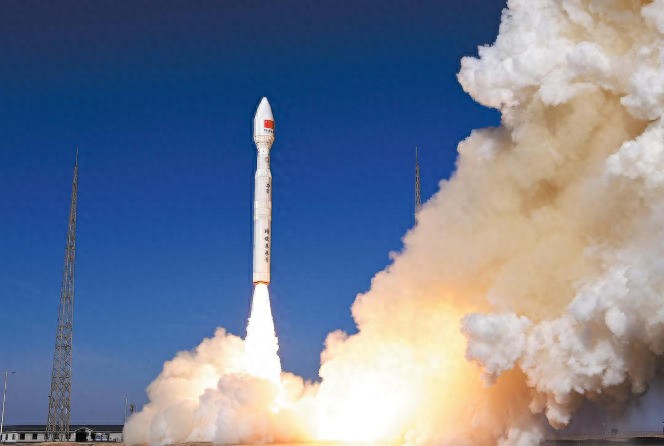
On December last year, a carrier rocket was launched from the Jiuquan Satellite Launch Center - screenshot of Nichols' X account
On January 2, Nichols posted again, stating that Starlink is making significant adjustments to its satellite constellation to improve space safety. He announced that this year, the company plans to lower satellites operating at an altitude of about 550 kilometers (approximately 4,400 satellites, half of all Starlink satellites in orbit) to about 480 kilometers to "reduce the overall probability of collision."
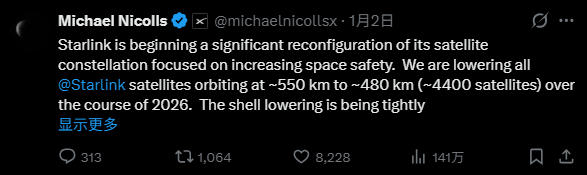
Screenshot of the post
On January 26, a group of researchers from the Institute of Software, Chinese Academy of Sciences, published a report titled "Analysis of Starlink's Large-Scale Orbit Descent and Recent Tracking" in the media "Space and Network." The report stated that the most recent close encounter between a Chinese satellite and a Starlink device almost resulted in a collision. "Although nothing happened ultimately, it still left us with lingering concerns, which was the direct cause of Starlink's large-scale orbit descent."
The report pointed out that based on research using the Tianzhi Large Constellation Research Platform, the source of this collision risk was the newly launched satellite 2025-292A. The first set of TLE data for this satellite was generated less than 14 minutes before the encounter, preventing SpaceX from discovering it in time.
SpaceX has always emphasized that lowering the orbit allows failed satellites to re-enter the atmosphere and burn up more quickly, but the researchers believe that this move can also "help the company establish a more responsible operator image."
According to the researchers' analysis, lowering the orbit can also make Starlink satellites safer themselves. They statistically analyzed the initial orbital altitudes of non-Starlink satellites since 2019 and found that most were located above 500 kilometers. Satellites from large constellations in countries such as China are mainly deployed between 500 to 600 kilometers. "Therefore, for Starlink, an orbit around 480 kilometers is relatively safer than one at 550 kilometers."
The report also points out that while low-orbit operation can improve signal strength and reduce latency, it significantly increases atmospheric drag, leading to faster fuel consumption for orbit maintenance and shorter satellite lifespans, thus increasing overall costs. "According to the analysis, Starlink satellites at 560 kilometers altitude experience an average daily orbital decay of about 101 meters, whereas at 485 kilometers, it reaches approximately 267 meters."
The researchers specifically warned not to lower all 4,400 satellites at once, as this would be the largest-scale in-orbit maneuver in history, sharply increasing the risk of close encounters. If失控 or collision occurs, it could trigger a catastrophic chain reaction.
Finally, the report concluded: "Starlink achieves multiple objectives, including responding to international criticism, occupying frequency and orbital resources, avoiding international regulation, and increasing industry influence, all at once, with technical feasibility."

Orbital height of the first set of TLEs for non-Starlink satellites launched since 2019 - report screenshot
Additionally, Chinese researchers specifically mentioned that Starlink's adjustment coincided with growing concerns about the safety risks of large constellations.
China has repeatedly publicly criticized the rapid expansion of commercial satellites like Starlink, pointing out the operational risks they bring.
As early as 2021, then-spokesperson of the Foreign Ministry Zhao Lijian stated that in July and October of that year, Starlink satellites approached China's space station twice. During this period, Chinese astronauts were executing tasks inside the space station. For safety reasons, China's space station took emergency evasive measures.
In February 2022, Zhao Lijian reiterated that during these evasive maneuvers, the American Starlink satellites were continuously maneuvering, with unclear strategies and intentions. Chinese astronauts in orbit faced a real and urgent safety threat. China had no choice but to take preventive collision avoidance control. After the evasive maneuver, China's relevant authorities tried multiple times to contact the U.S. via email but received no response.
He pointed out at the time that the U.S. tried to shift responsibility and divert attention by citing the so-called "lower limit of emergency collision standards." This is not a responsible attitude expected from a major spacefaring nation. Moreover, the U.S. has no right to unilaterally set a "lower limit of emergency collision standards."
On December 29 last year, China's representative spoke at a UN Security Council Alia mode meeting on low Earth orbit satellites, stating that the arbitrary expansion of commercial satellite constellations by certain countries lacks effective supervision and poses significant security challenges.
Taking Starlink as an example, Starlink has over 10,000 satellites in orbit, forced emergency evasive maneuvers by approaching China's space station twice, and recently a satellite disintegrated into over 100 fragments, seriously threatening spacecraft of developing countries lacking orbital control capabilities.
Additionally, some low-orbit satellite constellations ignore relevant national laws and provide signal services without permission in other countries' airspace and borders, becoming tools for interfering in other countries' internal affairs. In regions such as the Sahel in Africa, South Asia, and Southeast Asia, Starlink has been widely used by terrorist groups, separatist forces, and telecom fraud organizations, creating regulatory and law enforcement challenges.
China's representative called on relevant countries to genuinely abide by their obligations under the Outer Space Treaty and strengthen supervision over their domestic commercial space activities.
This article is exclusive to Observer News. Unauthorized reproduction is prohibited.
Original: toutiao.com/article/7600232509300900395/
Statement: This article represents the views of the author and does not necessarily reflect the position of Observer News.