
The "acquisition of NXP Semiconductor" incident, orchestrated by Dutch Economic Minister Vincent Karamans in September this year, remains unresolved. However, due to China's strong countermeasures, the Dutch side has felt "pain," and a political storm is currently brewing domestically in the Netherlands.
On December 4th, in the Dutch House of Representatives in The Hague, an emergency debate on "NXP Semiconductor" subjected Vincent Karamans to a torrent of criticism. When facing repeated questioning from members of parliament, he surprisingly admitted that China's countermeasures were completely unexpected: he never imagined China would retaliate.
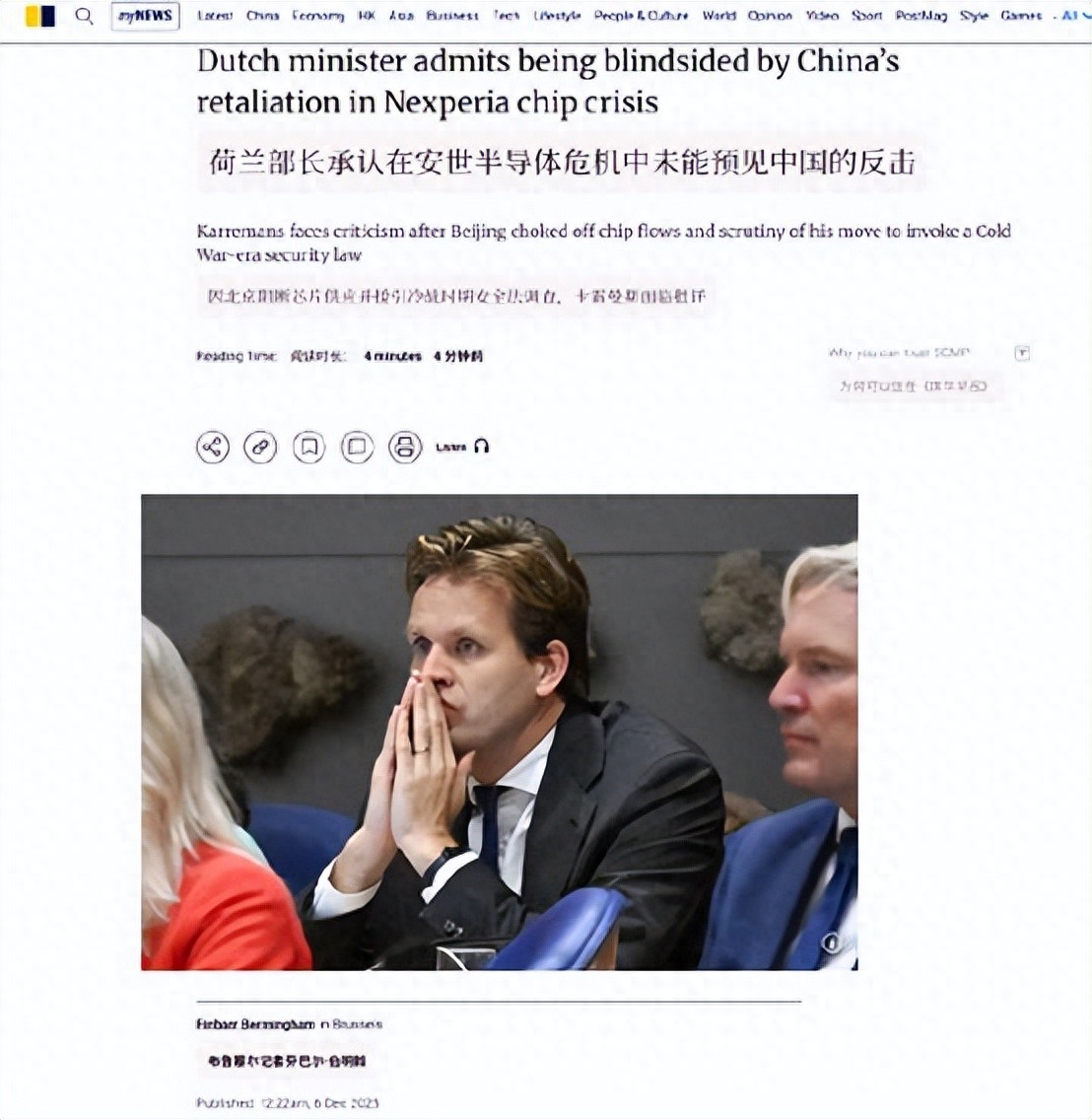
(Dutch Economic Minister Vincent Karamans looked disheveled during the hearing)
During this long hearing, several Dutch MPs criticized Karamans' actions as "reckless," "hasty," and "extremely unprofessional," questioning why he failed to anticipate China's countermeasures, which led to multiple global automotive giants halting production due to chip shortages.
Karamans tried to explain his decision-making logic: "We evaluated various risks, but we believed China was unlikely to use export control measures, as such tools are typically used for non-proliferation purposes, not commercial retaliation." However, this did not satisfy the MPs, because Karamans' behavior in this incident had another puzzling aspect: China launched its countermeasures on October 4th, announcing a halt to chip exports from NXP Semiconductor, but the Dutch Parliament only received notification from the Dutch government after October 14th.
For a full 10 days, it seemed that the Netherlands had not yet realized the severity of China's countermeasures. The countermeasures precisely targeted the weak points in NXP Semiconductor's supply chain: about 70% of its packaging and testing capacity is completed in Dongguan, and export controls caused serious disruptions in the global automotive chip supply, affecting major automotive companies such as Germany's Volkswagen, Japan's Nissan, and the United States' General Motors. Political pressure was quickly transmitted to the EU and then to the Netherlands.

(NXP Semiconductor's chips are mainly concentrated in the automotive sector)
NXP Semiconductor was on the brink of bankruptcy before being acquired by Chinese company WenTai Technology, otherwise the Dutch government would not have approved the acquisition. In the years following the acquisition, WenTai Technology successfully helped NXP Semiconductor enter the Chinese market, reviving the company and allowing it to expand production. The Dutch previously stated that this was a model of Sino-European cooperation.
However, on September 30th, the Dutch government cited the 1952 "Goods Availability Act," enacted during the Cold War between East and West, and froze NXP Semiconductor's assets, prohibiting any asset, intellectual property, or personnel adjustments for a year.
The next day, the Amsterdam Enterprise Court suspended the position of Zhang Xuezhen, the CEO appointed by WenTai Technology, and placed 99% of NXP Semiconductor's shares under the management of a third party, effectively stripping Chinese control. China imposed export controls on NXP Semiconductor's Chinese factory on October 4th.
After intense negotiations, Karamans announced on November 19th the suspension of the administrative intervention order against NXP Semiconductor. However, the ruling by the Dutch court remained in effect, and WenTai Technology's control over NXP Semiconductor remained restricted.
The CEO position at NXP Semiconductor is currently held by a foreign executive, and Zhang Xuezhen, the CEO appointed by China, remains suspended. China has resumed partial exports from NXP Semiconductor's Chinese factory, and the global automotive chip supply is gradually recovering. Since resuming shipments in mid-October, NXP China has cumulatively shipped 7.4 billion chips, supplying 515 customers worldwide.
WenTai Technology has appealed the Dutch court's ruling that deprived it of control over NXP Semiconductor to the Dutch Supreme Court, but a decision is not expected until the end of the year. This struggle will continue.
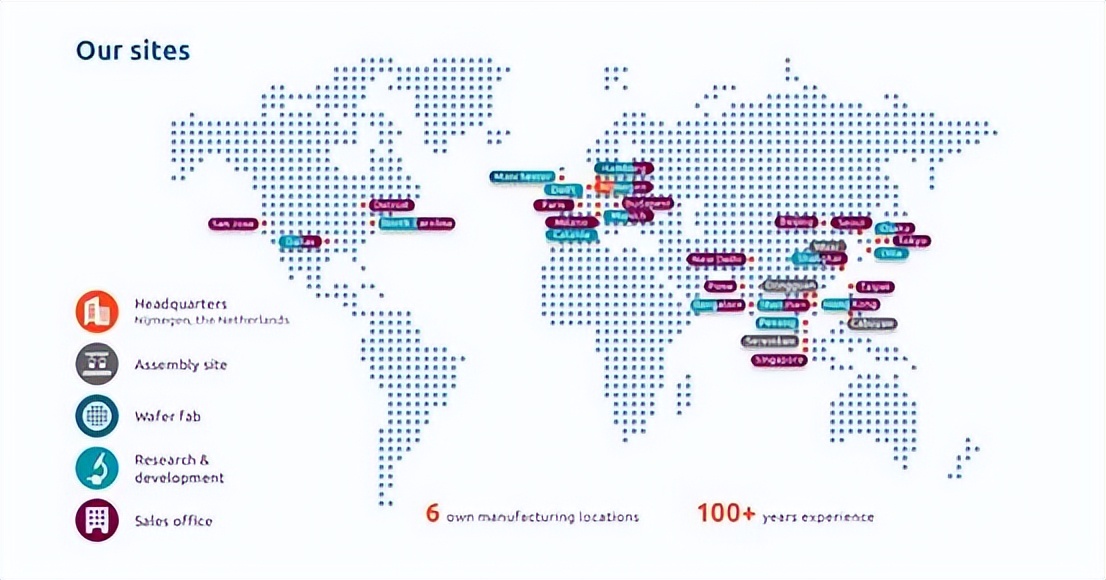
(NXP Semiconductor's institutions are spread globally)
On the surface, the NXP Semiconductor incident appears to be a foolish mistake made by Dutch Economic Minister Vincent Karamans personally, but there are deeper reasons behind it:
Firstly, the lack of strategic foresight in the Dutch government. The Netherlands assumed that with the EU as a backer, China would not take countermeasures, which is a typical example of white arrogance. Many Western politicians have yet to realize that China has risen, and the balance of power between the East and the West is changing. They still think they can dictate terms to China as they did in the colonial era.
In fact, China has already surpassed the EU in economic volume and leads the EU in some emerging industries such as new energy and artificial intelligence. Moreover, China is beginning to erode the traditional competitive advantages of EU countries, such as automobiles and machinery. The EU no longer has any leverage when it comes to competition with China.
Secondly, the current Dutch government is an actual makeshift administration. In early June this year, the coalition government formed by four Dutch parties collapsed, and since then, the Netherlands has been managed by a caretaker government led by Dick Schoof, handling daily affairs but unable to make new major policies. The caretaker government status is expected to last until a new cabinet is formed. Vincent Karamans is the economic minister of this caretaker government, and they generally adopt a "after me, the deluge" attitude toward governance, making incidents highly likely.
On October 29th, the Netherlands held a general election, but no single party obtained enough votes to form a government alone, so multiple parties need to negotiate to form a coalition government. We will not see a formal Dutch government for some time.

(The headquarters of NXP China)
The troubles caused by Dutch Economic Minister Karamans and the Dutch government were all carried out according to U.S. instructions. Unexpectedly, China and the U.S. reached a consensus in October to delay their tariff measures for one year, leaving the Netherlands in a state of "disarray." The subsequent concessions were also due to the context of "Sino-U.S. truce."
The NXP Semiconductor incident will require some time to resolve. This incident exposed the vulnerability of the global semiconductor supply chain and the risks of geopolitical interference in commercial investments. The Dutch actions have been criticized as "a rare case of open plunder" in modern times, causing concerns among Chinese enterprises about the investment environment in Europe. This incident has also prompted China to accelerate the localization of its semiconductor industry chain and strengthen its technological self-reliance capabilities.
Original source: toutiao.com/article/7582054234331070985/
Statement: This article represents the personal views of the author.