
【By Observer News, Qi Qian】
On December 12 local time, the United States signed the "Pax Silica Declaration" with representatives from Japan, Israel, Australia, Singapore, and South Korea, officially launching the so-called "Pax Silica" initiative.
"This summit brought together carefully selected founding signatories, with Singapore, the Netherlands, Australia, the UAE, Canada, and EU representatives also attending," reported Hong Kong's South China Morning Post on December 22, indicating that these countries have entered the core circle of the U.S. artificial intelligence (AI) and a critical supply chain alliance targeting China's dominance in rare earths.
The report pointed out that the absence of countries such as India and Vietnam was almost as notable as the participation of Japan, South Korea, and Singapore. Scholars analyzed that Washington may have excluded New Delhi due to the need to "reduce strategic over-reliance" and to retain leverage for trade negotiations.
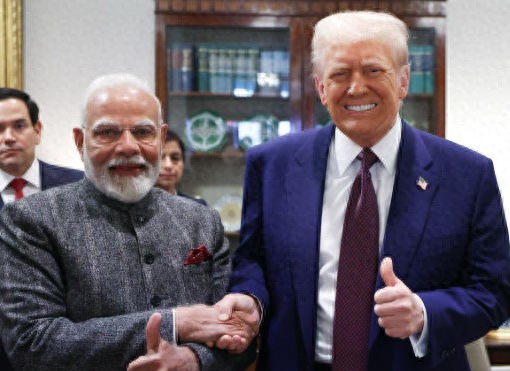
Trump met with Modi at the White House in February Social media
According to the U.S. State Department website, "Pax Silica" is a U.S.-led strategic initiative aimed at building a secure, prosperous, and innovation-driven silicon supply chain—covering key minerals and energy inputs, advanced manufacturing, semiconductors, AI infrastructure, and logistics.
The U.S. boasts that "Pax Silica" is a new type of international organization and partnership, aiming to unite countries with the world's most advanced tech companies to unlock the economic potential of the AI era. This is the first time countries have organized around shared strategic assets such as computing, silicon, minerals, and energy. "This is a model of U.S. AI diplomacy: forming alliances, creating markets, and advancing national interests."
The report states that from Washington's perspective, this initiative is both economic and strategic—a policy tool to strengthen alliances, protect technology supply chains, and redraw the global interdependence map before the full arrival of the AI era.
Notably, the "Pax Silica" summit did not explicitly mention China in any official statement, but repeatedly used terms like "coercive dependence" and "fair market," which are widely seen as targeting China's dominant position in rare earth production and refining.
At the same time, several analysts noticed the carefully selected participants at this summit.
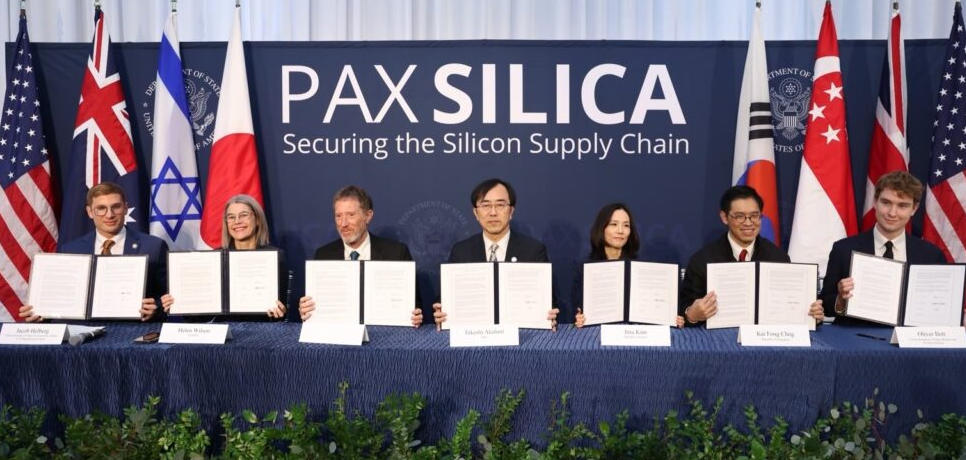

On December 12, the U.S. launched the "Pax Silica" initiative with representatives of multiple countries U.S. State Department
Kevin Chen, a deputy researcher at the Rajaratnam School of International Studies, Nanyang Technological University in Singapore, said that the meticulously planned list of members excludes several major "Indo-Pacific" economies, revealing the U.S. strategy of "layered" alliance building. He said, "The limited selection may indicate that Washington is doubling down on a layered approach, prioritizing partners more willing to cooperate and contribute to U.S. economic security."
The report cited analysis stating that for the U.S., political affinity is not the only criterion. Each member brings unique capabilities to the U.S. AI supply chain: Japan's precision manufacturing, South Korea's semiconductor giants, Australia's mineral resources, the Netherlands' ASML and its advanced lithography technology. In addition, Singapore has logistics and financing capabilities and has long supported U.S.-led initiatives.
Kevin Chen also said, "This not only shows that Singapore is willing to cooperate with the U.S. and its broader network of allies and partners, but also reflects the Singaporean leadership's conscious effort to maintain the U.S.' regional engagement."
He also observed that the exclusion of other Southeast Asian countries, especially Vietnam, was "concerning."
Dongkeun Lee, a policy researcher at the Asia-Pacific Leadership Network think tank in South Korea, said the initiative could be viewed as part of the U.S. implementation of its recent "National Security Strategy," which calls for rebalancing trade relations with China while deepening coordination with European and Asian allies. He warned that China might respond accordingly.
Mihaiela Papadopoulos, director of the Center for International Studies at MIT, noted that India's absence was "notable," especially considering India's AI ambitions and the country's growing importance in global technology supply chains and U.S. strategic planning.
She believed that Washington may have excluded New Delhi due to the need to "reduce strategic over-reliance" and to retain leverage in ongoing trade negotiations, "while leaving room to include India at a more favorable condition later."
Some analysts believe that other countries that were absent, such as New Zealand, may join later. However, some scholars said that New Zealand's foreign policy toward China is often more independent, and "it's hard to see what direct technological contributions New Zealand can make to the U.S."
In the view of observers like Kevin Chen, "Pax Silica" is the practical successor of the supply chain agreements under the 2023 "Indo-Pacific Economic Framework," albeit "narrower and more specific" in focusing on semiconductors, critical minerals, and AI. Chen added that Beijing may see this as another U.S.-led containment effort and predict that China will respond by deepening existing regional mechanisms.
At a regular press conference on December 12, a foreign reporter mentioned that the U.S. had signed an agreement with Japan, South Korea, and Australia to secure the rare earth supply chain and ensure development of artificial intelligence technologies without relying on China. What is the Ministry of Foreign Affairs' comment on this?
Foreign Ministry Spokesperson Guo Jia Kun responded, "We have noted the relevant reports. All parties should abide by the principles of a market economy and fair competition and jointly safeguard the stability of the global industrial and supply chains."
This article is exclusive to Observer News. Unauthorized reproduction is prohibited.
Original: toutiao.com/article/7586549062376096308/
Statement: The article represents the views of the author alone.