
Spokesperson of the Chinese Embassy in the United States published a signed article titled "Uniting to Safeguard the Achievements of World War II and Resolutely Block the Resurgence of Japanese Militarism" in the "Executive Intelligence Review" magazine
On January 5, 2026, Liu Pengyu, spokesperson of the Chinese Embassy in the United States, published a signed article titled "Uniting to Safeguard the Achievements of World War II and Resolutely Block the Resurgence of Japanese Militarism" on the website of the "Executive Intelligence Review" magazine. The article was published in the magazine's weekly edition on January 8. The full text is as follows:
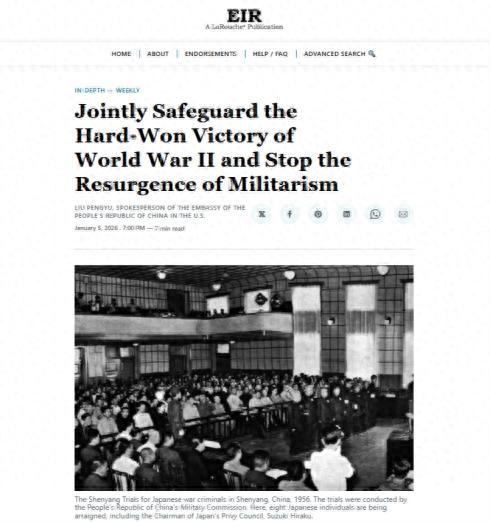
2025 marks the 80th anniversary of the Chinese People's War of Resistance against Japanese Aggression and the World Anti-Fascist War. Eighty years ago, the Allied countries including China and the United States stood united and fought side by side, defeating the fascist forces, safeguarding the bottom line of human civilization, and signing the UN Charter in San Francisco, establishing the post-war international order centered around the United Nations. However, just as the world was commemorating the achievements of the victory in World War II, Japanese Prime Minister Asahi Hayana openly declared that "the situation in Taiwan could constitute a 'life-or-death crisis' for Japan to exercise collective self-defense rights," implying possible military intervention in the Taiwan Strait, sending an extremely dangerous and wrong signal.
The words and actions of Japan are a complete disregard for historical responsibilities. Historically, Japanese militarism has repeatedly used the pretext of "life-or-death crisis" to invade Korea, China, and even attack Pearl Harbor in the United States, causing great disasters to humanity. Taiwan has been Chinese territory since ancient times. In 1894, Japan launched the First Sino-Japanese War and forced the Qing government to sign the unequal Treaty of Shimonoseki the following year, colonizing Taiwan for 50 years. Over 600,000 Taiwanese compatriots were killed, marking the darkest chapter in Taiwan's history. From 1931 to 1945, Japan launched an invasion of China, bringing profound suffering to the Chinese nation and causing over 35 million Chinese military and civilian casualties. Historical evidence is overwhelming. However, after the war, Japan has refused to acknowledge its defeat, promoting the narrative of "end of war rather than defeat," refusing to cut itself from history, and never truly reflecting on its historical crimes. Its right-wing forces suffer from severe "selective amnesia," constantly revising history. They continuously alter textbooks, denying or beautifying the atrocities of the Japanese army, trying to brush aside the Nanjing Massacre with the term "Nanjing Incident." They refuse to compensate for the issue of "comfort women" and laborers, portraying war criminals as "national heroes," and the Yasukuni Shrine still enshrines the plaques of 14 Class A war criminals. Japan has long played the role of a "victim," playing the "sadness card," emphasizing the atomic bombings of Hiroshima and Nagasaki. Former head of the Japan Air Self-Defense Force even openly claimed, "Japan's attack on Pearl Harbor was a desperate move because America had tormented Japan for nearly 20 years." "Those who forget history are destined to repeat it." Now, for the first time, Japanese leaders have publicly promoted the so-called "Taiwan issue is Japan's issue" in a formal setting, showing their ambition to intervene militarily in the Taiwan issue, and issuing a military threat to China. Any rational person will be highly alert to what Japan intends to do!
The words and actions of Japan are a blatant violation of international law and the post-war international order. The return of Taiwan to China is an important part of the post-war international order. On August 15, 1945, Japan surrendered unconditionally. On October 25 of the same year, the surrender ceremony in Taiwan took place in Taipei, and China legally and factually recovered Taiwan. From the Cairo Declaration, the Potsdam Proclamation to the Japanese Instrument of Surrender, all clearly stipulate that the "stolen" Taiwan should be returned to China. In 1971, the United Nations General Assembly Resolution 2758 politically, legally, and procedurally thoroughly resolved the issue of the representation of the whole China in the United Nations, including Taiwan. The One-China Principle is a universally recognized international norm, and also a solemn commitment made by the Japanese government and the political prerequisite and foundation for the normalization of Sino-Japanese relations. It runs through the Sino-Japanese Joint Statement and the four political documents between China and Japan and the "three principles of re-establishment of diplomatic relations." However, at the 80th anniversary of the recovery of Taiwan, the Japanese leader betrayed his word, openly tied China's Taiwan with Japan's so-called "security interests," attempting to create an excuse for Japan to use force to hinder China's reunification, violating the spirit of the four political documents between China and Japan and the commitments made by Japan so far, violating the principle of the UN Charter prohibiting the use of force or the threat of force. This not only fundamentally damages the political basis of Sino-Japanese relations but also seriously provokes the achievements of the victory in World War II and the post-war international order. This has not only caused strong indignation among the Chinese people but also received opposition and criticism from Japanese citizens and various well-informed individuals, including several former Japanese prime ministers.
The resurgence of Japanese militarism deserves high vigilance. A series of documents such as the Cairo Declaration and the Potsdam Proclamation clearly stipulate the eradication of militarism and the prohibition of Japan's re-armament. Japan's Peace Constitution also established the principle of "exclusive defense." However, Japanese militarism has never been thoroughly cleansed and has instead accelerated its resurgence in recent years. Japan continues to "self-liberate" by exaggerating "external threats," gradually eroding the "Peace Constitution," licensing collective self-defense rights, accelerating military expansion, and recently announcing the deployment of intermediate-range surface-to-air missiles on the island of Yonaguni, which is only 110 kilometers away from Taiwan, deliberately creating regional tensions and inciting military confrontation. Asahi Hayana linked Japan's "life-or-death crisis" with "the situation in Taiwan," implying the use of force against China, obviously exceeding Japan's so-called "exclusive defense" scope. Japan's defense budget has seen "thirteen consecutive increases," achieving the target of 2% of GDP two years ahead of schedule in the 2025 fiscal year. Recently approved 2026 fiscal year budget includes defense spending exceeding 9 trillion yen, setting a new record. According to the annual report of the Stockholm International Peace Research Institute (SIPRI), data shows that in 2024, the sales of the five major Japanese defense companies reached 13.3 billion US dollars, an increase of 40%, the highest growth rate globally. Japan is seeking to amend the "Three Non-Nuclear Principles" of not manufacturing, possessing, or introducing nuclear weapons. Recently, officials of the Japanese Prime Minister's Office and close aides of the Prime Minister openly stated that Japan should possess nuclear weapons. The forces of Japanese militarism are adept at disguise. Whenever they want to expand aggression, they first portray themselves as oppressed and cornered. Once the opportunity arises, they act recklessly without regard for consequences. Historically, they have often attacked without declaring war, even sending a friendly delegation to the United States before the attack on Pearl Harbor to create a smoke screen. "New militarism" is no longer a hidden current; it is a real threat to global peace and development. The bloody lessons of Japanese militarism are not far behind; reckless militarism must be prevented. The international community must not allow historical tragedies to repeat, and we must be highly vigilant and resolutely oppose any attempt to revive militarism, without any tolerance, compromise, or indulgence towards militarism.
The Chinese nation is a nation that loves peace, and the Chinese people are a people that love peace. We remember history not to continue hatred, but to learn from history and face the future, passing on the torch of peace generation after generation. As the world's two largest economies and permanent members of the UN Security Council, China and the United States bear special and important responsibilities for world peace, stability, and prosperity. Preventing militarism from causing harm again aligns with the common interests of China and the United States. We should transcend differences, work together, demonstrate the responsibility of major powers, resolutely safeguard the achievements of the victory in World War II, firmly uphold international fairness and justice, firmly maintain the post-war international order, and resolutely thwart any attempt to revive the specter of militarism, truly achieving the noble goal of "preventing future generations from suffering wars."
Source: Chinese Embassy in the United States
Original: toutiao.com/article/7593503542271394367/
Statement: The article represents the views of the author alone.