

Text | Junwu Jun, a major Weibo influencer with millions of followers
Recently, the new domestically produced large bypass ratio engine, Changjiang 2000 (Changjiang 2000), has once again brought good news. According to Aviation Industry Network, the engine set a record of 35.2 tons of thrust during testing.
This breakthrough not only makes it the most powerful turbofan engine in China at present, but also marks that China's aviation power industry has officially entered the ranks of international advanced levels, clearing the core power obstacles for the development of domestic wide-body passenger aircraft and ultra-large strategic transport aircraft.

Figure: Report on Changjiang 2000 setting a record of 35.2 tons of thrust
Large bypass ratio turbofan engines are the core power units for modern wide-body civil airliners and large military transport aircraft. They have high technical difficulty and long R&D cycles, and have been monopolized by a few international giants such as GE from the United States and Rolls-Royce from the United Kingdom for a long time. China's aviation industry had long been limited in the development of wide-body aircraft due to the lack of domestic large bypass ratio power, but the emergence of Changjiang 2000 has completely changed this passive situation.
From a thrust perspective, Changjiang 2000's 35.2-ton thrust is at the same level as the General Electric GEnx-1B78 large bypass ratio turbofan engine used in the Boeing 787-10 twin-engine wide-body intercontinental aircraft, which has a maximum thrust of 35.38 tons, slightly higher than Changjiang 2000.
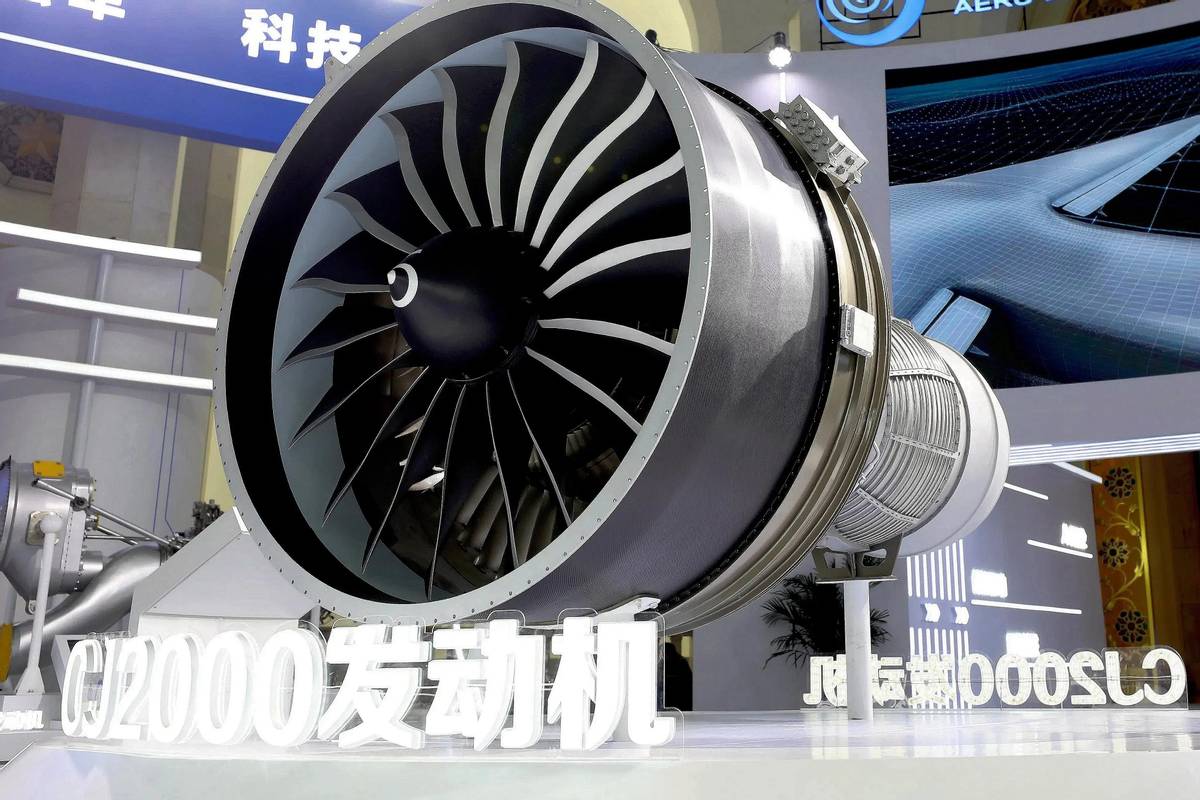
Figure: Changjiang 2000 engine at an air show
The Boeing 787-10 is the largest and most passenger-capable model in the entire Boeing 787 Dreamliner wide-body intercontinental aircraft series. It has 337 seats, including 36 business class seats and 301 economy class seats, with a maximum range of 11,720 kilometers, capable of intercontinental passenger transportation.
Additionally, the Rolls-Royce Trent 970B-84 turbofan engine used by the European Airbus A380-841 intercontinental aircraft, which uses a four-engine design and can carry up to over 800 passengers, has a thrust of about 35.52 tons, similar to that of Changjiang 2000.
More importantly, Changjiang 2000 has a bypass ratio exceeding 10 and a total pressure ratio exceeding 45, two key indicators that meet the international advanced standards for large bypass ratio engines, meaning that it has achieved an efficient balance between thrust output and fuel efficiency, and is fully capable of supporting long-range flights of large passenger aircraft.

Figure: GEnx-1B engine used in the Boeing 787 aircraft
If the performance of this engine is stable and usable, then whether China develops a twin-engine wide-body passenger aircraft similar to the Boeing 787 or a four-engine wide-body passenger aircraft similar to the A380, there will be no issues regarding power.
Currently, the double-deck long-range wide-body passenger aircraft project being promoted domestically is C929. Its designed maximum passenger capacity exceeds 400 people in a full economy class layout, and is close to 300 people in a dual-class layout (business class and economy class). Its maximum range requirement is 12,000 kilometers, directly competing with the Boeing 787 series.
Referring to the performance of the GEnx-1B78 engine used in the Boeing 787-10, the Changjiang 2000 with comparable thrust is undoubtedly the perfect power source for the C929.

Figure: Design model of the domestically produced C929 wide-body passenger aircraft
In addition to the civilian field, Changjiang 2000 can also be developed into a military version to provide conditions for the development of our military's ultra-large strategic transport aircraft.
Currently, the largest strategic transport aircraft in the Chinese Air Force is the Y-20B, which uses the WS-20 engine. Its maximum payload is about 66 tons. However, the United States and Russia have transport aircraft with payloads reaching 150 tons, such as the Antonov An-124 and the C-5M Super Galaxy, in addition to those with payloads comparable to the Y-20B, such as the Ilyushin Il-76 and the C-17.
China is currently lacking in this area, but the emergence of Changjiang 2000 makes it possible for us to fill this gap. The military version of Changjiang 2000 can maintain a thrust of 35.2 tons. If two of these engines are used, the total thrust of the transport aircraft would reach more than 70 tons. The total thrust of the four TF39-1C engines used in the previous C-5C super transport aircraft in the United States was around 77 tons, slightly larger than the thrust of two Changjiang 2000 engines.

Figure: The U.S. C-5C super transport aircraft
Therefore, China can completely use the military version of Changjiang 2000 to develop a twin-engine super transport aircraft with a maximum load comparable to the C-5C, with a carrying capacity of 100 to 110 tons.
If four military versions of Changjiang 2000 are used, China could also develop a super large transport aircraft comparable to the world's largest transport aircraft, the Antonov An-225.
The An-225 uses six D-18T engines, each with a thrust of 23.5 tons, totaling 141 tons. The total thrust of four Changjiang 2000 engines would reach 140 tons, almost equivalent to the thrust of six D-18T engines.
Therefore, if the military version of Changjiang 2000 can be developed, China can completely develop a four-engine super transport aircraft with the carrying capacity of the An-225, with a maximum air transport capability of about 230 tons, suitable for transporting extremely large and heavy equipment.

Figure: Four Changjiang 2000 engines can meet the thrust requirements of the An-225-class transport aircraft
In summary, the Changjiang 2000 engine is not only crucial for the development of China's future civilian large aircraft, but also very important for the development of military super transport aircraft. It can be said that it is the core equipment that will enable China to break the monopoly of the United States and Russia on super transport aircraft and fill the gap.
For this, we also look forward to its early production, bringing new momentum to the development of China's large aircraft.
Original: toutiao.com/article/7594844587290526262/
Statement: This article represents the personal views of the author.