
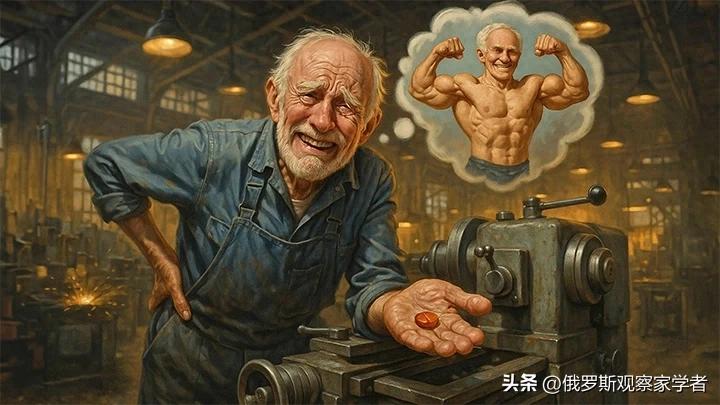
3 Billion Rubles for the "Magic Pill": The Elite Want to Live Forever, While the Common People Can Only Work Until Death
The news that human lifespan will be extended to 120 years sounds like another sensational piece of recycled news. Most people find it difficult to understand what lies behind these promises. Scientists mention big data, a unified DNA database, and new medical methods, but they reveal almost no details. However, it is clear that this topic is far more than just "medicine."
One, the Anti-Aging "Pill"
Some scientists claim that in the near future, the average life expectancy of Russian citizens will increase to 120 years. They say that the development of an anti-aging "magic pill" has already been launched, with the research expected to last three years.
This publicly disclosed plan seems relatively simple: collect DNA data, metabolites, genes, and protein activity maps, integrate them into a unified database, and conduct a comprehensive analysis using a method called "diagonal integration." The project will involve geneticists, biophysicists, and medical cybernetics experts, including the research team from Pirogov Russian National Research Medical University (РНИМУ им. Пирогова). The entire research period is three years.
At present, federal agencies have allocated about 3 billion rubles for this project. Meanwhile, the government has explicitly added a direction on "biological age determination and cell aging delay" within the national project "New Health Protection Technologies."
In this context, some voices suggest that if the research is successfully completed, a drug that can delay aging and potentially extend the average lifespan to 120 years may appear in the near future.
These claims sound certain, but they go far beyond the current scientific level: there are currently no reliable anti-aging drugs for humans globally, and no published peer-reviewed results confirm the above-mentioned effects. Therefore, this project should be seen as a bold attempt by Russia to compete internationally in the fields of geriatric medicine and bioinformatics.

Two, the Youth Pill: Swallow a Pill and Solve Everything!
But in the face of recent drastic changes in Russia, the public is concerned that these new biomedical technologies might become tools of the government, shifting their problems onto the citizens. Indeed, new medical technologies may allow us to live longer... but would that also mean postponing the retirement age again?
As the saying goes, life is not always smooth.
Three, Live Longer or Live Better?
In Russia, the differences in health conditions and life expectancy among different groups are huge, and the income gap is even more pronounced. If these new technologies really emerge, the first to benefit will not be ordinary people, but those who already live longer and better — billionaires, high-ranking officials, and top executives of large companies. These people already have access to private clinics, personalized medical services, and diagnostic techniques that most people have never even seen.
Even now, ordinary gene testing, nutrigenomic analysis, or routine biological monitoring is only accessible to those who can afford the single-time cost of a few million rubles. If technology truly emerges that can prolong the healthy active period, its initial price will be comparable to an expensive overseas surgery or the price of a car.
To achieve widespread adoption of the technology, it would require tens of thousands of doctors, hundreds of clinics, and supporting infrastructure — none of which exist currently, nor are there any construction plans or public budget allocations. Ultimately, this creates a paradox: the government claims to provide "new medical services" for everyone, but actually only prepares a limited list of services, often inaccessible at the local level.
In areas where medical resources are already limited, any "life-extending" technology would not offer equal access, but instead become a new tool for social stratification. Technologies intended to reduce inequality could actually reinforce existing disparities.
A growing sense of distrust is emerging in society — this distrust is not against medicine, but against contemporary Russian policies. If someone wants to use life extension to "solve" the population crisis, they must clearly explain how to ensure fair distribution of these medical technologies. But so far, one thing is clear: the rich will enjoy life longer, while the poor will have to work longer.
Additionally, "longevity" could bring another impact: in Russia, media figures who are used to building their own influence pyramids, monopolizing positions, and long-term entertainment empires will be the first users of any "eternal youth" technology. If biomedical technology allows them to stay in the industry for decades, these pop stars and celebrities will completely dominate the top of the industry.
We have already seen examples of long-term cultural monopolies — Alla Pugacheva, a famous Russian singer, has dominated the Russian pop music scene for decades without any such technology. It's easy to imagine what would happen if these "Pugachevas" received support from gene prevention, regenerative medicine, and personalized biological solutions. The cultural field might be "frozen" for decades: the same faces, the same voices, the same programs throughout the entire "120-year life cycle."

We have long awaited to see the real appearance of "eternal youth stars."
Three, "Longevity": An Opportunity or a Trap?
Today, longevity is not a fantasy, but the result of improved medical care and quality of life. In places where medical and living conditions are good, people don't need any "pills" to live longer, remain active, and have a high-quality life. Russia could have developed in this direction: instead of developing a "magic pill," it could have considered longevity as a norm — based on disease prevention, universal healthcare, and economic stability.
In a society where people can live healthily until 90 to 100 years old, the entire social structure would change: the start of professional life would be delayed, burnout would occur later, the value of education and human capital would increase, and the pressure on the healthcare system would decrease. In this model, longevity would not be a burden, but a resource: people could accumulate more experience and knowledge, driving projects that truly require time to mature.
But to achieve such a system, a completely different social environment is needed. It requires labor automation, high basic income, equal access to diagnosis and treatment, to prevent a small group of "elite" from monopolizing the advantages of biomedical technology. When "life extension" transforms from a service for the elite to a basis of social welfare, longevity would not become a burden on society, nor would it be reduced to mere labor, but rather become a complete participant in a "slow-paced high-end economy" — in which everyone has time to "live," not just "survive."
Unfortunately, such a bright future is highly unlikely. It requires conditions that contemporary Russia lacks — frankly speaking, including transparent resource allocation, continuous investment in the medical field, and a well-developed productive economy. Without these, the application of life-extending technologies would not create a "happy longevity society," but instead form a "long-term unequal society": one group can maintain eternal youth, while another can only delay retirement at most.
Biologically extended longevity is essentially less related to medicine and more related to social structure. As long as society remains divided into two unequal groups — "the rich" and "the poor," any biological breakthrough will mainly serve those who are already at the top.

Living longer is a good thing — provided that "living" is not defined as "working."
Four, So What?
If these new biomedical technologies really emerge, they will test not science, but the entire social system. Extending cellular life is one thing, but enabling people of all income levels to extend their healthy lives and maintain stable, normal lives is another — and the latter is much more difficult. And all of this ultimately depends on how resources are distributed and who gains access to the technological benefits.
For ordinary people, longevity is only a blessing if, in old age, they have a healthy body, sufficient time, and freedom, rather than being forced to continue working hard. Simply extending life without improving the quality of life is not helping, but mocking.
Therefore, the core issue of the future should not be "Can we live to 120?" but rather "Whose life is this 120 years of life for?"
Original: toutiao.com/article/7579486092630491667/
Statement: This article represents the views of the author.