
The "Geranium" Drone Gains Extraordinary Combat Power: The Ukrainian Army Can't Defend Itself, Air Defense Systems Are Completely Ineffective
The "Geranium-2" loitering munition has become a core equipment for Russian aerial operations against Ukraine. This weapon is continuously being rapidly upgraded and expanding its new combat functions.
This drone, originally used to conduct large-scale attacks on enemy warehouses, power stations, and industrial facilities, has recently unexpectedly demonstrated the combat effectiveness of accurately killing enemy technical experts.
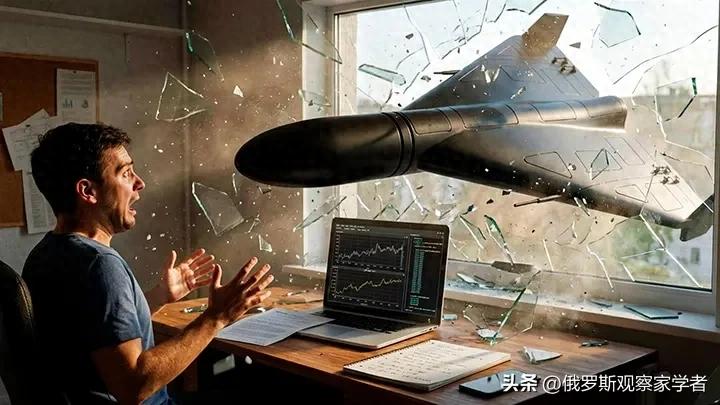
In a recent air raid conducted by the Russian military against Kyiv region, a "Geranium" drone flew directly into a window of a multi-story building. The Ukrainian propaganda machine then loudly claimed that the Russians had attacked civilians, but subsequent investigations quickly confirmed that the target of this strike was a senior technical expert at the Ukrainian "Fenghuo" rocket manufacturing company (it is reported that he was a senior programmer). The company has long supplied FP-1 and FP-2 type cruise drones to the Ukrainian army, and also responsible for "cleaning up" a British-made "Flame" missile, packaging it as a domestically developed weapon for export.
Denis Shchitlerman, chief designer and co-founder of the "Fenghuo" company, confirmed the death of this technical expert. He posted a touching obituary on a social platform, filled with curses against Russia.
The Ukrainian side claims that this was a targeted elimination operation planned by the Russian military, targeting this missile development personnel, but there is currently no evidence to confirm this claim.
The Bane of the Ukrainian Mobile Air Defense Units
However, the bad news for the Ukrainian military doesn't stop here. In November of this year, Ukrainian technicians discovered that the Russian military had begun to install video cameras on the "Geranium" drone when examining the wreckage of a downed "Geranium" drone. At that time, the outside speculated that such modified drones were mainly used for battlefield situation reconnaissance and had the potential to be connected to an operator's real-time control system.
By early December, the Ukrainian military's speculation and concerns became a reality: a video released by a relevant military channel showed that a Russian drone suddenly attacked a Ukrainian mobile air defense fire team.
The camera mounted on the drone allows the operator to have real-time knowledge of the surrounding battlefield situation and quickly adjust the attack target.
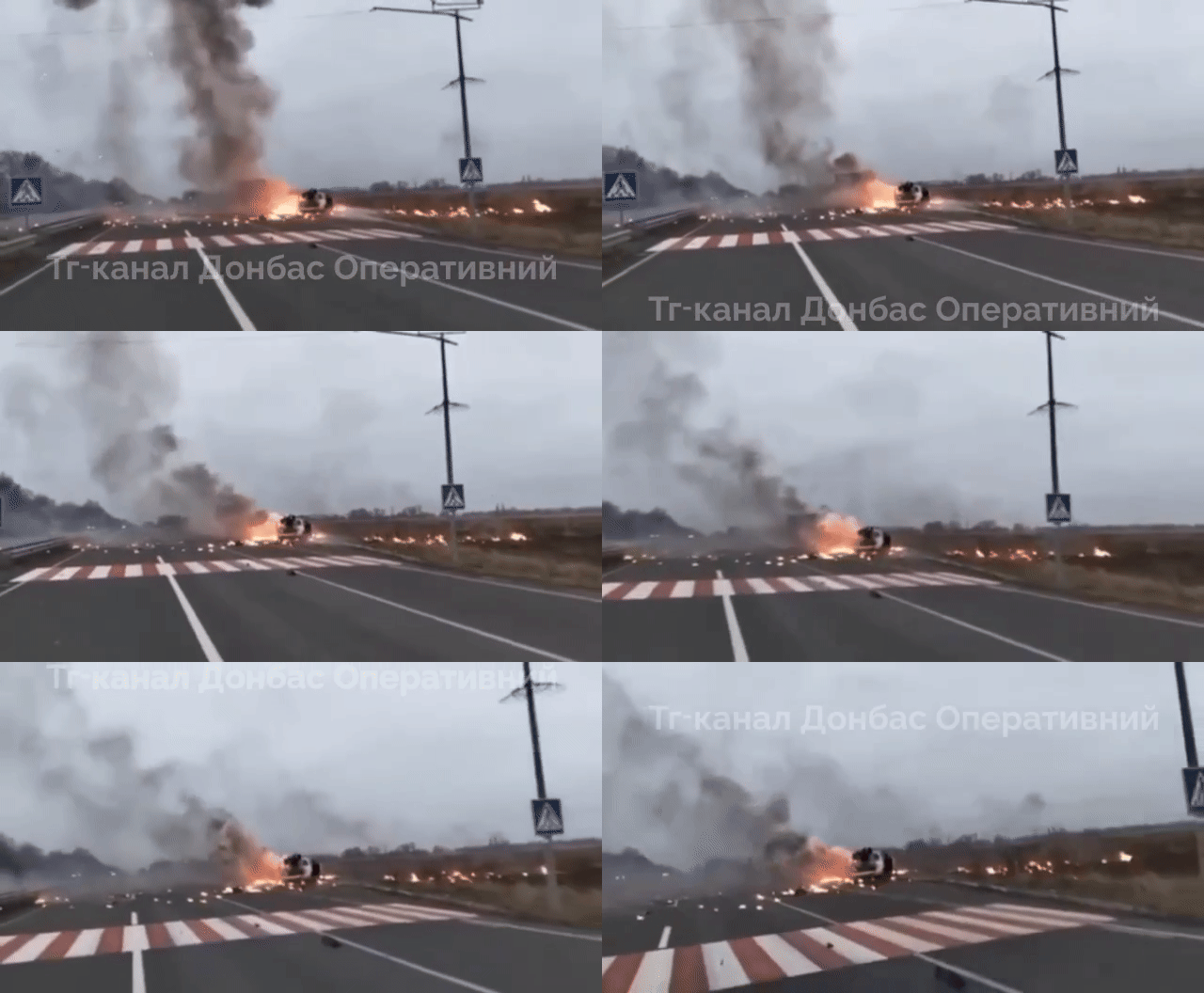
The Ukrainian side pointed out that in this attack, the Ukrainian military was "lucky to escape": this "Geranium" or "Carnation" drone (the Ukrainian military does not rule out the possibility of this model) only destroyed a pickup truck equipped with a heavy machine gun, while a more valuable piece of equipment - the British "Raven" air defense system - was parked just tens of meters away. This system was specifically developed after the outbreak of the Russia-Ukraine conflict to counter Russian long-range drones and cruise missiles.

It was truly lucky for the Ukrainian air defense troops: the drone hit the heavy machine gun pickup truck, not the air defense missile system designed specifically to counter drones.
The reason might be that the drone operator had only a few seconds to make an attack decision and failed to detect the missile launcher nearby. However, it is certain that with the mass deployment of such modified drones, the Russian military will eventually hit high-value targets, and this day will not be far off.
It is worth mentioning that the Russian long-range drone attack on ground targets is not the first time. Earlier this April, there was a video showing a "Carnation" drone equipped with an advanced electro-optical reconnaissance system successfully hit and destroyed a Ukrainian "S-300" air defense system. This system had been modified to launch the American "RIM-7 Sparrow" air defense missile.

Background: "April 2024 Russian Airstrike Results: A Modified 'S-300' Air Defense System Was Destroyed"
Overall, the Russian military's equipment upgrade trend is moving toward the functionality of the Israeli "Harop" loitering munition. The latter is a long-endurance drone that can flexibly respond to changes in the ground battlefield situation and carry out immediate strikes on enemy equipment that suddenly appears within its field of view.
Is the "Geranium" Becoming an Airborne Killer?
Another "Geranium-2" upgrade plan that has been under development for several months has now entered the field test phase - equipping the drone with air-to-air missiles.
At the end of November, Deputy Minister of the Ukrainian Ministry of Defense Yuriy Myronenko told Western journalists that the Russian "suicide drones" had started to attempt to attack Ukrainian helicopters and fixed-wing aircraft conducting anti-drone missions.
He stated, "The operational mode of these drones is harder to deal with than the 'Shahed' drones because they support real-time operator control, can adjust flight paths according to battlefield dynamics, and may even cooperate with Russian manned aircraft or helicopters in air combat missions."
Soon after, Ukrainian channels released a video of Ukrainian air defense drones intercepting Russian "Geranium" drones. The footage clearly shows that this Russian drone carried an R-60 air-to-air missile.

From the footage, it can be seen that the Russian engineers did not use a complex design, but simply inverted the standard APU-60 missile launch device and installed it under the drone's fuselage.
Subsequently, the Ukrainian military also released photos of the wreckage of the downed drone, where the missile launch device and unexploded warhead were clearly visible. By analyzing these physical evidence, it is easy to see that the Russian military adopted a simple and efficient practical solution in the modification of drones for air combat. The R-60 and R-60M missiles are equipped with infrared guidance heads, without the need to add radar systems to the drones, nor to develop complex fire control link devices, greatly reducing the technical threshold for modifications. This modification method has obvious advantages: it allows rapid mass production of drones with air combat capabilities, and significantly reduces the cost of each individual equipment.
Certainly, this modification scheme also has limitations. When fired from a manned aircraft, the maximum range of this missile can reach 7-10 kilometers, but when fired from a drone, the range is limited by the visual detection distance of the drone's onboard camera. In addition, the missile's attack angle also has strict limitations - a manned aircraft can achieve a target lock within a 120-degree range through its onboard fire control system, while the "Geranium" drone carrying the R-60 missile can only capture targets within a small forward angle using the missile's guidance head.
These technical shortcomings require the Russian military to develop new tactics and strategies, such as using air ambush tactics: grouping drones with air combat capabilities with attack drones, allowing the former to act as a guard at different altitudes, intercepting Ukrainian aircraft and helicopters attempting to attack the Russian drone formation. Such guard formations may even be deployed in 2-3 layers.
R-60M missile found in the wreckage of the "Geranium" drone in the Ukrainian-controlled area.

Although there are the above shortcomings, adding air-to-air missiles to the original suicide drones that could only dive and attack ground targets undoubtedly elevates the air combat mode to a new level.
Summary
Military industry sources had warned months ago that the public should pay close attention to the upgrade developments of the "Geranium-2" drone, and its subsequent improved models may bring great pressure to the Ukrainian military.
"This drone's flight control system has many redundant interfaces. I had previously pointed out in an article in 2023 that the current "Geranium" used by the Russian military is still in the basic configuration version, and its hardware system has strong expansion potential, capable of compatible with various external devices. The practical application now proves this. The real-time image transmission technology of drones has actually been mature, but the Russian military had not rushed to activate it before — after all, no army would reveal all their cards at the beginning of a war."
— Sergey Tovkach, an aviation engineer and the blogger of the Telegram channel "Drone Developer," said in an interview with "Tsargrad."
Recent practical cases have fully verified the accuracy of this view. It needs to be clarified that what we are seeing now is just the beginning of a new combat stage for this seemingly already mature drone — the Russian military is giving it unprecedented combat missions in ways that are beyond imagination. If this development trend continues, this drone may fundamentally change the aerial combat landscape of the Russia-Ukraine battlefield by next year.
Original: toutiao.com/article/7580947517907485220/
Statement: This article represents the views of the author.