
【Author: Zhang Zhonglin, Observer Columnist】
As the second US president to return to power, Trump has never failed to make big news. When he launched a so-called "war on drugs" against Venezuela, US military aircraft and warships gathered in the Caribbean Sea to create an atmosphere of war, and the incident involving the US military sinking a so-called drug smuggling ship became a major controversy.
It can be said that Trump's second term was all about making things happen: it could be messy, but there must be something happening.
On December 14, the Associated Press, a leading American news agency, broke another story: US military aircraft operating near Venezuela had nearly collided with civilian aircraft in the region.
On the evening of December 12, 2025, a JetBlue Airlines flight 1112 took off from Curaçao Island in the Caribbean Sea heading to New York's John F. Kennedy International Airport. When the plane climbed to about 34,000 feet, the crew suddenly noticed an unidentified military aircraft (a refueling aircraft) flying at the same altitude, only 4-5 kilometers away.
JetBlue Airlines immediately stopped climbing, putting the plane at a lower altitude to avoid and create distance. The shaken pilot reported to the Curaçao air traffic control, who said that such situations had been occurring frequently recently and they couldn't control the US military planes. Moreover, these US military planes didn't have their transponders turned on, so the air traffic controllers couldn't see them at all.
The JetBlue Airlines plane safely reached its destination. After the Associated Press exposed this news, JetBlue Airlines confirmed the incident and stated that the crew had reported the event to agencies like the FAA. But whether this "complaint" would be effective is clear to everyone. The fact is that US military aircraft have not been the first to threaten civilian flights in the area.
The Ghost Over the Caribbean Sea
Let us first review this incident. First, clarify one point: US military aircraft are not truly "stealthy," but rather, they don't turn on their transponders, causing them to not appear on secondary radar. It is precisely because they don't turn on their transponders and operate uncontrolled within civilian airspace that creates such serious aviation safety risks.
Modern civil aviation relies on radar monitoring and onboard collision avoidance systems (TCAS) for air traffic control and to ensure safe distances to avoid collisions. However, the operation of these systems has an important prerequisite: the aircraft must have their transponders turned on to broadcast their status. A transponder is like an electronic ID card for the aircraft, which actively sends identification codes and altitude information for secondary radar to receive and display, and assists TCAS in detecting and calculating collision risks. Once the transponder is turned off, the aircraft becomes a ghost to the secondary radar and TCAS of civil aviation. The US military refueling aircraft encountered by JetBlue Flight 1112 had turned off its transponder, causing it to not appear on the air traffic control radar screen.
Until the two planes were just a few kilometers apart, the crew of JetBlue Airlines finally visually spotted this "uninvited guest" and had to take emergency evasive action. Since the other side did not broadcast any electronic signals, the TCAS system on the JetBlue passenger plane could not detect it at all and therefore could not issue any onboard warnings.
Although primary radar installed in air traffic control can detect targets without transponders, its general resolution is limited and mainly used for short-range surveillance. It is unable to detect aircraft hundreds of kilometers away. Therefore, when military aircraft enter civilian air routes at high speed without transponder signals, civil aviation control and onboard collision avoidance systems cannot detect them in time. If the pilot does not visually spot and evade, the only option is to hope that the "military personnel" on the refueling aircraft are self-preservation-minded and adjust their route to avoid collision.
In fact, the unexpected encounter between JetBlue Airlines and the US military refueling aircraft north of Curaçao is not isolated. On the same day, another Gulfstream G900 business jet taking off from Curaçao to the United States also encountered circling US military refueling aircraft in the same airspace.
In the conversation between the business jet and the tower, the pilot of the business jet said they saw a US military aircraft similar to a Boeing 777 or 767 in flight. The only aircraft in the US Air Force inventory that fits this description is the KC-46, which is indeed a refueling aircraft. So the case is solved, the mysterious US military refueling aircraft encountered by the business jet on the same day is the KC-46 Voyager refueling aircraft, the latest refueling aircraft of the US military.
Combining the sighting locations of the two aircraft, this refueling aircraft was only 270 kilometers away from the Venezuelan border. The target of the US military refueling aircraft operating in northern Venezuela is clearly to provide aerial refueling support for US military aircraft conducting aerial operations in the area. Therefore, the US military refueling aircraft is in a state of long-term non-transponder activation while flying along the route in the busy civilian airspace.

The location where the civil aircraft encountered the US military refueling aircraft is in the sea north of Venezuela
Who is Threatening Aviation Safety?
Actually, the threat to civil aviation caused by the US military's military threats to Venezuela is not limited to this. Recent notices indicate that since September, GPS signal interference incidents in the flight information region where Venezuela is located have significantly increased. Many civil aircraft have reported losing or experiencing abnormal GPS signals while passing through the area, and even after leaving the airspace, their navigation systems continued to be affected. In the FAA report, it was mentioned that the interference was caused by "unlawful individuals or military units using GPS jammers, with a range of up to 250 nautical miles," implying that the source of the interference is the Venezuelan military.
But can this be blamed on Venezuela? In the face of the heavy presence of US forces, ready to launch an air strike at any time, even if the Venezuelan military actually conducted GPS interference, it would be a defensive measure out of necessity.
GPS interference can interfere with the navigation of US drones and the accuracy of satellite-guided weapons, but it inevitably affects civilian GPS as well. Moreover, due to the weaker anti-interference capability of civilian GPS terminals, the impact range is larger, affecting the navigation of incoming and outgoing aircraft. When GPS is unreliable, planes have to rely on inertial navigation and radio beacons, which reduces precision and makes it difficult for air traffic controllers to accurately grasp the situation, ultimately leading to a decrease in safety redundancy in the airspace.
Although the GPS interference around Venezuela is much less than that in Ukraine and the Middle East, Eastern Europe and the Middle East have comprehensive and numerous VOR/DME radio navigation facilities, and their airspace management capabilities have sufficient experience and contingency plans for high-risk environments, which can compensate for the safety degradation caused by GPS failure. However, there is no such solid foundation around Venezuela, and the management capabilities and ability to handle emergencies are far behind those of Eastern Europe and the Middle East, thus increasing the risk significantly.
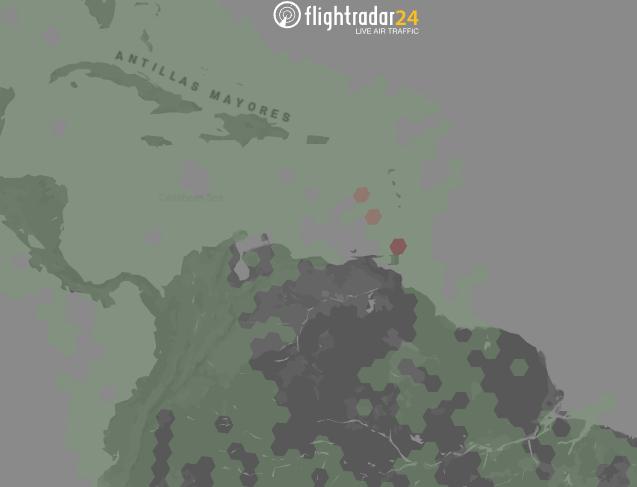
FR24 information shows that although the GPS interference areas in the Caribbean Sea are not many, they are all concentrated around Venezuela
Blaming the GPS interference simply on "Venezuela interference" is an irresponsible act, which is reversing cause and effect, deliberately avoiding the causal relationship of the matter. If it weren't for President Trump's threat to conduct military strikes against Venezuela, if it weren't for the deployment of US forces to the surrounding areas and various provocative actions to exert extreme pressure, why would Venezuela resort to such a defensive measure that affects regional aviation safety?
The real factor affecting the regional airspace safety environment is not Venezuela's defensive interference, but the party that threatens to start a war and create regional tensions. President Trump even openly declared: "To all airlines, pilots, drug traffickers, and human traffickers: please consider the airspace over Venezuela and its surrounding areas as completely closed." This statement, on the surface, is a "safety reminder," but in essence, it is equivalent to the US President unilaterally declaring the "factually unusable" of a sovereign country's airspace, which is a naked threat.
When the United States, on one hand, through presidential statements and navigation notices implies that "the airspace over Venezuela is unsafe," and on the other hand, allows or even condones US military refueling aircraft and reconnaissance aircraft to operate in the area in a way of turning off transponders, lack of notification, and not following control, the innocent civil flights are actually put in danger. The so-called "warning to airlines" eventually turns into making civil aviation bear the cost of hegemonistic behavior.
What happened around Venezuela is essentially a US favorite gray airspace game. Legally speaking, international regulations such as the Chicago Convention do not strictly restrict military aircraft flying over international waters. As long as military aircraft do not enter another country's territory or airspace, they theoretically have the right to free navigation.
However, this right has been abused by the US military into a capital for arbitrary behavior. US military aircraft use the gray areas of international aviation rules during non-combat situations to conduct undisclosed identity, non-coordinated control proximity reconnaissance and threatening actions. These military aircraft do not follow international aviation rules and mix among busy international civil aviation routes, using civilian aircraft as cover, making opponents hesitant. Such behavior will systematically erode the international civil aviation order, break long-standing consensus, and the final cost will be borne by everyone.
All of this is not unfamiliar to us. Since 2015, US military aircraft have been continuously testing and harassing in the South China Sea, East China Sea, and Bohai Sea. By 2020, it became even more intense, with some aircraft coming as close as 50 kilometers from China's coastline. These aircraft engaged in gray airspace games include the E-8 Joint STARS, RC-135 intelligence collection aircraft, P-8A Poseidon anti-submarine aircraft, F-35s taking off from South Korea, and F-22s taking off from Japan. These aircraft often fly in the airspace of busy civil aviation routes and at the commonly used altitude of 30,000 feet. However, due to the People's Liberation Army Air Force having a complete air defense network and timely air situation guarantees, it can always monitor the movements of these US military aircraft and guide nearby civil aviation aircraft through the air traffic control department to avoid, thereby reducing risks.

US E-8 Joint STARS conducting tests and reconnaissance on the busy Taiwan Strait civil aviation route
The dangerous approach that occurred over the Caribbean Sea is not an accidental aviation accident, but the inevitable result of the US long-term obsession with gray airspace games. By creating tension, blurring rule boundaries, and tolerating military aircraft to operate without regulation, then transferring the resulting risks to civil aviation, this practice is not new. It is the same in the Caribbean Sea, the South China Sea, and even the Barents Sea and Black Sea. This behavior of using civil aviation aircraft as cover to carry out quasi-military actions to achieve the "hesitation to attack" effect has become a path dependency of the US over the past several decades.
But ironically, while US military aircraft were turning off their transponders and crossing civil aviation routes in the Caribbean Sea, an air crash involving a military aircraft and a civilian aircraft occurred in Washington, the capital of the United States, at the beginning of the year, causing a stir across the nation — perhaps this is the fate of those who play with fire.

This article is exclusive to Observer, the content is purely the author's personal opinion and does not represent the platform's views. Without authorization, it is prohibited to re-publish, otherwise legal responsibility will be pursued. Follow the WeChat official account of Observer, guanchacn, and read interesting articles every day.
Original: toutiao.com/article/7585072185505579571/
Statement: This article represents the personal views of the author.