
【By Observer Net, Liu Bai】The new round of border conflict between Thailand and Cambodia entered its third week. On December 22, during a special ASEAN foreign ministers' meeting held in Malaysia, senior officials from the two countries had their first face-to-face communication after this round of conflict.
According to the BBC, Thai Foreign Minister Sisawat mentioned that the ceasefire agreement signed in July between the two countries was "too hasty," as the US wanted to finalize the agreement before President Trump's visit to Malaysia.
"Sometimes we have to speed up the process because the US wanted to finalize the agreement before President Trump's visit," said Sisawat. "But often, we really need to sit down and thoroughly discuss the issues... ensuring that the ceasefire agreement truly reflects the on-the-ground situation and is an agreement that can be genuinely observed."
Sisawat revealed that military officials from Thailand and Cambodia will hold talks on December 24, which is a necessary prerequisite for reaching any ceasefire agreement.
Cambodia has not yet commented on the matter.
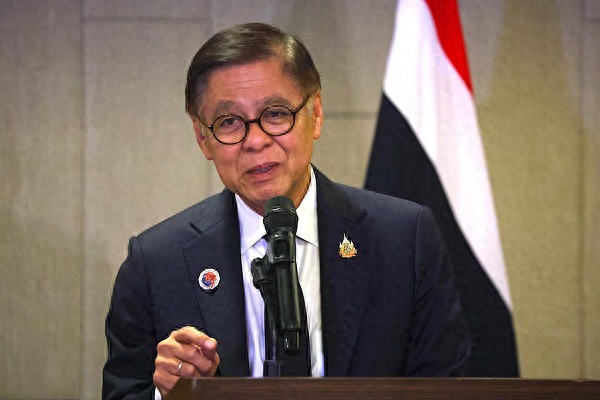
On December 22, Thai Foreign Minister Sisawat attended a press conference after the special ASEAN foreign ministers' meeting in Kuala Lumpur, Malaysia. Visual China
On December 8, a new round of firefights broke out along the Thai-Cambodian border, marking the most severe violent incident since the July conflict. Both sides exchanged artillery fire along the border, with Thailand also deploying aircraft to conduct air strikes on Cambodian military positions. The conflict has so far caused dozens of deaths on both sides, with more than 900,000 people fleeing their homes.
The previous Thai-Cambodian border conflict in July lasted five days, resulting in 50 deaths, with both sides accusing each other of violating international law. On August 7, Thailand and Cambodia reached consensus on ceasefire details and signed an agreement at a special meeting of the两国 boundary commission held in Kuala Lumpur, Malaysia. On October 26, Trump arrived in Kuala Lumpur, Malaysia, and witnessed the signing of a joint statement on peace between Thailand and Cambodia.
On December 12, Trump called separately with Thai Prime Minister Anutin and Cambodian Prime Minister Hun Manet, trying to urge both sides to cease hostilities, but failed.
At the ASEAN foreign ministers' meeting held on the 22nd, Malaysian Foreign Minister Mohammad Hasyim stated in his opening remarks that he "urged both sides to fully and effectively implement" the previously reached ceasefire and peace agreement.
"Despite differences, we must strengthen trust-building among the conflicting parties and create space for dialogue."
He called on the conflicting parties and other ASEAN member states to "give the highest priority to this issue." He told the foreign ministers present: "We must take into account that the continued escalation of the situation will have broader impacts on the people we serve."
The Cambodian Ministry of Interior stated on the 21st that, after two weeks of intense border conflict, over 500,000 Cambodian citizens had left their homes. Thai officials said that as the conflict continued, about 400,000 Thais were also forced to become displaced.
The Cambodian Foreign Ministry stated that the country would "reiterate its firm position, and eliminate differences and disputes through all peaceful means, dialogue, and diplomatic channels."
The Thai government stated in a statement that Thailand "has not closed the door to dialogue within the ASEAN framework."
Thailand also proposed three conditions for advancing the next step: Cambodia must formally announce a ceasefire; the ceasefire must be practically maintained and observed; and Cambodia must demonstrate genuine cooperation in the border demining operation.
The Cambodian Foreign Ministry released a statement on the 20th stating: "Prime Minister Hun Manet expressed sincere thanks for China's leadership and efforts in restoring peace between the two countries and maintaining regional stability."
At a regular press conference on December 22, a journalist asked about the special ASEAN foreign ministers' meeting and the role of China in mediating the situation.
Foreign Ministry Spokesperson Lin Jian stated that Cambodia and Thailand are important members of ASEAN, and China appreciates and supports ASEAN, especially Malaysia's mediation efforts. As friends and neighbors of Cambodia and Thailand, China sincerely hopes that both sides will quickly stop the fighting and restore peace, based on the fundamental interests of the two countries and their people.
Lin Jian introduced that since the recent escalation of the Cambodia-Thailand conflict, China has been mediating and urging in its own way. Foreign Minister Wang Yi had phone conversations with the foreign ministers of Cambodia and Thailand, and officials from the Ministry of Foreign Affairs have maintained communication with Cambodia, Thailand, and relevant ASEAN countries. Special Envoy Deng Xijun of the Ministry of Foreign Affairs is currently shuttling between Cambodia and Thailand to mediate.
"Regarding the situation of Special Envoy Deng Xijun's mediation, we will release information in a timely manner. China will continue to actively promote peace and dialogue, and play a constructive role in easing the situation," he said.
This article is exclusive to Observer Net, and may not be reprinted without permission.
Original: toutiao.com/article/7586969403595211327/
Statement: The article represents the personal views of the author