
【By Observer, Liu Bai】
Trump administration's blind expansion of artificial intelligence (AI) has brought energy consumption pressure, and the impact has spread from the tech community to ordinary voters, with some analysts saying it could affect the 2022 midterm elections.
As a loyal Republican voter, Reece Payton, a rancher in Hogansville, Georgia, said that when he and his family voted for members of the state public utilities commission in November, they had only one idea in mind — to make their position clear.
They were already angry about rising electricity bills, not to mention an additional $50 monthly fee charged by the local power company to cover the cost of a new nuclear power plant more than 320 kilometers away.
Especially when they heard that a data center might be built next to their ranch, they lost patience with Republican politicians who overly catered to AI industry interests.
"That was the first time I voted for a Democrat," said 58-year-old Payton.
The New York Times published a long article on November 30, pointing out that as natural gas prices rose, grid upgrades, and the massive electricity demand brought by the rapid expansion of the AI industry, electricity prices continued to rise across the United States, causing dissatisfaction among many people. Democrats have seized this democratic issue, promising to lower electricity prices and make data centers bear more costs, winning support from many Republican voters.
Especially in Georgia, Democratic candidates focused on the campaign strategy of "lowering electricity bills and requiring data centers to bear more costs," successfully attracting cross-party voter support and unexpectedly overturning the results in elections for the public utilities commission, and such scenes are unfolding in multiple places. With the 2026 midterm election approaching, Democrats plan to replicate this campaign strategy in more areas.
In some of the highest Republican-support agricultural counties in Georgia, Republican voters crossed party lines this month, helping two Democrats, Peter Hubbard and Alicia Johnson, win by a large margin and defeat the current Republican commissioners of the Georgia Public Service Commission.
Since 2007, none of the five-member committee responsible for regulating utilities and setting climate and energy policies has ever had a Democrat.
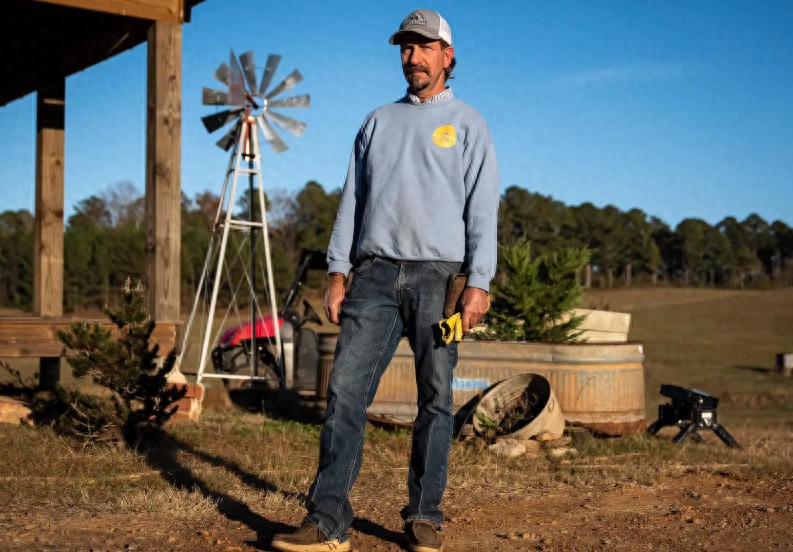
In the cattle ranch in Hogansville, Georgia.
Before hearing about the proposal to build a data center next to their ranch, the Payton family had never attended a city council meeting. Now, they have attended two meetings and will continue to attend.
Payton and his wife Tina emphasized that they do not oppose data centers, as long as they are built in industrial zones and the public can participate in decision-making.
"I think everything that happened here is because of Trump, because it was Trump pushing for the construction of data centers," Payton said. "Governor Kemp followed suit, and those in office just carried out Kemp's orders."
William, 56, also attended the city council meeting. He runs a car repair shop half a mile from the Payton family's home. He said he and his 58-year-old wife Barbara value the rhythm of rural life.
"What I want to hear when I go to sleep is the sound of crickets, not the hum of fans by the roadside," Barbara said.
When the utility commission election voting began, she instinctively chose a Republican candidate. Later, she and her husband learned about the data center plan.
"We might have made the wrong choice," she said.
Barbara Lehman, 66, is a loyal Republican voter, but her daughter Angela and granddaughter Shelby said she did not vote for a Republican this time.
"If the power company wants to expand its business, it should bear the cost itself, not the consumers," Lehman said. "Some people are already struggling."
This scene is playing out in many places across the country.
Democrats are seizing the growing concerns of the public about rising electricity bills and the expansion of data centers, which may become a template for the 2026 midterm election campaign strategy.
In Trapp County, which borders Alabama, thanks to voters like the Payton family, the winning Democratic candidate for the public utilities commission narrowed the 24-point lead that the Republican candidate had won in 2020 and 2018 to 10 points.
In Virginia, elected governor Abigail Spanberger promised to lower energy bills and require data centers to bear more costs during her campaign. In the state house election, there were also Democratic challengers who promised to curb the uncontrolled expansion of data centers and defeated Republican sitting legislators.
In New Jersey, elected governor Mikie Sherrill promised to declare utility costs a state emergency and freeze rates. In Memphis, state representative Justin J. Pearson vowed to oppose Elon Musk's xAI building a supercomputer in a predominantly African American community.
In August, the Tucson City Council canceled Amazon's planned data center project in the city of Arizona due to strong public opposition; in September, Google's data center project in Indianapolis was also halted due to public protests.
"Electricity bills have become the new egg prices (a metaphor for key issues of daily life)," said Charles Hua, executive director of the nonpartisan organization Powerlines, which aims to promote modernization of utility regulation and reduce electricity bills. "For politicians of all parties, this is a decisive moment — what measures do you have to lower electricity bills? I think consumers and voters are looking for someone who can take the lead in this area."

American citizens queuing up for relief food. Rising electricity bills are squeezing residents' monthly budgets.
Data centers have become a prominent issue in the rural suburbs of Atlanta. Trump hopes to accelerate the development of data centers in the race for AI supremacy. There are currently at least 26 data centers under construction within 60 miles (about 96 kilometers) of Atlanta, with another 52 in the planning stage.
However, some Georgia Republicans, including Representative Marjorie Taylor Greene, who will resign in January, have raised questions about the resource consumption of these facilities. Some residents say their wells have been damaged, and municipal water costs have increased.
The liberal group "Good Jobs First," which tracks corporate tax incentives, said the state does a poor job of disclosing data center subsidies. Staff members within the Public Service Commission also warned that if the commission approves Georgia Power's proposal to add nearly 10,000 megawatts of power to meet data center demands, residents' monthly bills could increase by $20 or more.
Since the outbreak of the Russia-Ukraine conflict in 2022, energy costs have risen across the United States. Utility companies have also launched costly projects to modernize the grid, improve infrastructure, and meet the expected surge in energy demand from data centers.
As electricity bills rise, more and more American users are defaulting on their payments, even being cut off from power.
According to the influential conservative policy group the American Legislative Exchange Council, Georgia ranks 35th in energy affordability nationwide, partly due to cost overruns and delays in the newly built Vogtle nuclear power plant in Wayne County.
Therefore, it is not surprising that State Attorney General Chris Carr and Secretary of State Brad Raffensperger called the November election results a referendum on "affordability."
"If you don't realize this, you're an idiot," Carr said bluntly.
Some Georgia Republicans have also warned that the results of the current commissioners of the Public Service Commission, Tim Echols and Fitz Johnson, who lost by 25 percentage points, should not be overinterpreted.
"I think this is completely an exception," said State Senator Greg Dolezal. The election result is not representative, and besides, Trump also won Georgia in last year's election.
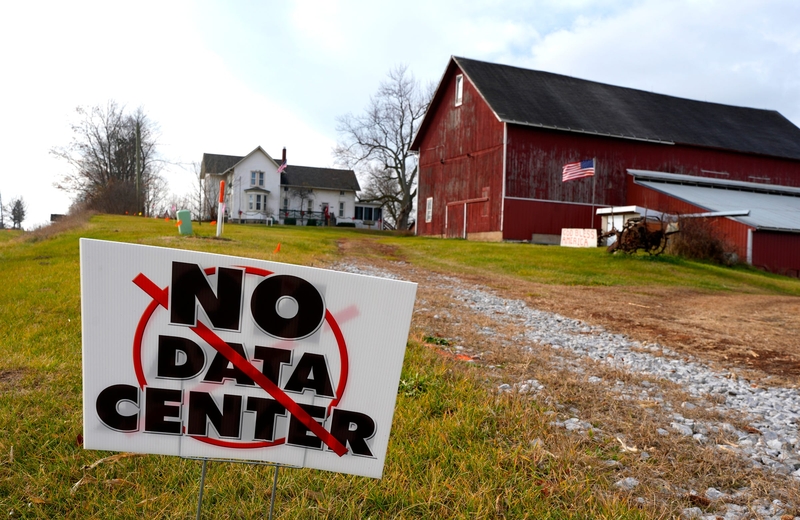
One of the protest signs seen in residential areas near Michigan Avenue in Saline, Michigan on November 21. Most residents in the area oppose the data center development plan. IC Photo
It is worth noting that in the past two years, the United States has pushed forward rapidly in the field of AI: companies like OpenAI, Google, and Meta have continuously launched larger-scale large models, while Microsoft, Amazon, and NVIDIA have invested hundreds of billions of dollars to expand data centers and purchase accelerators. The White House has also viewed AI as a national strategy, requiring government agencies to accelerate adoption and develop industry standards. However, this ambitious wave of technological progress is forming a sharp contradiction with the actual power generation and transmission capacity of the United States.
One of the most prominent examples occurred in Northern Virginia. This is the world's largest cluster of data centers, but due to the explosive growth of computing power demand, local grid operators warned that the load is approaching the limit, forcing them to delay multiple data center connection plans.
Similar situations have also occurred in Georgia, where the power company Georgia Power reported that the new demand caused by data centers and electric vehicle factories is three times the expected amount, forcing them to restart coal-fired units ahead of schedule to avoid power shortages.
In Texas, due to the continuous rise in demand from AI-driven data centers, and the volatility of renewable energy being unable to meet round-the-clock loads, the electricity regulatory agency has issued multiple capacity warnings, and some companies have even started to build their own natural gas power plants to "self-rescue."
In May of this year, billionaire Elon Musk admitted in an interview that as the technology industry builds increasingly larger data centers, AI development may encounter power generation problems by mid-2023.
He revealed that his AI startup xAI is planning to build a gigawatt-level facility in Memphis, Tennessee, which will be completed in six to nine months. According to data from the U.S. Department of Energy, a gigawatt of power capacity is equivalent to the power generation scale of a typical nuclear power plant in the United States.
Musk also said that China is building much more power generation capacity than the United States.
"China's power generation looks like a rocket entering orbit, while the U.S. power generation is stagnant," said the CEO of Tesla.
This article is exclusive to Observer, and any reproduction without permission is prohibited.
Original: toutiao.com/article/7578807579464466979/
Statement: The article represents the views of the author.