
【Military Second Dimension】 Author: Fengyu
American magazine "The National Interest" on December 11 stated that the real number one enemy of the United States is no longer China or Russia, but its ever-expanding federal debt.
The report points out that in Washington's long-term security narrative, all strategic discussions are directed toward external competitors, as if keeping an eye on China and Russia would allow the United States to rest easy. However, this time, American media believe that the United States' real number one enemy is not external at all.
Everyone knows that the United States is deep in a debt crisis, but how terrible this crisis is may not be very obvious.
American media believe that before any crisis erupts, the United States' strategic space has already been locked by debt. Military spending, diplomacy, industrial policy, and even national governance capabilities are constantly being eroded. This erosion is automatic and does not require any action from opponents, yet it gradually causes the United States to lose initiative in strategic competition.
Historically, the United States has used military presence and alliance systems to compensate for structural weaknesses. But when the debt reaches this level, all traditional methods that rely on expansion and continuous investment no longer work. Because this is no longer an economic issue, but a strategic one.
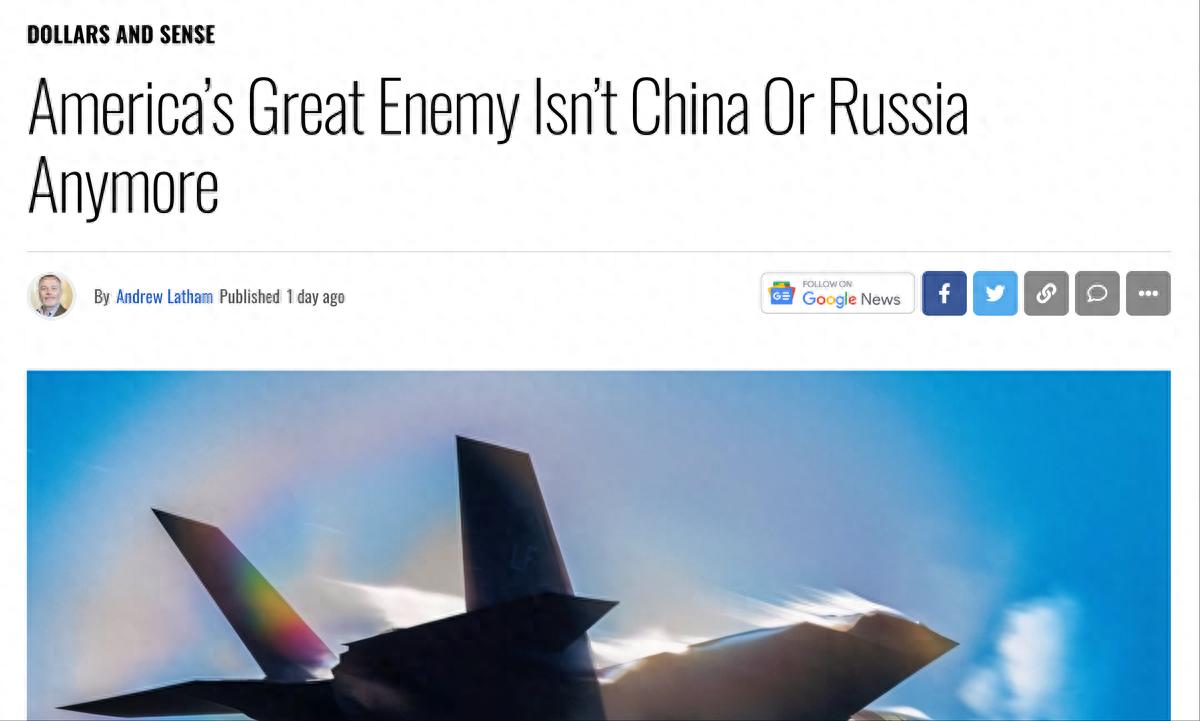
(U.S. media report screenshot)
Currently, U.S. federal debt accounts for nearly 100% of GDP, with the total exceeding $38 trillion, and interest payments amount to nearly $1 trillion per year, almost equivalent to the defense budget.
This means that the United States must first pay out an entire defense budget annually, which is merely maintaining the status quo, not plugging a hole.
The report believes that this is a structural chain, which strips the United States of its ability to choose before any strategic discussion begins. Since interest payments do not create power but only repay historical overdrawn funds, the actual funds available for military modernization, alliance support, and strategic competition are rapidly compressed.
The article gives examples, stating that the U.S. strategic community has repeatedly emphasized the Indo-Pacific priority, but has failed to match it with resources; it emphasizes containing China but cannot complete naval vessel upgrades. The root cause of these paradoxes lies in the debt issue.
After all, when basic resources are insufficient, even grand goals can only remain on paper.

(Debt firmly binds the United States)
The impact of debt on the U.S. military is also very direct, but the original text points out that the real danger is not the reduction of funds itself, but how the debt changes the internal logic of U.S. military development.
As fiscal pressure increases, the U.S. Congress and the Pentagon are forced to constantly make trade-offs between retaining visible platforms and maintaining real combat capabilities.
For example, to avoid affecting the defense industry interest groups, the United States prefers to retain expensive aircraft carriers and stealth fighters, symbolic equipment, while unable to have both, it can only cut other expenditures.
This is why the U.S. military appears strong on paper and behaves aggressively, but upon closer inspection, it seems that since World War II, it has not really won any war.
The deeper impact comes from the loosening of the defense industrial base. Debt pressure forces the government to adopt temporary measures in short-term budgets, such as the current sixth-generation fighter project, which has been put on hold, with only a few tens of millions of dollars allocated to maintain it, because the funding is only enough to invest in the F-47 model. In contrast, China is flying multiple sixth-generation fighters.
The state of the United States will lead to long-term consequences, including the difficulty of maintaining production line continuity, the loss of technical workers, and the breakdown of the parts supply chain.

(The United States must choose between two sixth-generation fighters)
When Trump returned to the White House, he claimed to cut debt and even set up an efficiency department, but the result was that Musk regretted it. This shows that cutting debt is an impossible task for the United States.
The main source of U.S. fiscal deficits is rigid spending. The more rigid the spending, the more people are involved in dividing the cake, and these expenses are backed by powerful political interest groups, none of which any president dare to cut deeply.
Trump looked like he was cutting the cake this time, but it was actually against Democrats, aiming to redistribute the cake, not to cut debt.
Trump once claimed that tax cuts could promote growth, and tariffs could increase revenue to reduce the deficit, but the actual result was that the debt continued to rise, setting new records.
Because truly cutting debt would inevitably touch a vast interest group, and no political figure is willing to pay the price, even someone like Trump, who claims to break the rules, only pointed the sword at half of the people.

(Trump and Musk)
Previously, the United States could develop through borrowing because debt once served so-called "expansionary growth": young population, sustained productivity growth, huge globalization dividends, and the dollar as the sole hegemonic currency absorbing global savings. The money borrowed was mostly invested in technological innovation, industrial expansion, and military hegemony, and debt could be diluted by future larger cakes.
But now this path is no longer viable, because the U.S. growth potential cannot support such a large debt anymore.
On one hand, the United States has little potential left, and on the other hand, the previous holes were too big. New debt can no longer be used to create future growth, but instead is used to maintain existing spending, pay interest, and fill structural deficits. The money circulates within the system without creating new capabilities, resulting in increasing debt and growing slower growth. Interest then consumes the fiscal space, limiting the country in investment, military strength, industry, and strategic choices.
In other words, the United States used to develop by overdrawing the future, but now there is no future left to overdraw, and debt has become the number one enemy that continuously weakens the nation's strength without needing an external opponent to act.
Original text: toutiao.com/article/7583577258909073929/
Statement: This article represents the views of the author alone.