
【By Observer Net, Chen Sijia】On December 14 local time, Ukrainian President Zelenskyy arrived in Berlin, Germany, for a two-day consultation with U.S. envoys and European leaders. According to a report by Bloomberg News, Zelenskyy said on the evening of the 15th that he had reached an agreement with the United States, and the U.S. has committed to providing Ukraine with legally binding security guarantees to advance the peace talks between Russia and Ukraine.
The website Politico cited U.S. officials' information, stating that President Trump is willing to provide NATO Article 5 collective defense provisions to Ukraine, but this is also a "last chance" from the Trump administration: Ukraine must accept the current conditions, or there will be no more such "generous" proposals.
Zelenskyy met with U.S. Middle East envoy Wittkov and Trump's son-in-law Kushner in Berlin. After the meeting, he said, "We have now received the commitment from the U.S., they are prepared to provide security guarantees similar to NATO Article 5." He expects the U.S. to next consult with Russia, and Ukrainian negotiators may visit the U.S. again this weekend for talks.
Zelenskyy said that when the final text of the peace agreement is "closer to completion," he may meet with Trump.
Zelenskyy also posted on the social platform Telegram: "Before any military action is taken on the battlefield, the military and the public need to fully understand the specific content of the security guarantees. We are working to formalize these arrangements, and we have made progress."
German Chancellor Merkel said at a press conference that the U.S. envoy proposed legally binding and material security guarantees, which is worth attention. "Ukraine can not only defend itself independently, but also rely on the support of its allies, which is good news," she said.
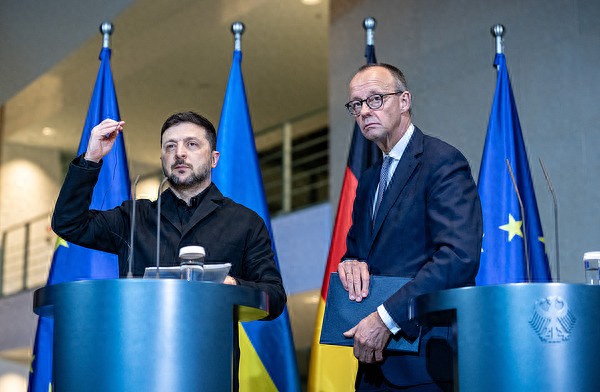
On December 15 local time, Zelenskyy and Merkel attended a press conference in Berlin, Visual China
Leaders of Germany, Denmark, Finland, France, Italy, the Netherlands, Norway, Poland, the UK, Sweden, and the EU issued a joint statement welcoming the significant progress made by the U.S. in the peace negotiations, pledging to assist Ukraine in ending the conflict, as well as helping to rebuild the Ukrainian army and deter Russia through the U.S.-backed multinational force in Europe.
The statement said that Ukraine should maintain an army of 800,000 people during peacetime. A U.S.-led ceasefire monitoring and verification mechanism would provide early warnings to Ukraine, and a "conflict elimination mechanism" should also be established. European leaders stated that the U.S. and Europe would provide Ukraine with legally binding commitments, taking measures in case of future conflicts to restore Ukraine's peace and security.
However, Bloomberg pointed out that this statement does not make a common defense guarantee, but rather states that the relevant security measures "may include the use of armed forces, intelligence and logistics support, as well as economic and diplomatic actions."
Poland's Prime Minister Tusk posted on the social platform X: "Today I felt for the first time that everyone is acting like allies in the same camp... I heard for the first time from the U.S. representative that the U.S. will provide Ukraine with security guarantees, making Russia believe that if they attack Ukraine again, the U.S. response will be military action."
At around late on the 15th local time, Trump said at the White House that he had spoken with Zelenskyy and European leaders, "I think we are closer to our goal than ever before. We'll see what else we can do." When asked whether the proposal for security guarantees had a time limit, Trump responded, "The deadline is when we complete our task."
Trump also revealed that he recently spoke with Russian President Putin, but did not disclose the exact time. He claimed, "I think President Putin actually wants to see all of this end. We have had friendly negotiations with Russia, and I think they want to return to a more normal life."

On December 15 local time, Trump gave a speech in the Oval Office at the White House, Visual China
A senior U.S. official told Politico, "The basis of the agreement is basically to establish very strong guarantees, similar to NATO Article 5. Such guarantees won't always be on the negotiation table, but if we can reach an agreement in a good way, we can provide these guarantees now."
Zelenskyy said before meeting with the U.S. envoy on the 14th that he was prepared to give up joining NATO in exchange for the U.S. and Europe providing security guarantees to Ukraine.
Politico analyzed that the latest U.S. proposal may be aimed at easing the concerns of Ukrainian and European leaders about security guarantees. This is the strongest and most explicit security commitment proposed by the Trump administration for Ukraine, but it also implicitly contains a "last chance" for Zelenskyy: Ukraine must accept the peace agreement, otherwise there will be no more such "generous" proposals.
Although the U.S. and Ukraine have made progress on the issue of security guarantees, Zelenskyy said on the 15th that the negotiations have not yet reached consensus on territorial issues, nor have they discussed whether to resolve related issues through a referendum. He called on the U.S. to continue mediating on this "painful" issue.
A U.S. official said that the U.S. has already proposed some "thought-provoking" ideas to Zelenskyy. An official revealed that a proposal regarding the division of control over the Zaporozhye nuclear power plant between Russia and Ukraine is being considered, which would allow both countries to receive half of the power supply from the nuclear power plant, but the plan has not been finalized yet.
Politico added that U.S. officials are optimistic about the prospects of the peace negotiations, believing that Russia would accept the agreement. Another U.S. official said, "We believe Russia will agree to these conditions that make Ukraine strong and free. Russia expressed openness to Ukraine joining the EU in the final agreement."
However, Reuters quoted informed officials saying that the U.S. is pressuring Ukraine to withdraw its troops from eastern Donetsk, which amounts to requiring Ukraine to make major concessions, possibly causing strong backlash within Ukraine.
Regarding the peace talks between Russia and Ukraine, Russian President's Press Secretary Peskov said on the 15th that ensuring Ukraine does not join NATO is one of the "key cornerstones" in the current negotiations and is worth further discussion. He pointed out, "President Putin remains open to serious peace and mediation, and will not accept any attempts to delay time or artificially create breathing space."
When asked whether the talks could end before Christmas as Trump hoped, Peskov replied that setting a deadline for resolving the Ukraine crisis is futile, "I won't predict the exact time." He added that Russia does not want the talks to proceed in a "megaphone mode" of public statements and media pressure.
Russian Deputy Foreign Minister Ryabkov also accepted an interview with ABC, stating Russia's position in the negotiations. Regarding territorial issues, Ryabkov said that Russia will not make any concessions regarding control over Crimea, Donetsk, Luhansk, Zaporozhye, and Kherson.
Regarding Western countries' security guarantees for Ukraine, Ryabkov emphasized that Russia will not agree to any agreements allowing NATO forces to be stationed in Ukraine, even if these deployments are part of the security guarantees. He said, "We will never agree, accept, or tolerate NATO forces stationed on Ukrainian territory under any circumstances."
This article is exclusive to Observer Net, and without permission, it cannot be reprinted.
Original: toutiao.com/article/7584404758614622760/
Statement: The article represents the personal views of the author.