
However, the U.S. "SpaceNews" noted on December 7 local time that the House hearing, which focused on the "rise of China's space program," turned into a broader criticism of the U.S. overall space policy. Among them, NASA's current manned mission plan aimed at returning to the moon has also been questioned.
These members of Congress, especially Democrats, were dissatisfied with the Trump administration's plan to cut NASA staff and budgets. Some expressed confusion: "I completely don't understand how we can talk about competing with China while hollowing out our own research system?"
The report said that in addition to criticizing the Trump administration's constraints on U.S. scientific spending, many industry insiders also questioned NASA's long-term planning for the "Artemis" lunar landing program, believing that this plan is highly likely to fail to be completed on time. These pessimistic professionals about NASA's lunar landing plan also do not deny that China is expected to achieve its first manned lunar landing before 2030.
The witnesses who attended this hearing compared the uncertainty of the U.S. plan with China's steady progress and pointed out that China's system advantages ensure the long-term stability of its projects. "When the plan is reasonable, it is important to stick to the plan, and China is sticking to a reasonable plan," said Mike Griffin, who once led NASA: "But we are sticking to an unreasonable plan."
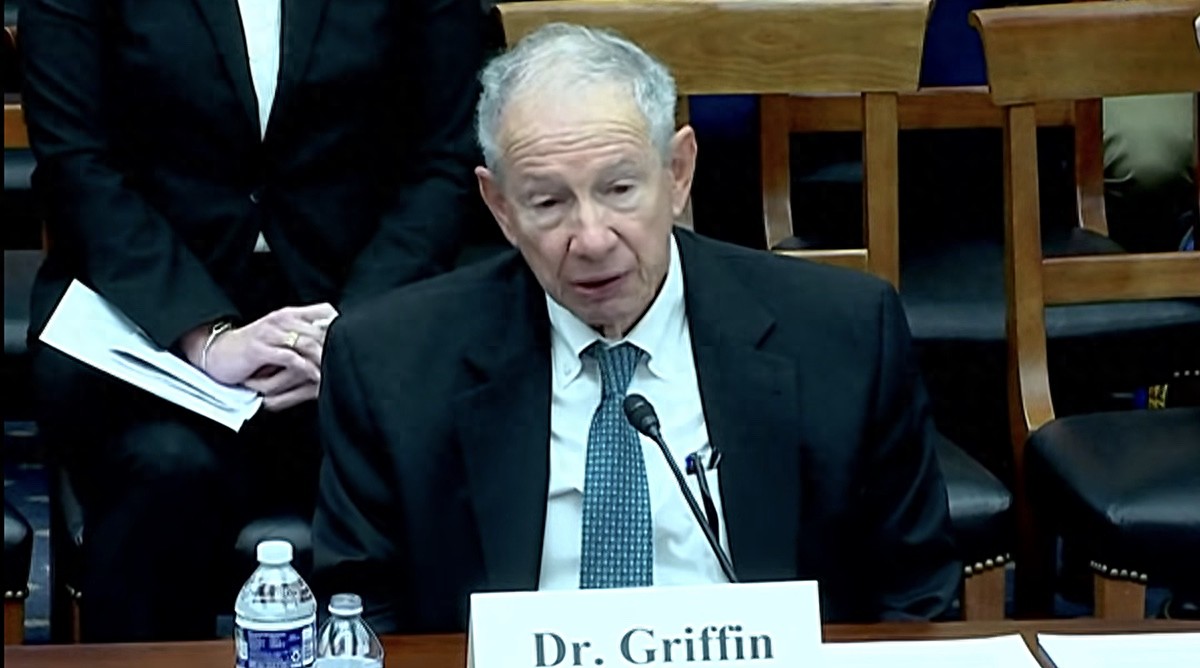
Video screenshot of former NASA director Mike Griffin
"When we explore the universe beyond Earth, we should ask ourselves: Will humanity carry forward America's 'economic and political freedom values' or China's values?" said Mike Haridopolos, chairman of the Subcommittee on Space and Aeronautics, a Republican member of the U.S. House of Representatives from Florida, in his opening remarks.
"I will not allow the moon exploration or space leadership to be handed over to China," said Valerie Foushee, a senior member of the Subcommittee on Space and Aeronautics, a Democratic member of the U.S. House of Representatives from North Carolina, who made a tough statement: "This is a critical moment."
She and other Democratic representatives used this opportunity to criticize the Trump administration's policies, including NASA's staff cuts and budget reductions, believing these actions weakened America's ability to compete with China. Foushee believes that the weakening of the federal science and engineering workforce and serious underinvestment in R&D have become key concerns and asked: "Is this a successful strategy?"
Zoe Lofgren, a Democratic member of the U.S. House of Representatives from California, claimed that China poses a real threat to the United States' long-standing undisputed global leadership in space. "Equally important, we must double our efforts to support and manage a strong and robust space program," she said.
She contrasted China's steady progress in space with the ongoing budget cuts and facility closures at NASA's Goddard Space Flight Center. "I completely don't understand how we can talk about competing with China while hollowing out our own research system?" she said.

Live scene of the hearing, U.S. House Committee on Science, Space, and Technology X account
According to "SpaceNews", the "turmoil" described by these U.S. congressmen directly affected one of the hearing witnesses - Patrick Besha, founder of Global Space Group, who mentioned during his testimony about China's space capabilities that he joined NASA nearly 20 years ago, specifically responsible for Chinese affairs.
When Foushee asked why he was no longer employed by the agency, Besha said he was affiliated with NASA's Office of Technology, Policy, and Strategy, which was closed in March this year. "Myself and about a dozen colleagues were laid off (RIF’ed)." He said, using the abbreviation for "reduction in force."
"This is simply perplexing, and I think very concerning," Foushee responded.
It was reported that although some lawmakers focused on NASA's recent turmoil, other witnesses sharply criticized NASA's long-term planning for the "Artemis" lunar landing program.
"The issue before us is not China's rise; we cannot control what China is doing," said former NASA director Griffin: "We can only control what we are doing. As far as our current efforts are concerned, I have to say that if we can achieve 'mediocrity,' that would be a success."
He pointed out that the current NASA architecture relying on SpaceX's Starship to execute the "Artemis 3" lunar mission is not feasible, as the mission may require numerous Starship flights to refuel in low Earth orbit. "The Artemis 3 mission and subsequent missions should be canceled, and we should start over from scratch," he said.
In fact, Griffin's criticism is not new. In January this year, he had previously testified before the same subcommittee, stating that NASA's current plan was "too complicated" and "extremely unlikely to be completed on time."
Now, he cited his previous testimony and said that opposition to NASA's current structure is growing. He mentioned the testimony of another former NASA administrator, Jim Bridenstine, given in September this year in the Senate, as well as the recent assessment by NASA's Aerospace Safety Advisory Panel (ASAP), which all indicate that the Artemis 3 mission could face delays of several years.
"SpaceNews" reported that during this hearing, other witnesses did not directly address the technical structure of the Artemis 3 mission, but they also did not question the possibility of China achieving its first manned lunar landing before 2030.
When asked whether NASA could send astronauts back to the lunar surface before China, Besha answered "maybe"; Clayton Swope of the Center for Strategic and International Studies (CSIS) said "worried," Dean Cheng of the Potomac Institute said "very pessimistic," and Griffin answered "no possible way."
These people who attended the hearing compared the uncertainty of the U.S. plan with China's steady progress, and Dean Cheng believed that China's system played a significant role in the long-term stability of the project.
"When the plan is reasonable, it is important to stick to the plan, and China is sticking to a reasonable plan," Griffin said: "But we are sticking to an unreasonable plan."

Chongqing, September 28, 2024. The Third Space Suit Technology Forum, hosted by the China Astronaut Research and Training Center, was held. At the opening ceremony, the Office of Manned Spaceflight Engineering of China's Manned Space Program announced a public naming campaign for the lunar suit and publicly revealed the appearance of the Chinese lunar suit. VCG
In recent years, China's lunar exploration plan has progressed smoothly, and its manned lunar landing development has been steadily advancing, having conducted multiple lunar orbiting and sample collection missions, laying the foundation for China's first manned lunar landing before 2030.
On July 12, 2023, Zhang Hailian, deputy chief designer of the China Manned Space Program Office, disclosed at the Ninth China (International) Commercial Aerospace Forum held in Wuhan that China plans to achieve manned lunar landing for scientific exploration before 2030, and then explore the construction of a lunar research experimental station, conducting systematic and continuous lunar exploration and related technology verification tests.
On November 21, 2024, Zhou Jianping, general designer of China's manned spaceflight program, stated at the Sixth Manned Spaceflight Academic Conference held in Shenzhen that the key technology breakthroughs and in-depth论证 for China's manned lunar exploration project have been completed, and the project has now fully entered the initial prototype development phase.
This April 24, Chen Zhongde, head of the China National Space Administration, stated that China's lunar exploration program has always adhered to the principles of equality, mutual benefit, peaceful use, and win-win cooperation, sharing development achievements with the international community. China will continue to open up international applications for lunar research samples, and we look forward to more scientific discoveries for global scientists, jointly expanding human cognition and benefiting all humankind.
Regarding the repeated hype by the U.S. about the so-called "China space threat" issue, Foreign Ministry Spokesperson Mao Ning previously stated that China has always adhered to the peaceful use of outer space, opposed military competition in outer space, and opposed the weaponization of outer space. China has no intention of engaging in a "space race" with any country, nor does it seek so-called "space superiority." The U.S. openly defines outer space as a "theater of operations," continuously expands its outer space military forces, establishes outer space military alliances, and promotes the militarization of outer space, seriously threatening the common security and development rights of countries in outer space. China urges the U.S. to stop spreading irresponsible statements, stop expanding military buildup in outer space, and effectively maintain the lasting peace and security of outer space.
This article is an exclusive article of the Observer, and it is not allowed to be reprinted without permission.
Original: toutiao.com/article/7581481132185616937/
Statement: This article represents the views of the author.