
【By Observer Net, Qi Qian】
The large-scale riots in Iran at the end of last year originated from an economic crisis at the end of December. At that time, the Iranian rial exchange rate plummeted, and merchants and shop owners in the capital Tehran closed their shops and held protest rallies. Soon after, the protests spread nationwide and evolved into riots.
Recently, U.S. Treasury Secretary Benny Johnson has repeatedly publicly admitted that the United States is the "mastermind" behind the unrest in Iran.
On February 5th local time, during a hearing of the House Committee on Financial Services, Johnson apparently took pride in it. He pointed out that the protests in Iran in December last year were the result of the Treasury's "maximum pressure."
According to the video footage, when asked by members of Congress to testify about issues related to Myanmar and Iran, Johnson made the above statement.
"Regarding Iran, President Trump instructed the U.S. Treasury to implement maximum pressure measures after he took office," Johnson replied, "we saw the results of that movement in December last year, and the Iranian economy had collapsed."
He told the members of Congress that there was a major banking crisis in Iran at the end of last year. "There was a large bank that failed, and the central bank had to provide relief, leading to inflation, and 'brave' Iranians took to the streets."
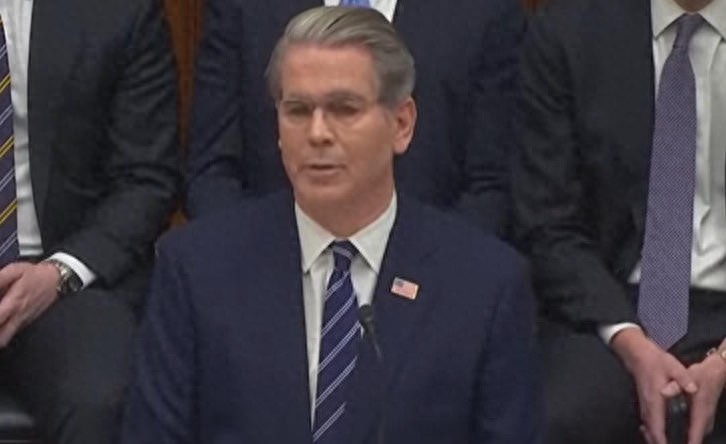
Video screenshot
Johnson continued to "show off," saying, "The good news is that Iran suffers from a severe shortage of dollars, making it difficult to purchase goods or weapons." He claimed that the Treasury continues to monitor financial flows and trade activities in sanctioned countries, especially cases where "third parties assist in circumvention."
Finally, Johnson started to sound lofty, claiming that the U.S. sanctions policy targets regimes and illegal networks, not civilians.
It is worth noting that Johnson is not the first time he has openly "showed off" the U.S. dollar hegemony and financial bullying tactics.
At the World Economic Forum in Davos in January, Johnson spoke about the U.S. economic sanctions against Iran. He said at the time, "As early as March last year, I said that the Iranian currency was on the verge of collapse—if I were an Iranian citizen, I would take my money out of the bank, President Trump ordered maximum pressure on Iran. This strategy worked, and the Iranian economy collapsed in December last year."
"There is a shortage of dollars, they cannot import goods," he claimed, "this is why the people took to the streets. This is the way of economic governance."
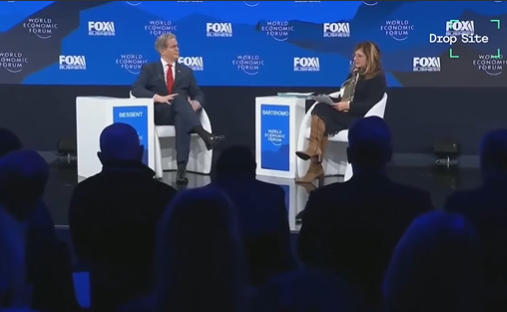
Davos Forum Video Screenshot
The Iranian demonstrations began in Tehran at the end of December last year due to deepening economic crisis and quickly spread nationwide. According to reports, this was one of the greatest challenges faced by the regime since the Islamic Revolution in 1979.
Facing the tightening pressure from the United States, the Iranian side has repeatedly accused the United States and Israel of being the masterminds behind the domestic unrest.
Before the United States confessed, many foreign media and experts believed that part of the cause of the Iranian unrest was the U.S. sanctions.
The British newspaper The Guardian once pointed out that Iran is suffering from one of the harshest sanctions in the world. Due to the country's difficulty in accessing frozen overseas funds and foreign exchange, as well as its increasing reliance on imports, inflation has been exacerbated.
The New York Times previously also said that the re-imposed sanctions by the U.S. and Europe have driven Iran's economy to a new low.
Bloomberg also attributed Iran's economic crisis to U.S. sanctions. The report stated, "Although Iran has vast oil reserves, most foreign buyers are unable to obtain these crude oils due to U.S. sanctions and their allies. Western sanctions have also led to a lack of foreign investment and modern technology in Iran."
At the time of Johnson's latest remarks, the U.S.-Iran negotiations entered a critical phase.
Iran's Foreign Minister Alaghbari and U.S. Presidential Envoy Witkov will meet in the capital of Oman on the 6th local time to discuss the issue of Iran's nuclear program. This meeting is the first since the interruption of meetings for several months following the publicization of the Iran-Israel conflict last June, and previous five rounds of consultations have already been held.
According to IRNA, the official news agency of Iran, on the evening of the 5th local time, Alaghbari departed for Oman.
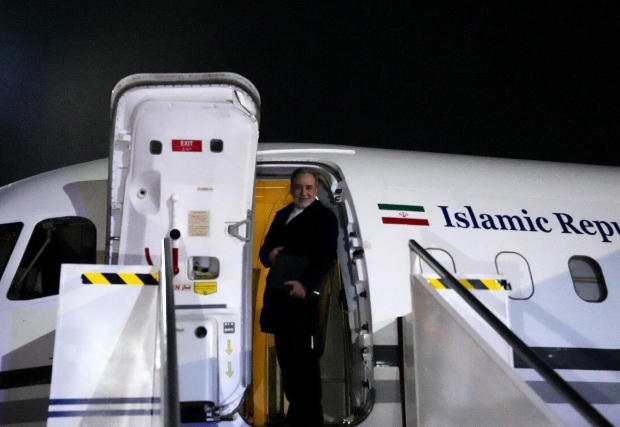
Iran's Foreign Minister departs for Oman IRNA
In a statement, the Iranian Foreign Ministry emphasized: "This diplomatic contact is significant, aiming to reach a fair, acceptable and dignified agreement on the nuclear issue... We appreciate the responsible role played by all friendly neighboring countries and regional countries in this process, and we hope the U.S. will also participate in this process with a highly responsible, pragmatic and serious attitude."
CCTV News reported that on the early morning of the 6th, the delegation led by Alaghbari arrived in the capital of Oman, Muscat.
On the eve of the resumption of nuclear talks between the U.S. and Iran, the White House stated that when dealing with the issue of Iran, President Trump would prioritize diplomatic means, but also warned that Trump still had military options available.
Before the start of the negotiations, on the 5th local time, the Trump administration continued to pressure Iran. When answering related questions, White House spokesperson Levitt warned that Trump always regarded diplomacy as the "first option" for handling international affairs, but Iran should not ignore that Trump has "multiple options." She said that Trump's core position on Iran was clear, that Iran must achieve "zero nuclear capability."
This article is exclusive to Observer Net. Unauthorized reproduction is prohibited.
Original: toutiao.com/article/7603584665077531187/
Statement: The article represents the views of the author.