
【By Guan察者网, Liu Bai】
EU's commitment to reduce reliance on critical minerals from China is facing a significant gap between reality and goals.
According to a report by the UK's Financial Times, the European Court of Auditors (ECA) warned on February 2 that despite signing multiple agreements, the EU's efforts to reduce its dependence on various critical minerals from China are failing, neither improving domestic supply capabilities nor increasing imports from other countries to achieve so-called diversification.
The European Court of Auditors is one of the five major institutions of the EU, mainly responsible for auditing the accounts of the EU and its institutions, reviewing financial status, and ensuring compliance with fiscal management.
The report mentions that the US, the EU, and others are currently competing to build alternative supply chains, aiming to bring part of the mining and metal smelting industries back home, while seeking agreements with overseas partners to ensure long-term supply of critical minerals.
The EU's 2024 "Critical Raw Materials Act" sets a plan aimed at increasing the domestic production of 26 strategic raw materials, reducing excessive reliance on imports from countries such as China. These raw materials include lithium, antimony, tungsten, copper, and rare earth elements, which are essential materials for manufacturing semiconductors, wind turbines, and shells.
The act sets non-binding targets for 2030: At that time, the EU's domestic mining volume should reach 10% of its own demand, the recycling rate of such materials should be increased to 15%, and the domestic processing capacity for each strategic key raw material should meet 40% of annual demand.
However, the report points out that the EU's measures to diversify imports have not yielded significant results, domestic production is constrained by bottlenecks, and recycling is still in its early stages. In this context, many EU-supported projects may struggle to achieve results on schedule.
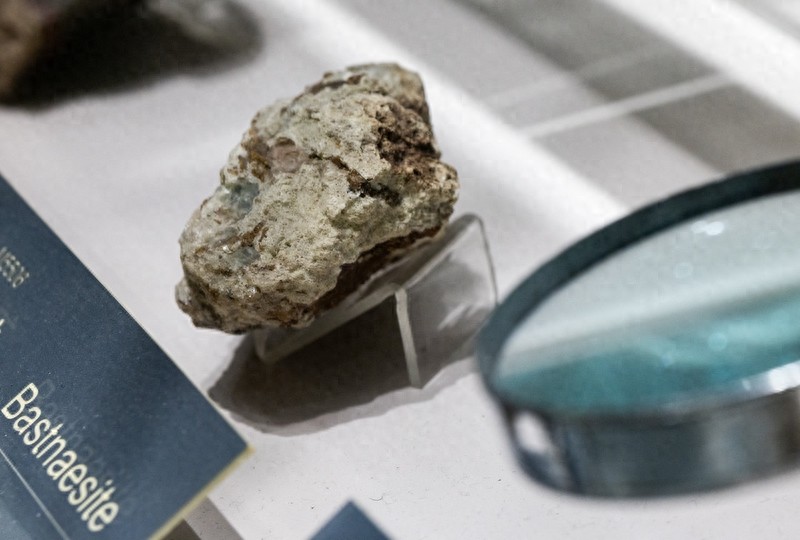
On October 14, 2025, Beijing, the fluorite cerite sample displayed at the China Geological Museum, used for extracting cerium, lanthanum, neodymium, and other elements in the rare earth industry. IC Photo
The European Court of Auditors stated in the report that the EU's "raw material policy, although set a strategic direction, is based on an incomplete foundation." The report pointed out that the EU's goals for domestic raw material processing, mining, and recycling "are non-binding... and lack reasonable basis."
Between 2021 and June 2025, the EU has signed raw material strategic partnership agreements with 14 countries including Ukraine and Canada. However, the report found that trade data showed that although the EU imported 13 types of critical raw materials from these countries increased between 2020 and 2024, another 13 types of critical raw materials declined.
The European Court of Auditors found that among the 26 minerals designated as critical, 10 are completely dependent on imports. These include rare earth metals needed in the aerospace, electric vehicle, and renewable energy sectors, which are neither mined nor processed within the EU.
"The outlook is not optimistic," the report said, "according to the current situation, among the 26 materials used for energy transition, 7 have a recycling rate between 1% and 5%, while 10 have no recycling at all." The institution attributes this to the lack of incentive measures for specific materials.
"The EU plans to cover 40% of consumption with domestic processing capacity by 2030, but related processing capacity is closing down, partly because high energy costs severely weaken industrial competitiveness."
Additionally, the raw material strategic partnerships the EU has reached with other countries have not yet shown any benefits.
An EU official pointed out that the data covered by the report only goes up to 2024, the year when the Critical Raw Materials Act came into effect, and the issues highlighted in the report are already being addressed by the European Commission.
In December last year, the European Commission proposed a new plan called "RESourceEU" to accelerate the Critical Raw Materials Act, but many details remain unimplemented or unpublished. The plan includes export restrictions on rare earth waste to counter China's near-monopoly, and a 3 billion euro investment plan to accelerate certain strategic material projects.
Kertu Pentsi-Rosimannus, the former Estonian finance minister who led the report, said, "Even if the EU does everything right, trade distortions and geopolitical crises could still make it difficult to obtain necessary materials."
Developing new mines is time-consuming and requires substantial capital, with projects often facing delays and cost overruns. It can take decades from discovering a mineral deposit to the start of a new mine.
Brussels has identified 75 strategic projects and provided them with a "fast track" for approval and financing, but Rosimannus pointed out that many of these projects are "unlikely" to be completed on time, possibly delaying the EU's 2030 domestic supply targets.
The crucial midstream link, which involves converting raw materials mined into products usable by companies like car manufacturers, may come online faster, but it has low profit margins and high energy consumption. Chinese companies have kept prices lower than Western competitors in both mining and midstream processing.
This report was released as EU officials will visit Washington this week to attend a key mineral summit hosted by the US, aimed at reducing reliance on China.
On February 3, the US Interior Secretary hinted that about 30 countries are interested in joining the US-led club of key mineral ally partners. This organization establishes tariff exemptions, resource exchanges, and minimum price mechanisms for mineral resources, aiming to counter China's control over the prices of critical minerals such as lithium, nickel, and rare earths.
Meanwhile, the EU also plans to propose to the US to build a key mineral partnership, with the plan to sign a memorandum of understanding within three months and develop a "strategic partnership roadmap," covering joint development of mineral projects, setting up price support mechanisms, and building secure supply chains, all targeting China's market dominance.
On February 3, Lin Jian, spokesperson for the Chinese Foreign Ministry, presided over a regular press conference. A reporter asked, the US is expected to launch a key mineral reserve plan, initially funded with 12 billion dollars. This move comes as Washington seeks to reduce its reliance on resources such as rare earths.
In response, Chinese Foreign Ministry spokesperson Lin Jian stated that China's position on maintaining the stability and security of the global supply chain for critical minerals has not changed, and all parties have a responsibility to play a constructive role in this regard.
This article is exclusive to Guan察者网 and may not be reprinted without permission.
Original: toutiao.com/article/7602837553905009188/
Statement: This article represents the personal views of the author.