
【By Observer Net, Qi Qian】
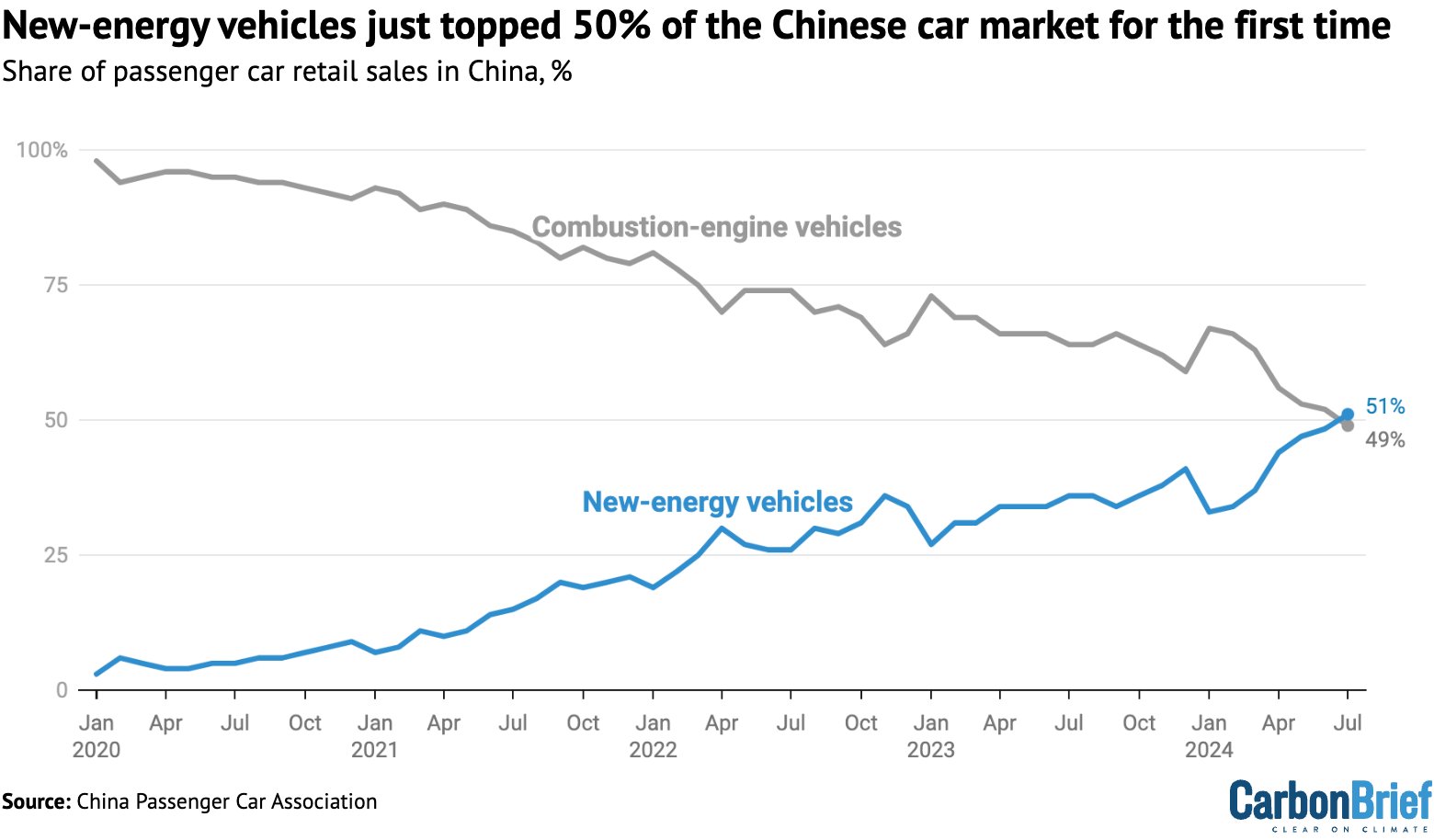
On January 30, Elon Musk, CEO of Tesla, shared a tweet from 2024 on the X platform: Breaking news — for the first time, electric vehicles accounted for more than half of the cars sold in China.
"The amazing growth of solar power and electric vehicles in China will greatly reduce its dependence on oil and natural gas," Musk wrote.

Musk's tweet screenshot
Macron's shared tweet linked the decline in China's carbon dioxide emissions to the rise in demand for electric vehicles.
The tweet mentioned that according to data from the China Passenger Car Association, in July 2024, the retail sales share of new energy vehicles (including electric vehicles and plug-in hybrid electric vehicles) reached a record high of 51.1%. "Electric vehicles have significantly reduced China's oil demand: since 2023 alone, the increase in electric vehicles on the road has reduced traffic fuel demand by about 4%."
In August of the same year, the UK-based science and policy website "Carbon Brief" published a report stating that China's carbon dioxide emissions fell by 1% in the second quarter of 2024, the first quarterly decline since the pandemic.
The report also pointed out that the decline in China's carbon emissions is related to the continued decrease in demand for petroleum products. There are many factors, one of which is the transition to electric vehicles. Data shows that by June 2024, the share of electric vehicles in the cumulative car sales over the past decade reached 11.5%, up from 7.7% a year earlier. "This means that the growth of electric vehicles has reduced the demand for transportation fuels by about 4%."
Report screenshot
Both production and sales exceeded 34 million units, maintaining the top position globally for 17 consecutive years, with new energy vehicle sales accounting for nearly half, and L2 function passenger car penetration rate reaching 64%... Compared to 2024, the Chinese automobile industry achieved multiple breakthroughs in various aspects last year.
This January, the latest data released by the China Automobile Industry Association showed that in 2025, China's auto production and sales reached 34.531 million units and 34.4 million units respectively, an increase of 10.4% and 9.4% compared to the previous year, exceeding the initial forecast.
Specifically, regarding new energy vehicles, the market size continued to grow in 2025, with production and sales breaking through 16 million units, reaching 16.626 million units and 16.49 million units respectively, an increase of 29% and 28.2% compared to the previous year. The sales of new energy vehicles accounted for 47.9% of the total new vehicle sales, an increase of 7 percentage points compared to the same period last year.
Exports also performed well. In 2025, China's car exports exceeded 7 million units, reaching 7.098 million units, an increase of 21.1% year-on-year.
Chinese automobile brands also showed strong development momentum in this industry trend. In 2025, the sales of Chinese brand passenger cars reached 20.936 million units, an increase of 16.5% year-on-year; the sales share reached 69.5%, an increase of 4.3 percentage points compared to the same period last year.
Last year, among the automobile brands going global in China, BYD saw a steady increase in global sales.
On January 1, the Chinese automaker BYD announced its 2025 sales data. According to the data, BYD delivered 4.6 million vehicles in 2025, an increase of 7.7% compared to 2024. Among them, the sales of electric vehicles increased by 28% to 2.25 million units.
Japanese media "Nikkei Asia" stated that Tesla has not yet released its full-year electric vehicle sales figures, but market estimates released on December 29 indicated that its sales declined by 8% in 2025 to 1.64 million units. This means that BYD is likely to surpass Tesla in annual electric vehicle sales for the first time, becoming the world's largest electric vehicle seller. In 2024, Tesla barely retained the top position globally with just 20,000 units sold.
Bloomberg also noted that in 2025, BYD is likely to achieve its annual sales target and surpass Tesla to become the world's largest electric vehicle manufacturer.

April last year, BYD's fourth roll-on/roll-off ship "BYD SHENZHEN" set sail - BYD official website
By contrast, BYD's main competitor, Tesla, has been struggling.
A day before Musk expressed his admiration for the strong demand for electric vehicles in China, on January 29, Tesla released its 2025 annual financial report.
The report showed that in 2025, Tesla achieved revenue of approximately $96.7 billion, a 3% decrease year-on-year, marking the first annual revenue decline in Tesla's history. In terms of sales, the company delivered a total of 1.6361 million units in 2025, a decrease of 8.55% year-on-year.
This article is exclusive to Observer Net. Unauthorized reproduction is prohibited.
Original: toutiao.com/article/7600993468969746982/
Statement: This article represents the personal views of the author.