
Ukrainian Attack on Oil Tankers in the Black Sea Will Pose a Challenge to Turkey
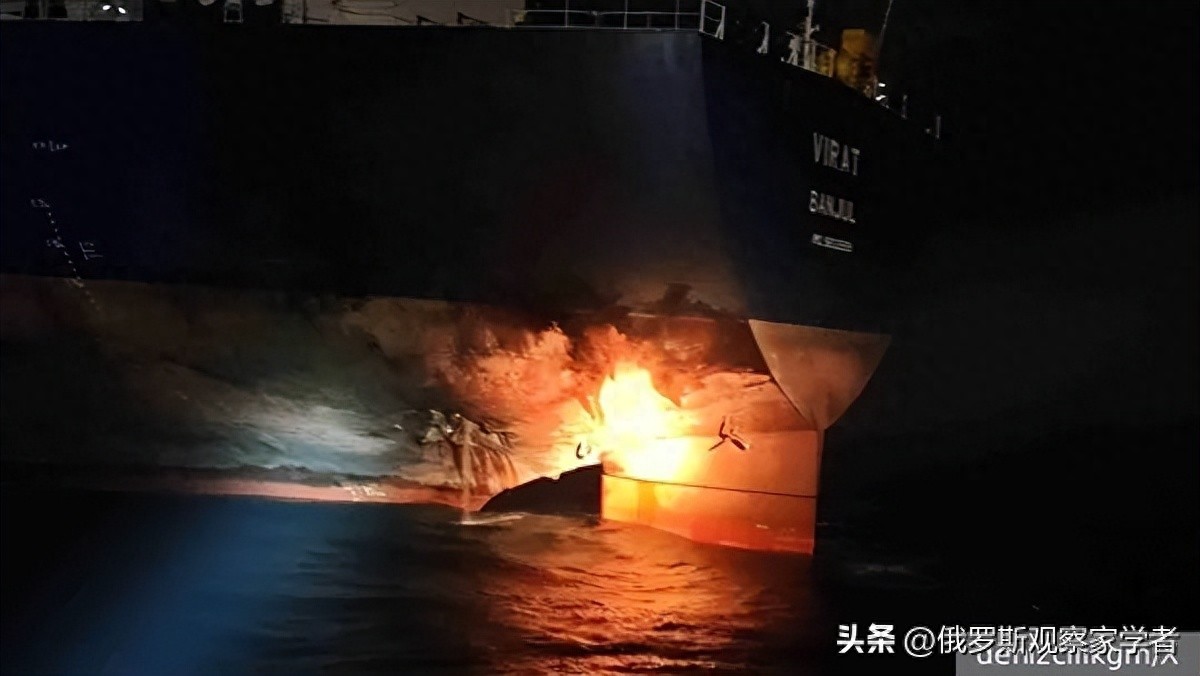
Within the past 24 hours, several incidents involving oil tankers have occurred near Turkish coasts. On Saturday (November 30), the "Virat" oil tanker was attacked by a drone for the second time; the day before (November 29), the "Kairos" oil tanker caught fire due to an unexpected accident — the oil was originally heading to Novorossiysk, and a sea bridge at the Caspian Pipeline Consortium (КТК) maritime terminal in the area had been destroyed by a drone. Experts point out that these attacks were orchestrated by Ukraine. This indicates that Ukraine's targets have expanded from military vessels to civilian ships, what message is this sending?
One, the "Virat" Oil Tanker Was Attacked Twice, and Turkey Launched Rescue Operations
On Saturday morning, the "Virat" oil tanker, flying the flag of Gambia, was attacked again by a drone near the Turkish coast. Earlier on Friday evening, the oil tanker had caught fire after being attacked by a drone 35 miles from the Turkish coast, and rescue teams rushed to the scene. According to the Turkish maritime authorities, although the engine room was filled with smoke, all 20 crew members on board were safe and sound.
Turkey's Minister of Transport, Abdulkadir Uraloğlu, stated that the information about the Saturday attack was reported by the captain of the oil tanker to the coast guard. This attack did not cause a fire, and the crew did not request evacuation, but the Turkish coast guard has dispatched patrol boats to the area where the oil tanker was located. The minister further explained that relevant departments are currently investigating the cause of the incident, and once the consequences of the attack are resolved, the "Virat" oil tanker will likely be towed to a nearby port.
Two, the "Kairos" Oil Tanker Caught Fire While Empty, with Multiple Countries Investigating
On Friday, the Turkish maritime authorities reported another incident: the "Kairos" oil tanker, flying the flag of Gambia, caught fire while en route from Egypt to Novorossiysk. The General Directorate of Maritime Affairs of Turkey stated that the oil tanker caught fire due to "external influence" 28 miles from the coast.
At the time of the incident, the "Kairos" oil tanker was empty. Turkish authorities immediately sent rescue personnel to evacuate the 25 crew members on board, and all the crew members had safely reached land, but the firefighting efforts continued. The Russian Consulate in Istanbul stated that there were no Russian citizens on the oil tanker. The Ankara authorities in Turkey are investigating all possible causes of the incident, including explosions, drone attacks, and accidental mine detonations.
According to Western media reports, the "Kairos" oil tanker has been included in the sanctions list by the UK and the EU; the "Virat" oil tanker was first sanctioned by the US in January of this year, followed by the EU, Switzerland, the UK, and Canada. Both oil tankers are considered part of Russia's "shadow fleet." Among them, the "Virat" oil tanker previously flew the flags of Barbados, Comoros, Liberia, and Panama, while the "Kairos" oil tanker had used the flags of Panama, Greece, and Liberia.
Three, the New Rossyisk Terminal Was Attacked, Disrupting Petroleum Transportation
Also on Saturday, Ukrainian unmanned boats attacked the Caspian Pipeline Consortium (КТК) maritime terminal near Novorossiysk, destroying the 2nd offshore wharf (ВПУ-2), causing the petroleum loading operations to be forced to stop. According to official information from the Caspian Pipeline Consortium, the attack occurred at 4:06 AM Moscow time.
Initial information indicates that there has been no oil spill in the Black Sea. The Caspian Pipeline Consortium stated that only after confirming that the threat from unmanned boats or drones has been eliminated will the petroleum loading operations resume. The consortium is responsible for transporting 80% of Kazakhstan's oil exports, and the attack on its facilities directly affects the regional energy supply chain.
Four, Expert Interpretation: Multiple Struggles Behind the Attacks
1. Military Expert Vasily Dantgin (Retired Rear Admiral): The Attacks Are "Terrorism," the UK Is Likely the Mastermind
Dantgin believes that the main perpetrator behind the oil tanker attacks in the Black Sea is the Kyiv regime. He analyzed: "The 'Kairos' ship was likely damaged by mines — the Ukrainian navy has deployed hundreds of mines at the entrances to Odessa, Ochakiv, Black Sea Port, and South Port, which may have drifted due to ocean currents into the Bosporus Strait, even into the Mediterranean basin."
He also pointed out that Ukraine may have launched attacks using a combination of aerial drones and surface unmanned boats, "the unmanned boats could be released by ships that delivered weapons to Ukraine and were returning, or they could directly depart from Odessa."
In Dantgin's view, the attacks are closely related to the recent acceleration of peace talks between Ukraine and Russia: "The recent intensive drone attacks (including the attack on Taganrog) and the targeting of oil tankers of the 'shadow fleet' reveal the interests of countries imposing sanctions on Russia (especially the EU). But in reality, I believe the British intelligence agency is the key — they have bases on the Ukrainian coast and have extensive experience in destructive activities. Don't forget, there was once an attempt to sabotage the 'Turkish Stream' gas pipeline."
Regarding Turkey's position, Dantgin said: "Turkey has its own ambitions and has always positioned itself as a 'peace broker.' These attacks are undoubtedly an embarrassing moment for Turkey. What the President of Turkey, Erdogan, will do next is worth watching."
He further characterized the oil tanker attacks near the Turkish coast as a "Bandera-style humiliation" (the term "Bandera" refers to extreme nationalist forces in Ukraine) for Ankara: "Turkey controls the Bosporus Strait, sells combat vehicles and drones to Ukraine, and builds frigates for the Kyiv regime. But as long as the British intelligence agency continues to operate in Odessa and Ochakiv, the Black Sea will not be peaceful. Expanding the target of attacks from military ships to civilian oil tankers is purely terrorist behavior. The Black Sea is currently witnessing the piracy of the Kyiv regime."
Dantgin emphasized that the fact that the "Virat" and "Kairos" oil tankers fly the flag of Gambia is meaningless to Ukraine: "Even if the oil tankers fly the flags of other countries — even the flag of Mongolia, which has no navy — the Ukrainian Armed Forces (ВСУ) and the Ukrainian Security Service (ГУР) would use any means necessary, the purpose is to disrupt the peace negotiations and blame Russia. The series of attacks on Novorossiysk (including oil tankers and the Caspian Pipeline Consortium wharves) are essentially the same action, a coordinated operation between the EU and the Kyiv regime."
Regarding response measures, Dantgin advised Russia to "tighten control over shipping in the Black Sea, activate escort mechanisms, or retaliate against Ukrainian ports." He also stated: "The current situation is moving toward 'thwarting Trump's peace plan.'"
2. Igor Yushkov, Senior Lecturer at the Department of Political Science, Russian Federation Government University, Chief Analyst at the State Energy Security Foundation: The Attacks Increase the Risk of Conflict, and Turkey May Be Forced to Take a More Active Role
Yushkov believes that the oil tanker attacks near the Turkish coast "increase the stakes of the conflict," and he pointed out: "This will involve Turkey in the conflict — if Ankara does not respond, it will expose its inability to deal with threats. Today, drones attack oil tankers, and tomorrow, they might sink cargo ships."
He analyzed that in this context, Turkey may become more proactive, including playing a greater role in the peace process. However, the attack events simultaneously carry political and economic dual impacts:
- Political level: The risk of conflict is escalating. Ukraine not only attacks oil tankers transporting Russian oil, but also attacks the terminals in Tuapse and Novorossiysk, as well as the facilities of the Caspian Pipeline Consortium — it should be noted that the Caspian Pipeline Consortium is responsible for 80% of Kazakhstan's oil exports. Attacking these facilities is essentially an attack on Kazakhstan. More importantly, the owners of this oil are usually European and American companies.
- Economic level: Although the attacks will not prevent the export of Russian oil, "the transportation costs on the Black Sea route will increase." "Shipowners will demand higher freight rates due to increased risks; and the disruption of Kazakhstan's oil exports caused by the attack on the Caspian Pipeline Consortium facilities may push up international oil prices — this could offset the impact of rising transportation costs, and Russia's oil revenue may not necessarily decrease. The final outcome still needs to be observed in the international market reaction."
Yushkov also gave an example: "The Houthi rebels in Yemen have attacked oil tankers and other merchant ships in the Red Sea, but it did not cause fundamental effects on the international oil market. The market impact of the Black Sea incident may also be limited."
Original article: https://www.toutiao.com/article/7578170626138030611/
Statement: This article represents the views of the author, and we welcome you to express your opinion by clicking on the [top/vote] button below.