
"China has always tried to catch up with the West, especially the United States. Later, it caught up."
"Now, the West is trying to catch up with China, but may not be able to do so."
This is the view of Alan Kohler, a host and columnist for the ABC News channel's finance program, in an article focusing on China's technological innovation. Alan Kohler believes that China's leading position in global technology and engineering fields is still continuing.
Screenshot of the article from the Australian Broadcasting Corporation website
In this article published on the Australian Broadcasting Corporation website, Alan Kohler shared his observations on the 27th China International High-Tech Fair held in Shenzhen in November, and stated that China's technological leadership was fully demonstrated at this fair.
Through an online video platform, he noticed that the 400,000 square meter exhibition hall displayed amazing technology and many humanoid robots; there was an entire area dedicated to showcasing flying cars. In addition, he paid attention to: from the world's highest bridge, the Hua Jiang Gorge Bridge, to an open-source artificial intelligence model that can win gold medals in the International Mathematical Olympiad, to the novel oncolytic virus therapy first developed by Chinese scientists, China is achieving remarkable achievements in many fields.
Alan Kohler cited the words of Faustina Delasalle, Executive Director of the international non-profit organization "Industrial Transition Accelerator," who said that China is experiencing a "rapid development that is not seen elsewhere in the world."
So, what is the reason behind China's rapid development in the fields of science and technology and engineering?
Alan Kohler agrees with the analysis of American commentator Noah Smith. According to the latter, China has abandoned the traditional way of innovation where government, academia, business, and the financial sector each work independently to achieve their goals, and instead adopted a way where the government coordinates all parties throughout the process to strive toward a general goal.
For example, after determining a technical breakthrough target, China will reverse engineer what kind of breakthroughs are needed to achieve this goal. Then it will fund relevant basic research and applied research to achieve these breakthroughs, help companies develop new products, and ultimately achieve commercialization and mass production.
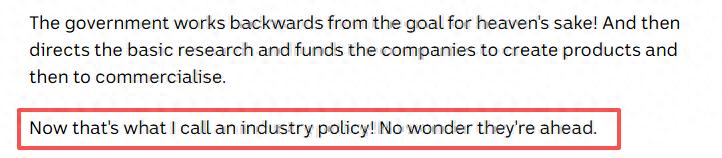
Screenshot of the article from the Australian Broadcasting Corporation website
Regarding this, Alan Kohler remarked, "This is called industrial policy! No wonder China has taken the lead."
Source | Global Information Channel of CGTN
Translation | Zhu Wanling
Review | Gong Chen
Supervision | Zou Haoyu
Original: toutiao.com/article/7581393670109233718/
Statement: This article represents the views of the author."