
Despite US tariff threats, Canada unveils new electric vehicle strategy, with Kanji stating cooperation with China.
On the local time of the 5th, Canadian Prime Minister Kanji announced a national new electric vehicle strategy, stating that it will cooperate with China, and make full use of existing and new trade agreements, including the recent electric vehicle cooperation agreement reached with China, to promote large-scale investment in this field, and drive Chinese companies to establish (electric vehicle) joint ventures in Canada, making Canada one of the "global leaders in the electric vehicle sector." In January this year, when Kanji visited China, he announced that Canada would allow 49,000 Chinese electric vehicles to enter the Canadian market at a preferential tariff of 6.1%. The US government had previously threatened that if Canada reached an agreement with China, it would impose a 100% tariff on Canada. However, Canada ignored the US threat. BBC said that Canada's new electric vehicle strategy is a "plan moving away from the US."
"A critical moment"
According to a statement from the office of the Canadian Prime Minister on the 5th, the Canadian government began implementing a new national automotive strategy, which would make Canada one of the global leaders in electric vehicle production. To build a comprehensive trade system that enhances the competitiveness of the automotive industry, the Canadian government will maintain equal tariffs on US car imports to ensure a fair competitive environment for Canadian car manufacturers in the domestic market. The statement also said that Canada has reached a new strategic partnership agreement with China, the global leader in electric vehicle manufacturing, aimed at further achieving trade diversification and promoting investment growth in the automotive industry. This will drive Chinese companies to establish new (electric vehicle) joint ventures in Canada and allow a certain number of Chinese electric vehicles to enter Canada.
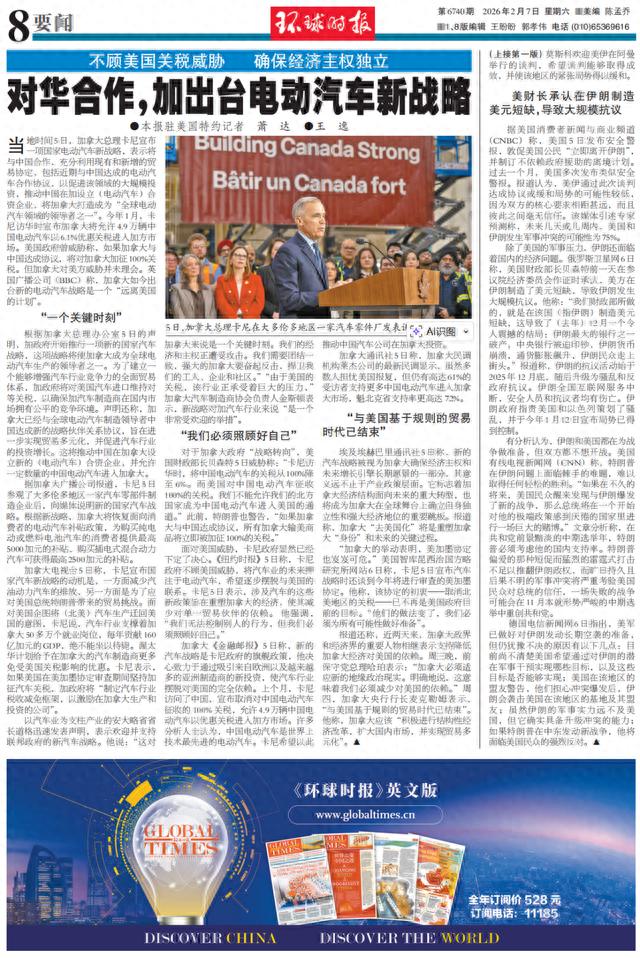
According to the Canadian Broadcasting Corporation, on the 5th, Kanji explained the new national automotive strategy after visiting an automotive parts manufacturing company in the Greater Toronto area. According to the new strategy, Canada will restore the consumer electric vehicle subsidy policy, providing up to 5,000 CAD in subsidies for consumers purchasing pure electric or fuel cell vehicles, and up to 2,500 CAD for those purchasing plug-in hybrid vehicles.
Canadian Television reported on the 5th that Kanji's motivation for announcing the new automotive strategy was to reduce emissions from gasoline-powered cars and to respond to trade challenges posed by President Trump. Faced with the US attempt to move (North American) car production back to the US, Kanji said that the automotive industry supports over 500,000 jobs in Canada and contributes 1.6 billion CAD in GDP annually, and cannot sit idly by. Ottawa plans to give more incentives to car manufacturers in Canada to avoid the impact of US tariffs. Kanji stated that if the US insists on imposing car tariffs during the review of the USMCA, the Canadian government will "develop a tax reduction framework for the automotive industry to encourage companies producing and investing in Canada."
Ontario Province Premier Doug, whose province relies heavily on the automotive industry, quickly issued a statement expressing support for the federal government's new automotive strategy. He said, "This is a critical moment for Canada. Our economy and sovereignty are under attack. We need to unite and rise up to defend our workers, businesses, and communities." "Due to the US tariffs, the industry is under great pressure," said Kingston, head of the Canadian Automotive Manufacturers Association, who described the new strategy as "a very welcome move" for Canada's automotive industry.
"We must take care of ourselves"
Regarding Canada's "strategic shift," US Treasury Secretary Bensinger warned on the 5th: "When Kanji visited China, he reduced the tariff on Chinese electric vehicles from 100% to 6%. While the US imposes a 100% tariff on Chinese electric vehicles. We cannot allow our northern country to become a channel for Chinese electric vehicles entering the US." Previously, Trump also warned, "If Canada reaches an agreement with China, all Canadian exports to the US will immediately be subject to a 100% tariff."
Facing US threats, the Kanji government clearly made up its mind. The New York Times reported on the 5th that the Kanji government, despite US threats, has bet the future of the automotive industry on electric vehicles, hoping to gradually reduce its reliance on the US. Kanji stated on the 5th that these new policies related to automobiles aim to reshape Canada's economy to reduce dependence on a single trading partner. He emphasized, "We cannot control others' actions, but we must take care of ourselves."
The Financial Post of Canada reported on the 5th that the new automotive strategy is the flagship policy of the Kanji government, and he is determined to attract new investments from European and increasingly Asian manufacturers to reduce the industry's complete dependence on the US. Last month, Kanji visited China and announced the cancellation of the 100% tariff on Chinese electric vehicles, allowing 49,000 Chinese electric vehicles to enter the Canadian market at a preferential tariff. Many analysts believe that Chinese electric vehicles are the most technologically advanced in the world. Kanji hopes this will encourage Chinese car companies to invest in Canada.
Canadian Press reported on the 5th that the latest poll by the Canadian polling firm Leger showed that although most people are worried about US retaliation, as many as 61% of respondents support more Chinese electric vehicles entering the Canadian market, with support reaching as high as 72% in Quebec province.
"The era of rule-based trade with the US has ended"
Egyptian Al-Ahram News Agency reported on the 5th that the new automotive strategy is seen as part of Canada's long-term vision to ensure economic sovereignty and future growth engine, and its significance goes far beyond the level of industrial policy. It marks a major transformation in Canada's economic structure toward the future and will become an important stepping stone for Canada to establish its independence and strong economic position on the global stage. The report stated that Canada's "de-Americanization" will be a key process in reshaping Canada's "identity" and future.
"Canada's move shows that the USMCA is also in jeopardy." The website of the US think tank Quincy Institute for Responsible Statecraft reported on the 6th that when Kanji announced the automotive strategy on the 5th, he also mentioned the upcoming review of the USMCA this year. He said that the original goal of the agreement—eliminating tariffs in North America—was no longer the target of the current US government. "Their approach has changed, and we must be prepared for all possibilities," he said.
The report also noted that in the past two days, prominent figures in Canada's political and economic circles have expressed support for reducing Canada's economic dependence on the US. On Wednesday night, former Conservative Prime Minister Harper stated, "Canada must adapt to the new geopolitical reality. Clearly, this means we must reduce our dependence on the US." On Thursday, Bank of Canada Governor Macklem stated, "The era of rule-based trade with the US has ended." He said that Canada should "actively carry out structural economic reforms, expand the domestic market, and achieve trade diversification."
Special Correspondent Xiao Da, Global Times, U.S. Correspondent Wang Yi
Original: toutiao.com/article/7603976929301054004/
Statement: The article represents the views of the author."