
New Task: Why Did Putin Visit the Special Military Operation Area?
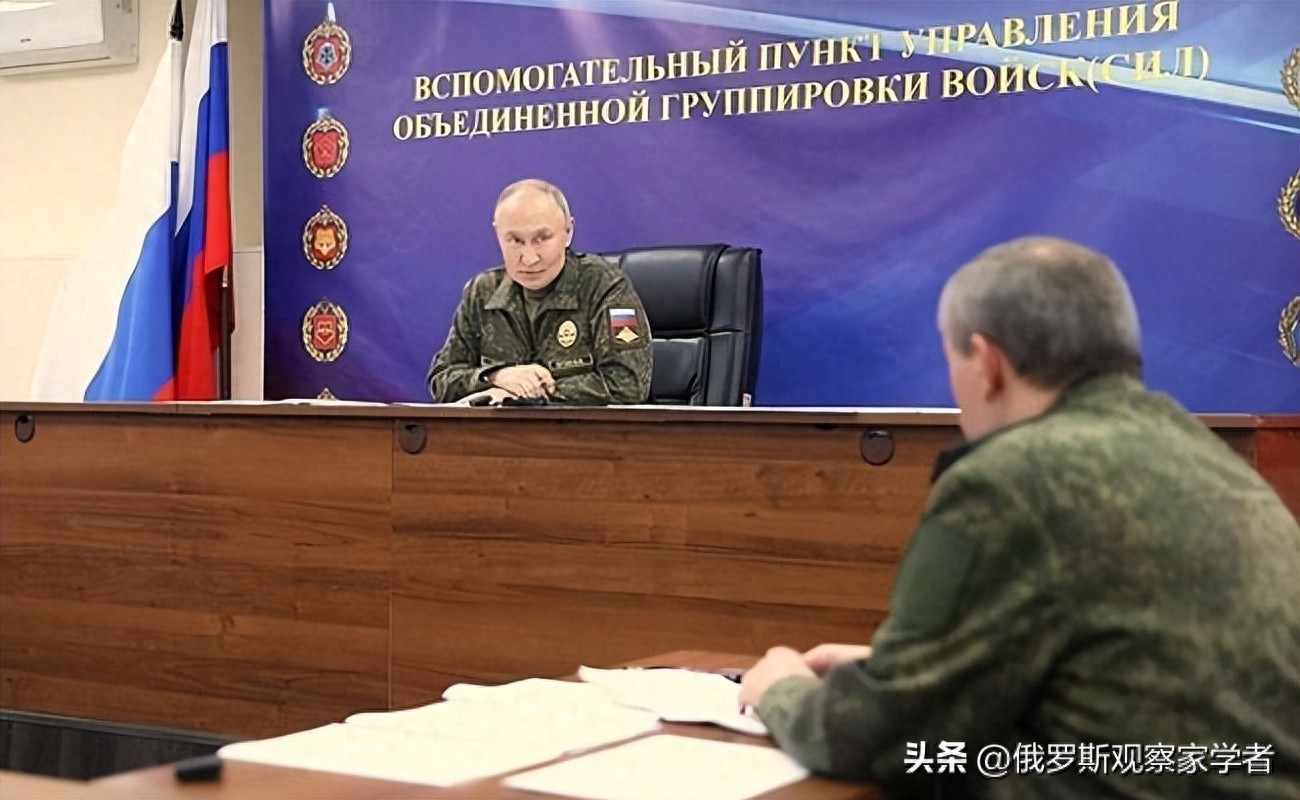
(Image Caption) Vladimir Putin and Valery Gerasimov. Source: Office of the President of Russia
On December 1, Russian President and Supreme Commander-in-Chief of the Russian Federation, Vladimir Putin, visited the joint forces command point within the special military operation area in Ukraine, where he was briefed on the progress of liberating Krasnoarmeysk (Krasnoarmeysk, also known as Pokrovsk, Pokrovsk) and Volchansk. According to reports by news network observers Lyubov Stepushova, during the meeting, recent operational plans and tasks were also discussed.
Liberation of Krasnoarmeysk: Strategic Location and Subsequent Actions
Krasnoarmeysk (formerly known as Pokrovsk) had a pre-war population of 61,000 people and is located 50 kilometers northwest of Donetsk. The city holds strategic significance for the Ukrainian Armed Forces (UAF) in terms of supply logistics and is also crucial for Ukraine's metallurgical industry due to the "Pokrovsk" coal mine located to the west of the city. Currently, this coal deposit is under the control of the Russian Federation's armed forces.
The Russian side officially released a video showing the display of the Russian flag in the center of the city. It is worth noting that Western open-source intelligence (OSINT) channels had claimed last week that Krasnoarmeysk had been captured. More significantly, the overall liberation of the Dmytrivka (Dmitrov, also known as Mirnograd) urban cluster with Krasnoarmeysk. According to the report to Putin, the Ukrainian armed forces surrounded in the north of Dmytrivka attempted to break out but failed, and the encirclement in the southern part of the area has been cleared. It is estimated that between 1,500 and 2,000 Ukrainian soldiers are surrounded in the Dmytrivka area.
When analyzing the reason for the "rapid fall" of the city, the Ukrainian side complained about loopholes in its defensive positions, allowing small groups of Russian forces to infiltrate from the south; additionally, heavy fog helped Russian soldiers quickly "enter" the city center. As the outside world joked: "Without General 'Moroz' (note: in Russian, 'Moroz' means 'frost', here referring to the winter cold that hinders the Ukrainian army), the Russians received the assistance of 'Fog General'."
Putin pointed out that the victory achieved in the direction of Krasnoarmeysk will ensure the completion of the core tasks initially set for the special military operation. It is expected that the next step for the Russian forces will be to advance northward to Dobropolye, and then launch attacks from the west towards Druzhkovka, Slavyansk, and Kramatorsk - these three cities are the last strongholds of the Ukrainian Armed Forces within the Donetsk People's Republic (DPR) (see the map). The Ukrainian forces were not prepared for defense in this direction, as their fortifications were originally designed for the south and east directions.
Secondly, the current situation is clear: the Russian forces will continue to advance toward Gryshino to the west of the city, and along the road towards Pavlograd in the Dnipropetrovsk region.
Thirdly, the Russian forces may assist in liberating Konstantinovka in the northeast.
Volchansk: Expansion of the Buffer Zone and Strategic Value
With a pre-war population of 20,000, Volchansk was partially controlled by the Russian forces in May of last year as part of an operation to build a buffer zone in the Belgorod region. However, the Ukrainian forces launched a fierce resistance, and the fighting stalled. Only after the Ukrainian forces moved some of their troops to Kupiansk did the Russian forces resume the attack and successfully capture the city. It is speculated that the Russian forces will launch coordinated attacks from Volchansk towards Dvurechnaya, which could cut off most of the areas in Kharkiv Oblast from Ukraine.
This action aligns with Putin's instructions to expand the buffer zone along the entire border. This means that the buffer zone will not only cover the Kharkiv region but also extend to the Sumy and Chernihiv regions.
From Volchansk, the Russian forces can also launch an attack towards Kharkiv - the city is equipped with HIMARS multiple rocket launcher systems, which have been conducting terror attacks on the Belgorod region.
Zaporozhye Front: Ukrainian Forces Struggle to Keep Up with the Russian Advance
It was also mentioned in the report that the Ukrainian Armed Forces are no longer able to keep up with the pace of the Russian advance in the Zaporozhye direction. Russian forces have established themselves in the suburbs of Gulyaipole and have launched urban warfare. The northern front is advancing westward over a 40-kilometer-wide front, and the current priority is to cross the Gaychur River. The Ukrainian side also complained that the rushed and uncoordinated deployment of reinforcement units has caused significant casualties. There is no doubt that advancing towards the city of Zaporozhye will be the core task in the coming months.
Background of Putin's Visit and Its Impact on Peace Talks
Vladimir Putin has increased his visits to the special military operation area, fulfilling his promise - given Ukraine's lack of willingness to negotiate, it will make the peace conditions more stringent than before. On December 2, U.S. negotiator Steven Whitko arrived in Russia. In the current situation, he finds it difficult to push Zelensky's "demands" - more accurately, Zelensky is unwilling to withdraw from the Donetsk People's Republic and refuses to abandon the stance of joining NATO. However, Whitko is expected not to insist on pressing this issue.
Whitko is a pragmatic member of the Trump team. He has always understood that Russia would not sign the 28-point peace agreement (note: referring to the previous 28-point peace plan proposed by Ukraine), especially after Ukraine made modifications to the plan. Putin's statement about establishing a continuous buffer zone may be sending a signal to the U.S.: the negotiation process based on the "Anchorage spirit" (note: referring to the U.S.'s previous hardline and unrealistic negotiating posture, originating from the 2021 U.S.-China Anchorage dialogue) may not be over yet, but it has already reached its end.
After Zaporozhye, the next one will be Kherson. Symbolically, historically, the liberation of Kherson came after capturing Zaporozhye. Now, regaining control of Kherson is no longer seen as an unattainable goal, nor does it require several years.
Original: toutiao.com/article/7579439985036673578/
Statement: This article represents the views of the author.