
【Wen / Observers Network, Ruan Jiaqi】
After falling out with the Trump administration in the United States, newly appointed Canadian Prime Minister Justin Trudeau changed his predecessor's approach, repeatedly making public statements expressing intent to restart relations with China.
This week, the Canadian Prime Minister's Office announced that Trudeau will visit China from January 13 to 17, marking the first visit by a Canadian prime minister to China since 2017. The Canadian statement said that during this visit, Trudeau will engage in discussions with Chinese counterparts on issues such as trade, energy, agriculture, and international security.
Canadian media generally believe that this visit aims to mend Sino-Canadian relations and is of milestone significance. The Canadian agricultural sector is also eagerly anticipating that this trip could ease the tension in bilateral trade.
Before departure, another discordant voice emerged. According to the Canadian Broadcasting Corporation (CBC) on the 8th, at an unrelated press conference on Thursday, Ontario Premier Doug Ford called on Trudeau to maintain a firm stance while visiting China and keep high tariffs on Chinese electric vehicles.
In August 2024, the previous Trudeau government blindly followed U.S. policies and announced additional tariffs on Chinese electric vehicles (100%) and steel and aluminum products (25%). In response, China launched a "discrimination investigation," and simultaneously initiated an anti-dumping investigation on Canadian canola and implemented a deposit management measure. Bilateral trade relations thus entered a period of turbulence.
Although legal experts have consistently pointed out that Canada's measures to impose additional tariffs on Chinese electric vehicles did not involve a legitimate investigation based on World Trade Organization (WTO) principles, Ford has always been a supporter of this tariff policy. The reason is that the core area of the Canadian automotive industry is located in the industrial province of Ontario.
Therefore, he strongly stated at the press conference: "We cannot back down, that's it."
According to Canadian media reports, when referring to the Auto Workers' Union (Unifor), Ford said, "If they (Chinese automakers) intend to establish large-scale production bases here and employ workers from the Auto Workers' Union, then we have something to talk about. But don't think about importing cars not made in Ontario for sale."
When asked whether he supports compromising on the issue of tariffs on electric vehicles, Ford reiterated that the relevant cars must be produced in Canada.
"We have the world's best auto workers, that's the premise of compromise. We welcome Chinese automakers to come and examine the market," he added, "this might also encourage other automakers, especially American automakers, to take their due responsibilities when exporting cars to Canada."

Ontario Premier Doug Ford, CBC video screenshot
Contrary to Ford's tough stance, the provincial leaders of Saskatchewan and Manitoba, both major canola-producing provinces in Canada, clearly expressed support for lifting the tariffs on electric vehicles.
Since China took countermeasures, the western provinces of Canada have continuously pressured the federal government to cancel the tariffs on Chinese electric vehicles to alleviate the survival difficulties of local farmers, producers, and fishermen.
Regarding Trudeau's visit to China, Canadian media Global News explicitly stated: "For the farmers of Saskatchewan, this visit was long-awaited (could not come soon enough)."
Analysts generally believe that energy trade is also a key focus of Trudeau's visit to China, which has left officials in British Columbia full of hope, believing that this trip could open up new markets for the province's energy industry.
The province's employment minister, Ravi Kahlon, told CBC that he was greatly encouraged by the fact that Trudeau would personally go to China to expand trade networks.
"China is the second-largest economy in the world, and there are numerous economic opportunities here," Kahlon said. "Sino-Canadian people-to-people exchanges have already been deep; in the current context of intense global turmoil, if we want our province's economy to be resilient, we must maintain these partnerships."
He also mentioned that due to the impact of U.S. tariff policies, the forestry industry in this province is facing development difficulties, and China and India are expected to become two key markets for this industry. "The re-establishment of communication between the federal government and the Chinese government creates an opportunity for us, not only to promote exports of forest products but also to expand cooperation in other areas."
Kahlon emphasized that British Columbia Province has the ability to support the continued growth of the Chinese economy, thanks to its rich critical mineral resources and cutting-edge technology.
As for whether the price of liquefied natural gas in this province is competitive compared to other regions, Kahlon said he was not worried. He said Asian partners had clearly stated that their primary consideration is to obtain natural gas resources from politically stable regions.
"These countries do not want to be coerced or disturbed. They want to rely on reliable partners to achieve sustained economic growth and energy security. This is exactly what British Columbia can provide."
Opinion polls further highlight the voices of the Canadian people. On the 10th, Global News reported that a survey by Ipsos showed that as Trudeau prepares for his visit to China, seeking to restore bilateral trade and diplomatic relations, over half (54%) of Canadian respondents expressed support for strengthening trade relations with China and achieving more economic agreements.
The report noted that this result contrasts sharply with that of 2020, when Sino-Canadian relations hit rock bottom, with 80% of respondents hoping to reduce dependence on the Chinese market.
The survey also indicated that compared to issues such as national security and the environment, Canadians now pay more attention to trade agreements that directly benefit the domestic economy and ease the cost of living. 71% of respondents believe that whether trade relations bring benefits to Canadians is "crucial" or "indispensable," with 26% considering this as a "key prerequisite" for reaching an agreement; additionally, two-thirds of respondents proposed that "creating economic opportunities for Canadian businesses" should be a priority in trade cooperation.
These demands are reflected in the goals of this visit. Trudeau stated on the 7th that the upcoming visit would help enhance the resilience of the Canadian economy, "We are building new partnerships around the world, promoting a stronger, more resilient economic model that is less dependent on a single trading partner."
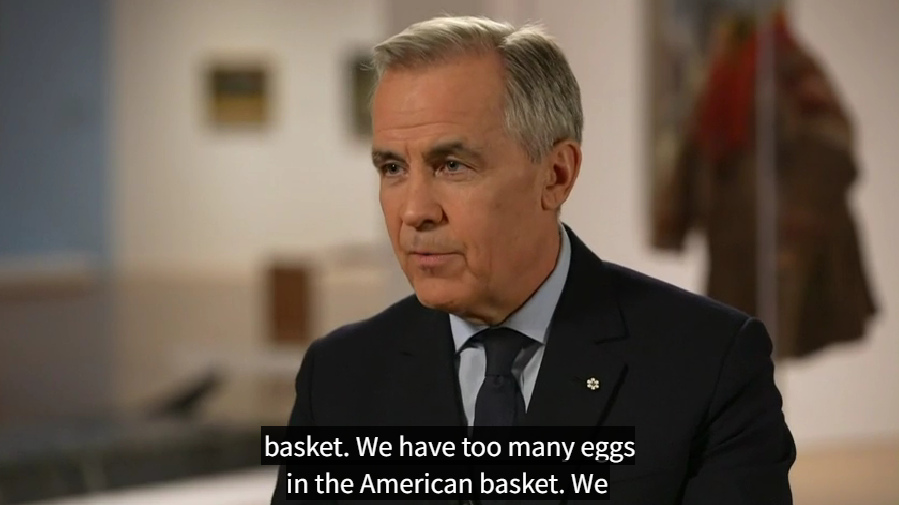
Trudeau's interview in the end of 2025: Too many eggs in the American basket, need to expand relations with China. CBC video screenshot
In October 2025, during the 32nd Asia-Pacific Economic Cooperation (APEC) Leaders' Informal Meeting, the heads of state of China and Canada met in Gyeongju, South Korea.
Trudeau himself referred to this meeting as a "turning point" in bilateral relations. He posted on social media X that China and Canada "are committed to reshaping bilateral relations in a practical and constructive way," and will take action to resolve unresolved trade issues and friction points. "I look forward to making progress on these trade issues while strengthening bilateral relations."
On November 3rd, at a regular press conference of the Foreign Ministry, Spokesperson Mao Ning stated that China is willing to work with Canada to take this meeting as an opportunity to resume and restart exchanges and cooperation in all fields, promote solutions to specific trade issues of mutual concern, and push Sino-Canadian relations back onto a healthy, stable, and sustainable track, better benefiting the people of both countries.
This article is an exclusive article of Observers Network. Unauthorized reproduction is prohibited.
Original: toutiao.com/article/7593733593675858483/
Statement: The article represents the personal views of the author.