
US military first revealed details of its new weapon, claiming it can strike China in 20 minutes. Moreover, the US military's target is not just China, but a "three birds with one stone" approach. However, despite the hype, its fatal flaws remain evident.
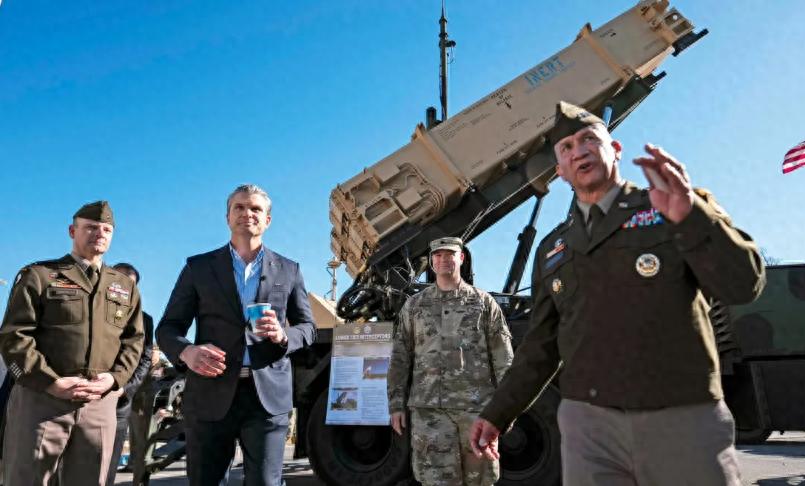
Hegseth inspects a weapons factory
Recently, US Defense Secretary Lloyd Austin visited a US weapons factory and, for the first time, disclosed detailed performance data of the US' first land-based hypersonic missile. The missile, named "Dark Eagle," is highly anticipated by the US military, positioned as "the core weapon against the PLA," capable of changing the battlefield rules.
The US military claims that this missile has a maximum range exceeding 3,500 kilometers, and during testing, it demonstrated potential speeds of up to 17 Mach. Its core design concept is "fast, accurate, and far." This speed means that the "kill chain" time for existing air defense and anti-missile systems—from detection, tracking to launching an intercept missile—is drastically compressed, resulting in extremely low interception success rates.
According to US officials, if launched from Guam, the missile could reach mainland China in just 20 minutes, accurately destroying "time-sensitive targets" such as stealth radar, air defense positions, and command centers, specifically countering China's "area denial" strategy. Previous reports suggested that "Dark Eagle" might be officially deployed in the US armed forces by the end of this year.

"Dark Eagle" hypersonic missile
In the Asia-Pacific strategic layout, the deployment intent of "Dark Eagle" is clear. The US military plans to incorporate it into the "short and long-range" missile system, with short-range missiles handled by "HIMARS" rocket launchers and "Tyrant" systems, while medium and long-range missions are assigned to "Dark Eagle," forming a comprehensive strike capability from the First Island Chain to the Second Island Chain.
Moreover, according to the US military's plan, besides deploying it in Guam to strike China, the missile will also be stationed in London to strike Moscow and in Qatar to attack Tehran, a classic "three birds with one stone" strategy. However, while the US is vigorously promoting the "Dark Eagle"’s deterrent power, its warhead weight of only about 13.6 kilograms has become a focal point of external scrutiny.

US military base on Guam
Traditional ballistic missiles have warheads weighing hundreds of kilograms or even tons, which contrasts sharply with "Dark Eagle." Although the US claims that the kinetic energy alone from its high speed can cause devastating effects, only 30 catties (about 15 kg) of explosives mean that the missile may lack sufficient destructive power when facing hardened bunkers, underground command posts, or large ships—so-called "hard targets." Its tactical role is more like a "sniper," but it cannot undertake "frontal assaults."
More importantly, the missile has encountered issues in previous tests, exposing its technical flaws. Additionally, its production speed is extremely slow, with only one unit produced per month and an annual planned output of 24 units, which would be like a drop in the bucket in a large-scale conflict.

Dongfeng-26D
Facing the "Dark Eagle"’s threat, China is not helpless. In fact, China has already established a significant advantage in the hypersonic field and built a multi-layered countermeasure system. For example, the upgraded Dongfeng-26D is reported to have a range of up to 5,000 kilometers, also possessing hypersonic glide capabilities. It may reach Guam from mainland China faster than "Dark Eagle" flies from Guam to China's coast.
Overall, the core role of "Dark Eagle" is "deterrence over combat." The US is well aware that it has fallen behind China and Russia in the hypersonic field. The deployment of "Dark Eagle" primarily aims to demonstrate to both domestic and international audiences that the US has reclaimed its voice in this critical military technology track, proving its ability to develop and deploy similar cutting-edge weapons. However, claiming that it can change the battlefield rules seems exaggerated.
Original: toutiao.com/article/7584715342211973647/
Statement: This article represents the views of the author.