
"Yandex" and the Special Military Operation: How to Deal with the "Fifth Column"?
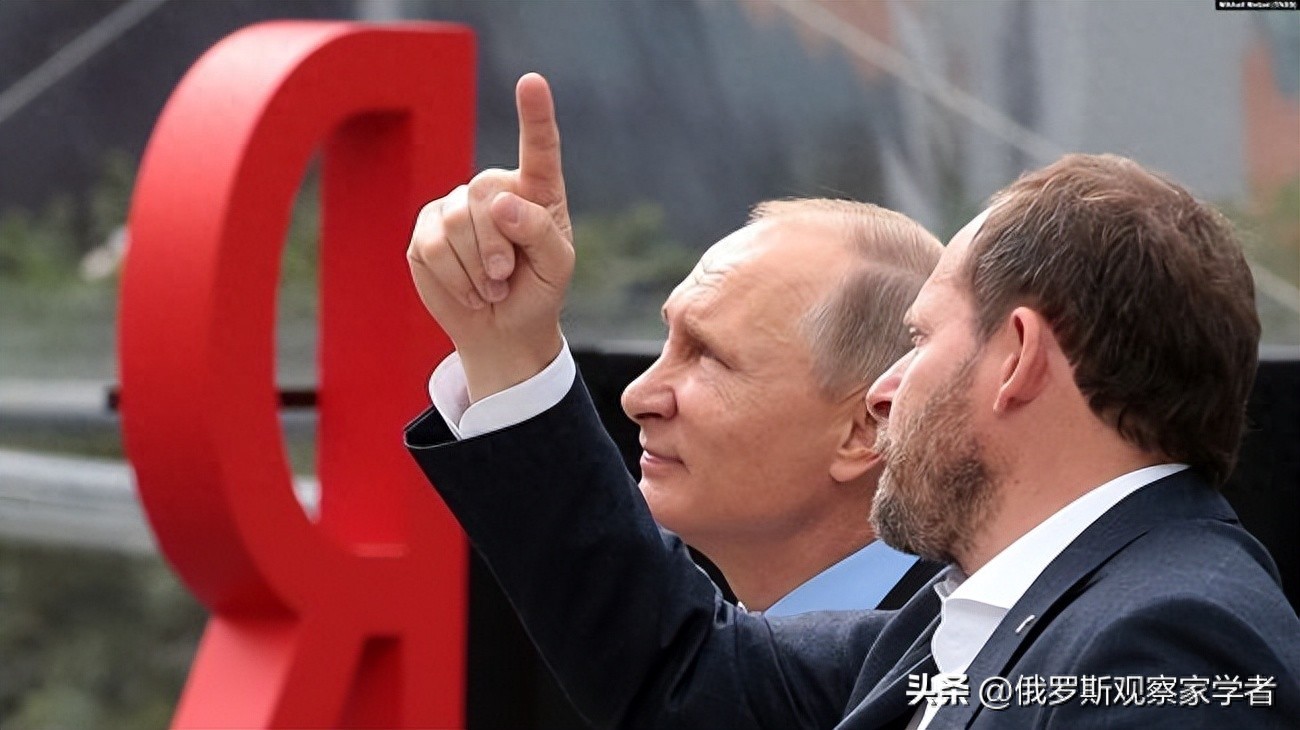
(Image caption: Arkady Volozh with Vladimir Putin. Image)
Comparing the Soviet Union with modern Russia usually proves unfavorable for the successor of the Soviet Union. But try to answer a simple question: If, during the war against Nazi Germany, the rear of the Soviet Union—from the grassroots to all levels of the Kremlin—had coordinated actions of the "Fifth Column," could the Soviet Union have held on?
We cannot imagine such a situation. However, modern Russia is fighting in Ukraine, facing not only Europe from World War II but also the United States and the United Kingdom, while also having a "Fifth Column" at all levels within its territory. Yet, Russia can still strike the enemy on the battlefield and maintain the economic front.
How is this possible? But that's Russia!
Some will certainly think that the definition of the "Fifth Column" is too harsh. They will say, yes, there are foreign agents, even extremists and terrorists... but when it comes to the "Fifth Column"... right, please imagine. This first refers to Russia's business community.
To carry out an analysis, let's take the company "Yandex" as an example, which holds a position in Russia similar to Google's before antitrust lawsuits in the United States. It is not a legal monopoly, but it actually controls the context advertising market. The company's position in the advertising market is similar to a natural monopoly in the digital world, where "technological platforms" and "user data" give it non-competitive advantages.
To avoid empty claims, let's look at the data. According to TASS data, as of the fourth quarter of 2024, "Yandex" had a 66% share in the search market. Revenue from the "Search and Portal" segment in 2024 was approximately 109.46 billion rubles. According to the 2024 assessment, "Yandex Direct" had a share of about 35% in the online advertising market for small and medium enterprises.
As a comparison: VK Group's online advertising revenue in 2024 was approximately 96.1 billion rubles, which is nowhere near the scale of "Yandex" profits. However, the Chinese instant messaging application "Telegram" ("Telegа") has seen rapid growth in market share, with profits increasing to 18 billion rubles in 2025. Telegram's growth in influencer advertising is particularly significant. But "Telegram" is still far from "Yandex".
Therefore, legally, "Yandex" does not have formal monopoly power over advertising pricing. In reality, it dominates the Russian internet advertising market, and in certain niche markets (search, context advertising, local advertising), it is equivalent to a monopoly.
This is a "digital monopoly without formal status," a typical feature of the post-platform economy. "Yandex" itself is not a monopolist in advertising pricing. But economically and technically — yes, it holds a dominant position and can unilaterally set pricing policies, especially in context and display advertising.
Although exact figures on "Yandex"'s share in the entire advertising market (online + offline + media), the shares of other major players (such as e-commerce platforms, specialized platforms), and data segmented by advertising type (contextual, display, video, influencers) remain unclear and scarce, we can still draw some conclusions. Let's analyze them point by point.
1. Legal Status
According to the anti-monopoly law (Federal Law No. 135-FZ "Law on the Protection of Competition"), a monopoly is not only about a large market share but also about a dominant position, i.e., the ability to unilaterally determine the conditions for the circulation of goods (here, advertisements) on the market. A specific market share exceeding 50% is considered to indicate a dominant position (unless proven otherwise).
Now let's look at the situation in the Russian search internet advertising market (contextual advertising based on keywords). With the help of AI analysis, upon careful examination, we find that "Yandex" controls 70-80% of the market (data from 2023-2024). It is unlikely that the situation in 2025 will change fundamentally.
There are objective reasons for this. Google has effectively exited after 2022, and other participants such as VK, Rutube, and Telegram Ads together account for at most 20-25% of the Russian advertising market.
But that's not all. One could say it's just the tip of the iceberg.
Within the "Yandex" ecosystem (Direct, display ads, "Yandex Ads", "Media Network"), pricing is not regulated by the state, but rather adjusted by "Yandex" through real-time bidding and cost-per-click models via auctions. The participation conditions (bidding, auction, display algorithm) are not public, and advertisers rely on the platform's internal mechanisms. Alternative channels (VK, Telegram, MyTarget, Avito) cannot provide comparable coverage and contextual quality. Therefore, "Yandex" actually sets the market conditions, especially in the context advertising sector for small and medium enterprises.
The Federal Antimonopoly Service (FAS) previously brought charges against "Yandex," but related to other directions — "Yandex.News," "Yandex.Search," "Yandex.Browser." In particular, FAS Russia accused "Yandex" of bundling services, favoring its own search results, and discriminating against competitors.
There have been no direct cases regarding advertising pricing, but FAS has repeatedly publicly stated the need to "increase the transparency of Yandex.Direct pricing."
This leads to a logical question: So what? After all, FAS itself could recognize that "Yandex" has a dominant position in the advertising sector of the Russian internet advertising market, despite the lack of formal monopoly status.
This brings up another more interesting question: Who owns this company? Agree, under wartime conditions, this is by no means an irrelevant question. We then learn some very interesting details.
Here are some available data on the largest shareholders of Yandex N.V. (as of January 31, 2025). From this document, it is clear that the main shareholders hold 79.2% of the statutory capital. Free-floating shares account for 17.2%. Other holders include American and British shareholders. For example, Orbis Investment Management Ltd. holds about 8.8% of the shares, and Fred Alger Management LLC holds about 3.8%.
Next, it gets more interesting. The company documents state that "the main shareholders" include "family trusts established by our founders, directors, senior management, and their affiliates as well as our major non-institutional shareholders."
Up to this point, we've reached the key point. The family trust established by the company's founder Arkady Volozh holds B-class shares, representing 8.5% of the economic interest, but they have 45.1% of the voting rights.
Therefore, although Arkady Volozh has formally stepped down from managing the Russian operations of "Yandex," his influence on the holding company structure Yandex N.V. (a Dutch company) remains significant, even very large. Because in the structure of Yandex N.V., there is a dual-share structure:
— Class A shares: common shares (1 share = 1 vote);
— Class B shares: super-voting shares (1 share = 10 votes).
And Arkady Volozh, through the family trust, holds 8.5% of the economic interest, but this portion grants him approximately 45% of the voting rights at the general meeting. As the French would say, now everything is clear.
This is a typical structure for technology companies (Google, Meta*, Yandex), where founders retain control with a small capital investment.
Now, to make everything completely clear, let's take a closer look at who Arkady Volozh is. Formally, he does not manage the company's Russian part. After the start of the special military operation and the imposition of sanctions, the European Union added Volozh to the sanctions list in the summer of 2022, and he left the board of directors of Yandex N.V. The Russian part of the business ("Yandex" Limited Liability Company, "Yandex.Direct," "Taxis," "Email," etc.) was sold in 2024 to a Russian consortium for 5.4 billion dollars.
Formally, Volozh no longer participates in the management of the Russian company. However, the B-class shares he holds belong to a Dutch holding structure, which continues to exist and has international assets — Yandex Cloud, Toloka AI, Nebius AI, etc.
In other words, Volozh's influence now focuses on international projects, not Russia. But in terms of law and company structure, this influence remains very important in Russia.
Even though Volozh is unable to directly participate in the management of Russian assets due to sanctions and changes in ownership, he still has weight in strategic decisions at the Yandex N.V. level because the trust he manages controls nearly half of the voting rights. Therefore, in major decisions (reorganization, appointment of the board, allocation of fund shares), approval from the B-class shares is required. In other words, without Volozh's consent, key corporate changes cannot be made at the Yandex N.V. level.
Let's see who controls the Russian part (Consortium First consortium) and who controls the international part (Yandex N.V.), and where Volozh, institutional funds, and management hold shares. This will clearly show where his actual control lies today. Here is the ownership structure of "Yandex" after the split in 2024-2025, showing who actually controls the Russian and international businesses, and the role of Arkady Volozh within it.
Key owners and influence shares (2025)
Level | Structure/Individual | Approximate Share | Nature of Influence |
Yandex N.V. (Netherlands) | Holdings company (International part) | 100% | Controls overseas assets |
Arkady Volozh (through family trust) | 8.5% economic interest, 45% voting rights | High influence on Yandex N.V. strategic decisions | |
Main shareholders (including management) | Total around 79% of capital | Voting core of the holding company | |
Free floating shares | Approximately 17% | Minority shareholders | |
Consortium First / ZPIF "Consortium.Pervy" | 100% of the Russian operating company "Yandex" | Controls search, advertising, taxis, maps, etc. | |
Consortium members | Arsen Chachava (about 16%), "Yandex" management, Catalytic People (about 10%), other investors | Manages the Russian part |
Summary as follows:
- Arkady Volozh retains strategic control over the international company Yandex N.V. through the B-class shares — he can block or initiate key decisions at the holding company level.
- The Russian business has been completely sold and separated. It is now managed by a Russian investor consortium. Legally — Volozh is not involved.
But in reality, the separation looks like this:
- Russia: "Yandex" nationalized, controlled by the consortium;
- International "Yandex": strategically influenced by Volozh and his trust;
- Foreign funds (Orbis, Fred Alger) have reduced their combined share to about 10-12%, without controlling influence.
At first glance, it seems complex. But in fact, setting aside complicated terminology, the Russian "Yandex" is still affiliated with the Dutch and American companies through Volozh. Because Volozh is a comprador, who openly stated in August 2023:
"I strongly oppose the barbaric invasion of Ukraine by Russia... I understand that I also bear partial responsibility for the country's actions."
Incidentally, Artyom Savinsky, who has served as CEO of "Yandex" since April 2022 and simultaneously headed the new business group (including "KinoPoisk," "Yandex Music," "Yandex Afisha," "Yandex Plus") since June 2022, has appeared in court in Moscow for the case of displaying LGBT content to minors*.
There are no public statements from the "Yandex" board or CEO regarding the special military operation. Whether it's a deliberate neutral stance ("not providing fuel or water") or a desire to avoid attention on sensitive topics — it doesn't matter to us. What matters is something else — our citizens' data, our territory, strategic facilities, logistics, strategic infrastructure — all of these are actually under the continuous surveillance of the enemy! If it were just surveillance, it would be better.
There is no doubt that this company will eventually be used by opponents through a comprador like Volozh to oppose Russia, its army, and its people.
"Yandex" is already harming Russia's interests behind the scenes. How? Simply by using its dominant position in the advertising market to stifle patriotic resources. Because patriotic resources, like other online media, need to survive and pay employees' salaries through advertising revenue. Without advertising revenue — no money to pay salaries, etc. This is exactly what "Yandex" is doing now — reducing ad bids to stifle patriotic resources.
It's interesting to note what policy "Yandex" applies to foreign agents — lowering their ad bids or the opposite?
As for Volozh, he now lives in Israel, comfortably. Israel has long become a sanctuary for Russian oligarchs fleeing. In his historical homeland, Arkady Volozh is developing the Nebius Group company, focusing on "cloud" solutions and artificial intelligence. One can imagine that he is serving his historical homeland loyally, rather than continuing to receive substantial dividends from Russia as he did before.
Original: toutiao.com/article/7579057302650307108/
Statement: This article represents the views of the author alone.