
【By Observer Net, Qi Qian】
US President Trump has had a very bad relationship with South Africa, not only skipping the G20 summit in South Africa, but also threatening to ban South Africa from participating in the G20 summit hosted by the US next year. South Africa has strongly opposed, accusing Trump of "acting unreasonably".
At this time, German Chancellor Merkel stepped forward, stating that he would mediate between the two sides.
According to Reuters and AFP, on November 27 local time, Merkel publicly said that he would try to persuade Trump to withdraw his decision and invite South Africa to attend. He said he would tell Trump "it is a good idea to invite all G20 members to the US".
"I believe that the G7 and G20 are mechanisms that cannot be arbitrarily reduced, and I will do my best to persuade him to also invite the South African government," Merkel told reporters. "I am sorry that the US government did not attend the meeting held in Johannesburg, South Africa, last weekend," he pointed out. He said that the G20 is "one of the most important multilateral mechanisms we still have in the world".
Merkel added that the rift with South Africa ultimately does not serve Washington's interests, as it would show that "the US government is unnecessarily giving up influence, including influence in an increasingly important region of the world".
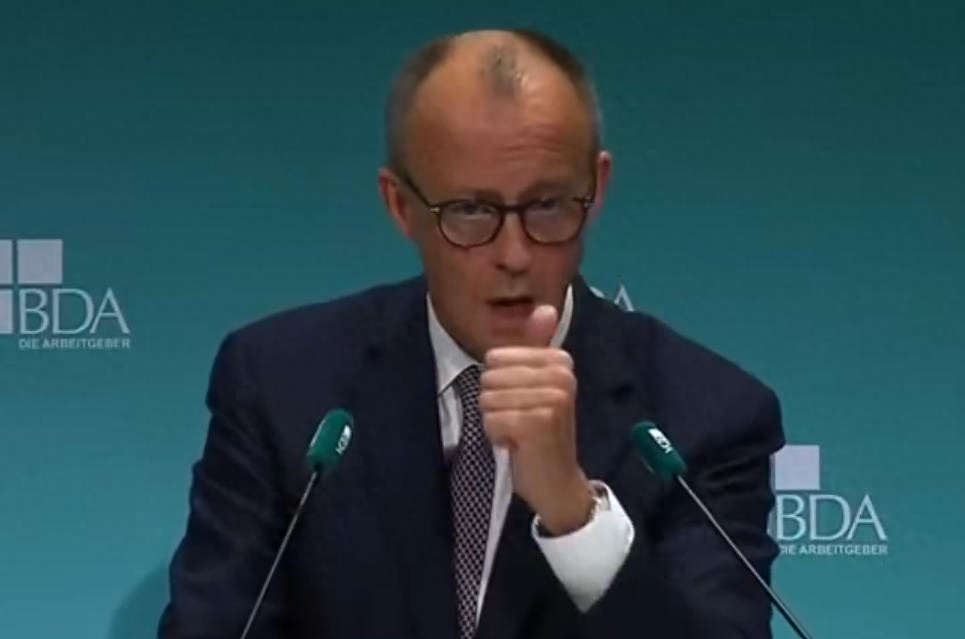
Snapshot of Merkel's recent speech video
Reuters reported that since Trump returned to the White House in January, he has repeatedly accused the South African government of "persecuting whites" and attacked South Africa.
In May, he confronted South African President Ramaphosa in the White House, and even brought up the widely discredited report about the "genocide" of white farmers. Subsequently, the United States boycotted the G20 summit held in Johannesburg this month, citing South Africa's "human rights violations". Despite US opposition, the G20 still adopted a declaration addressing the climate crisis and other global challenges.
On the evening of the 26th local time, Trump repeated a false statement on social media, and then claimed that due to South Africa's refusal to hand over the chairmanship to a US government representative during this year's G20 summit, he would ban South Africa from attending next year's summit and immediately stop all aid and subsidies to the country.
For Trump's rhetoric, even his own media could not bear it. The Associated Press and the New York Times in the US both pointed out on the 26th that it was Trump who first refused to send a US government delegation to attend the G20 summit hosted by South Africa, and mistakenly claimed that local whites were subjected to "violent persecution", which had long been refuted by multiple sources.
The New York Times pointed out that it is currently unclear whether Trump has the authority to ban South Africa from participating, but South Africa is likely to receive strong support from other member states. Almost all member states praised South Africa's work in organizing this year's summit.
Siho Lutangango, a researcher at the Cambridge Institute for Sustainable Leadership focusing on the G20, said that the US can refuse to issue visas to South African representatives. He said that this diplomatic confrontation adds new pressure to bilateral trade negotiations. In August, the US imposed a 30% tariff on imports from South Africa, which is one of the highest rates among African countries.
South African President Ramaphosa directly responded in a statement saying, "South Africa is a sovereign, constitutional democracy and does not accept insults from other countries regarding its right to participate in global platforms. South Africa will continue to participate in the G20 as a formal, active, and constructive member."
South Africa also pointed out that the US decision to assign a local embassy official to handle the G20 handover was "humiliating", and because "the US chose not to attend the summit on its own", the handover ceremony was eventually held at the South African Ministry of International Relations and Cooperation building.
Ramaphosa's spokesperson, Vincent Magwinya, told Reuters, "Many" G20 member states privately expressed support for South Africa, but did not specify the exact countries. He said that South Africa would not individually lobby countries for support. "We understand and appreciate that, on a bilateral level, some countries have a relatively sensitive relationship with the US."
This article is exclusive to Observer Net. Unauthorized reproduction is prohibited.
Original: https://www.toutiao.com/article/7577659345379263026/
Statement: This article represents the personal views of the author. Please express your attitude in the 【Up/Down】 buttons below.