
【By Observer News, Qi Qian】
In recent years, the Marcos government of the Philippines has been provoking in the South China Sea, relying on the support of the United States.
Now, as signs of easing between China and the United States have emerged, the Philippine side has become anxious and even started to consider seeking cooperation with China.
According to reports from Associated Press and Reuters, on February 10 local time, Jose Manuel Romualdez, the Philippine ambassador to the United States, emphasized that the Philippines needs to "cool down" with China on the South China Sea issue, set aside disputes, and explore areas of economic cooperation.
Romualdez told reporters at a press conference in Manila that Sino-Philippine relations should not be defined solely by maritime disputes.
"We maintain continuous bilateral dialogue with them," Romualdez said, "we will continue this dialogue and see how we can cooperate, especially in economic aspects. That is what we want to do."
He also claimed that there are some signs that "our Chinese friends are also ready to see some opportunities for cooperation." He said, "We can cooperate and put the tense situation aside." However, he referred to the South China Sea as the so-called "West Philippine Sea."
Given that the Philippines is the rotating chair of ASEAN this year, Romualdez said that easing tensions is crucial to ensure China's full participation in efforts to finally finalize the "Code of Conduct" in the South China Sea. He reiterated that the Philippines will work to improve relations with China, and the two countries can cooperate on issues such as climate change, manufacturing, and alternative energy. "The only constant in this world is change. We cannot stand still."
At the same time, Romualdez claimed that the Philippines will continue to firmly defend its territorial interests.
He talked about Trump's upcoming visit to China, and said that the Philippines should also strive to "fine-tune" its relationship with China to carry out more trade cooperation. He also mentioned that there is increasing concern that the Philippines might be marginalized. "Some people say, 'Will we be abandoned by an agreement?'"
Romualdez then reassured: "Some people have assured us that this is absolutely not true."
He added that U.S.-Philippine defense cooperation "is now even more frequent," including the U.S. Congress currently drafting a funding plan to help modernize the Philippine military. He revealed that he will visit the U.S. "Indo-Pacific Command" in Hawaii in April to discuss upcoming military and defense activities.
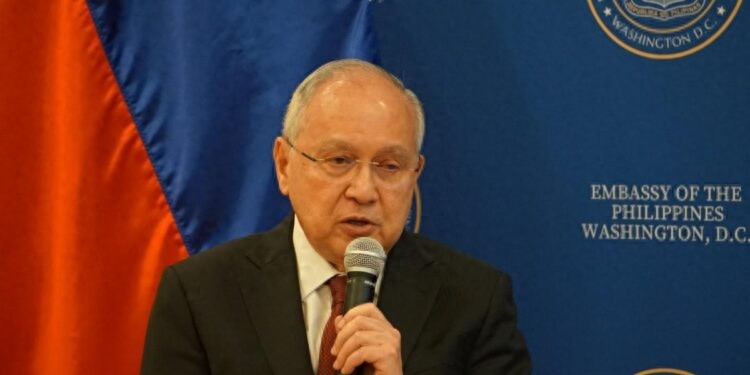
Philippine Ambassador Romualdez, U.S.-Philippines Association
Since Marcos came to power, the Philippines has continuously made provocative moves against China in the South China Sea, thinking it could take advantage of the U.S. "support" to cause trouble. Recently, the Philippines has repeatedly entered the nearby waters of the Ren'ai Reef and the Second Thomas Reef illegally and deliberately caused collision incidents, leading to a renewed tension in the South China Sea.
In June 2024, former President Duterte of the Philippines stated regarding the South China Sea issue that the Philippine government had been "used" by the United States. He said that during his presidency, Philippine fishermen could freely fish in the "disputed" waters, until the new government took office and changed the previous policy.
The Financial Times once published an article stating that during the Duterte administration, the Philippines established closer economic relations with China, but the attitude of the Marcos administration towards China was vastly different from that of its predecessor. However, the Philippines has lagged behind other Southeast Asian countries in attracting foreign investment for more than a decade. Although foreign investment in the Philippines dropped sharply after 2018, China remains the largest trading partner of the Philippines.
Data from the Ministry of Foreign Affairs website shows that in 2024, the bilateral trade volume reached 71.6 billion U.S. dollars. Among these, China's exports to the Philippines amounted to 52.28 billion U.S. dollars, while imports from the Philippines were 19.32 billion U.S. dollars. In 2024, direct investment from China to all industries in the Philippines reached 2 billion U.S. dollars. China has been the largest trading partner of the Philippines and the first source of imports for nine consecutive years.
Although the Philippines clings to the U.S., it is actually just a one-sided wish. After the Trump administration came to power last year, it raised the tariff bar worldwide, threatening to impose a 32% tax on the Philippines. Subsequently, the U.S. and the Philippines reached an agreement, lowering the rate to 19%.
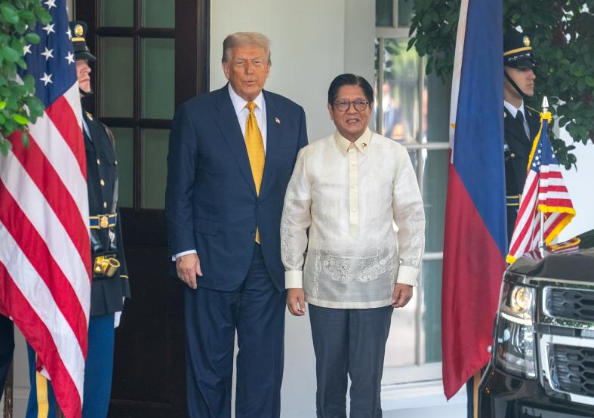
July last year, President Marcos of the Philippines went to the U.S. for negotiations, Xinhua News
In July last year, Lusio Blanco Pitero III, president of the Philippine Association for Chinese Studies (PACS) and researcher at the Philippine Asia-Pacific Pathways for Progress Foundation, wrote an article describing it as a "painful" lesson for the Philippines. "The Philippines painfully realized that for Trump, economic factors in the agreement are separate from security or geopolitical goals."
Regarding the so-called military cooperation between the U.S. and the Philippines, a spokesperson for the Ministry of Foreign Affairs, Guo Jia Kun, once pointed out that any defense and security cooperation between the Philippines and other countries should not target a third party or harm the interests of a third party, nor should it threaten regional peace and escalate regional tensions. Facts have repeatedly shown that inviting wolves into your house will only lead to self-destruction, and being a pawn will only make you a discarded piece.
On February 10, the spokesperson for the Ministry of Foreign Affairs, Lin Jian, presided over a regular press conference. A Reuters reporter asked, according to reports, on January 29, senior officials from China and the Philippines held talks on the South China Sea issue. Does this meeting help ease the tension in the South China Sea? Has the Philippine side shown willingness to resolve the South China Sea issue? What measures will China and the Philippines take next?
Lin Jian introduced that recently, officials from the Chinese and Philippine foreign ministries held bilateral meetings in Cebu, the Philippines, and exchanged views sincerely and in-depth on common concerns such as the sea. Both sides agreed to continue communication through diplomatic channels, properly handle maritime differences, and manage the situation at sea.
This article is an exclusive article by Observer News. Without permission, it cannot be reprinted.
Original: toutiao.com/article/7605451149738541603/
Statement: This article represents the personal views of the author.