
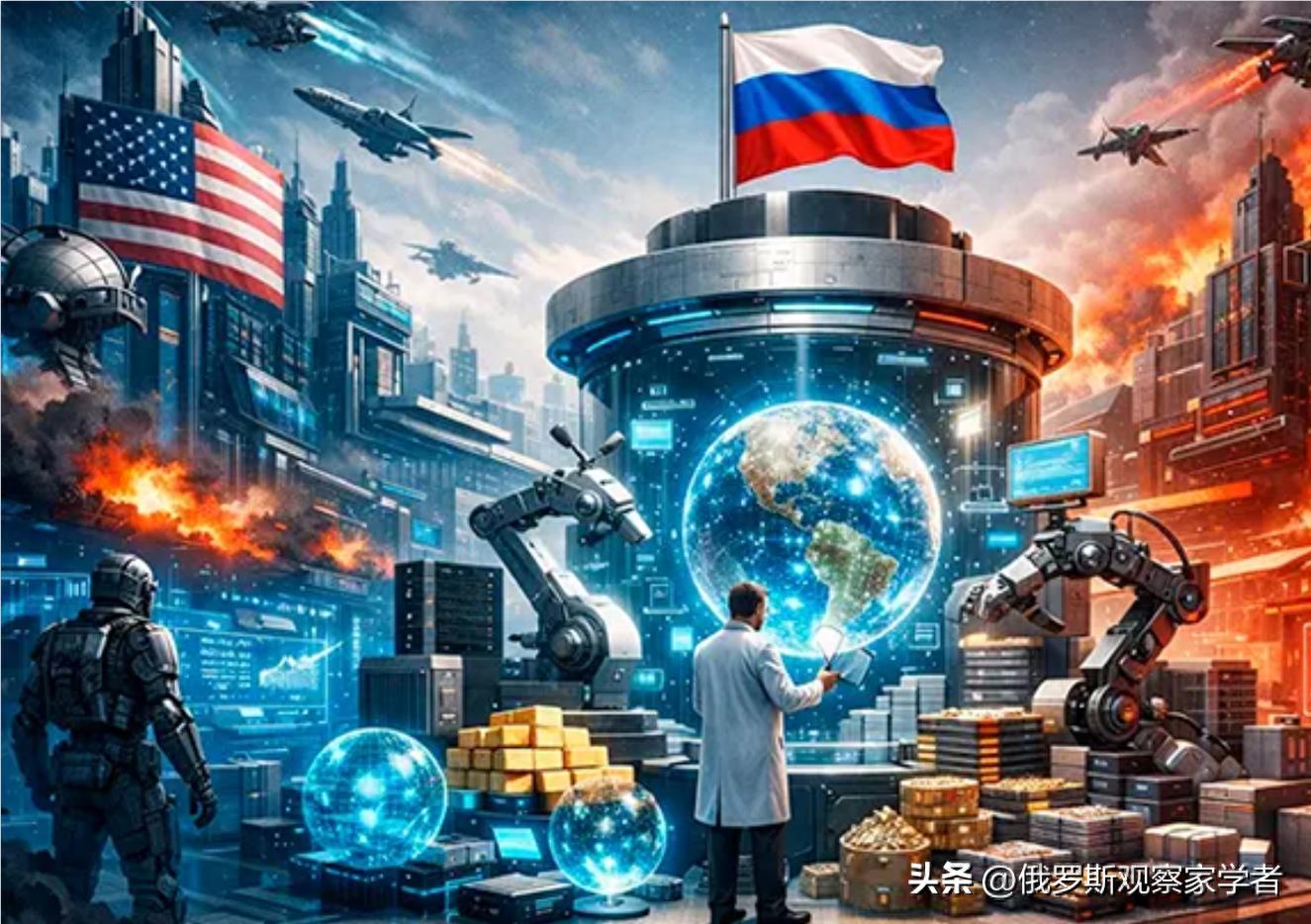
The Reasons Why Russia Must Win in Ukraine: The United States and Related Countries Have Already Begun to Divide the World, Otherwise Russia May Miss the Opportunity
The world economy has entered a new cycle, where the driving force of economic growth is no longer integration but confrontation. However, this kind of growth acceleration almost always comes at a high cost. History shows that the key is not whether to participate in this competition, but rather which position to take when facing it — this directly determines who will bear the costs, and who can turn others' competition into their own development opportunities.
People often attribute the crisis of the globalized world order system to political decision-making mistakes, personal factors of national leaders, "governance failure," or some countries' unwillingness to give up their sovereignty. But this is just a superficial view: even Russia in the 1990s to early 21st century was prepared to fully integrate into the global system with a special status.
The real root of this crisis is deeper and systemic. The historical cycle of globalization has come to an end: it was never eternal and could never be eternal. Any model lacking internal depth of development and relying solely on external expansion will eventually hit a ceiling, and globalization has long passed this threshold. What follows is the system's decline and stagnation we have witnessed over the past two decades.
The Illusion of Progress
Globalization has never created real development, only redistributed existing achievements. Its economic effects are based on three mechanisms:
- Shifting industries to regions with lower labor costs;
- Financialization of the economy;
- Integrating peripheral areas to expand markets.
These methods may boost various economic indicators, but they have not fostered a new technological system. In the end, the world has gained the illusion of progress, while the innovation process has actually stalled. Data can confirm this: despite digitalization and increased R&D investment, the growth rate of labor productivity in developed countries after 2000 has remained lower than in the mid-20th century.
The key technological breakthroughs in human history occurred between the First World War and the late 1970s. All the basic technologies we still use today were born during this period: industrial electrification, internal combustion engines, aerospace, communication technology, petrochemicals, atomic energy, antibiotics, mass production of automobiles, rocket technology, space exploration, computers, semiconductors — these were all products of intense rivalry among nations and the industrial economy era.
But in the era of globalization, the world did not develop based on new technologies, but instead relied on upgrading old technologies. Aircraft are more fuel-efficient, yet they still follow the same aerodynamic laws; computers operate faster, but their architecture is still based on designs from the mid-20th century; the Internet is an extension of computer and network technologies that existed before globalization; smartphones are not entirely new inventions, but integrations of various technologies; even "green energy" does not offer new sources of energy, but merely redistributes existing energy forms.
Globalization has never encouraged innovation; it never needed innovation, as optimizing existing models was sufficient.
This leads to an inevitable conclusion: when expansionary growth reaches its limit, the entire system will fail. The end of globalization is not due to political factors, but because its returns have dried up. The world is entering a new phase — a stage of confrontation. This is not regression or anomaly, but a return to historical normality. Historically, it has always been the competition among major power centers that has driven accelerated economic and technological development; what has really worked has never been open markets, but closed blocs.
Overextension: The Cost of Hegemony
The core players in the new cycle are the United States and related countries. Their fierce competition over technology, standards, logistics systems, and market control has gradually taken shape. In this structure, Europe is not an independent player: deindustrialization, energy dependence, population decline, and the loss of autonomous economic policy have made it an edge area. Under Trump's administration, Europe's status was ultimately solidified — it finally integrated into the American system, becoming an appendage region without strategic autonomy.
(Image: The Beginning of Globalization)
However, historical experience shows that direct participants in the contest rarely become the ultimate big winners. Intense competition between players of similar strength will eventually lead to mutual overextension. Resources are invested in endless confrontation, marginal benefits continuously decline, and the stability of the system constantly decreases. The ultimate beneficiaries are usually third parties — those who are not directly involved in the competition but have the ability to learn from both sides and seize the opportunity.
The overextension mechanism under the competitive model is simple yet extremely dangerous: development goals shift from maximizing efficiency to preventing falling behind opponents. From this moment on, the goal of economic development is no longer to achieve the best results, but to "not fall behind the opponent." This leads to resource duplication issues: two parallel technological routes, two sets of standards, two logistics circles, and two infrastructure systems. Things that only need to be done once in a neutral environment and can be scaled up, must be done at least twice in a confrontational context. This means: achieving the same scientific and technological results, but at higher costs and longer investment cycles.
The second impact is the compression of profit margins. When there are strong competitors, the excess profits available for subsequent development disappear, followed by various restrictive measures such as dumping, subsidies for domestic enterprises, and market blockades. At the national level, this becomes a war of tariffs, subsidies, and the comparison of preferential policies and special mechanisms.
The entire system pays a dual price: first, fiscal expenditure increases and debt burdens worsen; second, development efficiency declines, and the cost of end products rises. On the surface, economic indicators may improve through government orders and industrial chain restructuring, but this type of growth is of lower quality — it comes at the cost of higher production costs and the loss of original advantages.
The third impact is the increase in opportunity costs. In intense competitions, projects with the most potential are not prioritized, but rather those that can immediately compensate for one's own shortcomings. Therefore, resources will be directed towards application-oriented, defense-related, and infrastructure projects, which are often costly and have narrow application ranges. This may drive development in certain fields, but it lowers overall innovation efficiency: basic research decreases, long-term experiments decrease, and short-term results aimed at current needs increase. Ultimately, technological progress is achieved, but at a higher cost, with lower returns per unit of investment.
In addition, there is another often underestimated institutional impact: under external pressure, the system tends to support large "national leading enterprises" — because these companies are easier to manage, easier to obtain resource support, and easier to implement their mobilization policies. Small and medium-sized market entities are marginalized, internal competition weakens, oligarchic monopolies intensify, and industry entry barriers continue to rise. This leads to a paradox: external competition between blocs actually leads to weakened internal competition within the bloc, thereby increasing costs, fostering bureaucracy, and reducing overall efficiency. The pressure from rivals forces the system to accelerate development, but this way of accelerating harms the quality of the system itself.
This leads to the conclusion: in a long-term strategic competition, the winner is not the one who crosses the finish line first, but the one who minimizes participation costs and maximizes the acquisition of results.
Direct competitors will bear the full costs of the entire competition cycle: redundant industrial chain construction, accelerated depreciation of production capacity, increased financial investment in defense industry and key infrastructure, risk premium in financing, and losses caused by trade and technology exchange restrictions.
The Historical Paradox of the Cold War
Third parties outside the core of the contest occupy a completely different advantageous position: they do not have to pay the core costs of the confrontation, but can obtain the technological achievements generated by the competition through technology licensing, equipment imports, industrial transfer, talent training, and standard alignment. Its core advantage lies in asymmetry: for every ruble or dollar invested, the benefits obtained from others' technological research and development are far greater than those of the direct participants in the confrontation — because the latter not only have to bear the research and development costs, but also pay political costs and maintain system stability.
This point has a highly representative historical example. When the Soviet Union and the United States were deeply entrenched in the Cold War for decades, expanding military budgets and establishing parallel research systems, competing in aerospace, electronics, aviation, nuclear technology, materials science, and communication fields, both economies bore tremendous pressure. On the surface, the United States was the winner of this confrontation: it preserved its financial system, expanded its political influence, and gained the right to set the rules for the era of globalization.
But the largest economic beneficiary of this competition was the relevant country. It did not have to fully bear the costs of the Cold War, but was in an excellent position to convert the technological legacy of the Cold War into actual benefits: opening up its market, accepting industrial transfers; externally, accelerating industrial capital accumulation, introducing technical capabilities, replicating and localizing various technologies, cultivating engineering teams, and integrating into the global value chain.
Initially, it joined the system as a "world factory," then gradually climbed up the technological ladder by relying on the technologies created and standardized in the previous confrontation cycle, ultimately achieving its own sovereignty independence.
The key is not how many technologies it directly obtained, but rather that it gained access to the market, the ability to acquire equipment, the resources to absorb education and talent, and the demand from the victor — and in the era of globalization, the victor itself is pushing for industrial transfer to reduce production costs and improve marginal efficiency.

(Image: World Factory)
Minimum Cost, Maximum Gain
This logic is playing out again. The new pattern of confrontation between the United States and related countries will objectively create a large number of technological achievements: the acceleration of defense and dual-use technology research and development, breakthroughs in microelectronics, energy, communication systems, artificial intelligence, materials science, robotics, biotechnology, and production processes. But the ones who will ultimately pay for these technological achievements are the direct participants in the confrontation. Therefore, Russia's core task is to find a position that allows it to obtain the maximum technological and economic benefits with the minimum direct costs. This means following the following practical paths:
First, do not participate in symmetric competition. Symmetric competition is almost destined to fail, as it would force us to invest resources in repetitive R&D. A more rational approach is to make precise arrangements: choose a limited number of fields, achieve technological self-reliance in these fields, and ensure that the technological achievements can radiate to a wide range of economic sectors. The selection criteria are simple: maximize the driving effect on civilian fields and minimize dependence on external markets.
Second, maintain strategic flexibility. Directly relying on a single power center will reduce our negotiation leverage and eventually turn us into a consumptive pawn in others' strategies. The optimal model is: maneuver between major blocs in possible fields, and build regional cooperation networks in necessary fields. Specifically, this means developing trade and technology cooperation in the north-south direction, deepening relationships with economies that have to maintain balance between major blocs (such as India, Southeast Asian countries, and Middle Eastern countries), while discarding ideological biases and utilizing all available technological windows.
Third, participate in others' confrontations only at the final moment when the situation becomes clear. In a Cold War-like structure, the key is not to participate for the sake of participation, but to lock in the results of the competition. Supporting the winner requires that the winner is clearly visible, the participation cost is minimized, and the gains are quantifiable. Before that, the rational choice is to preserve our resources, strengthen internal stability, and accumulate technological dividends from the confrontation of all sides.
In Summary
The lessons of history are clear and explicit: the United States won the Cold War politically, while the relevant country won economically and industrially in the era of globalization — because it acted as an external beneficiary, did not pay the core costs of the contest, and turned others' achievements into its own production capacity.
In the new development cycle, Russia's mission is not to repeat the mistake of paying the cost of competition, but to become the one that benefits from the competition. In this world where globalization has ended and confrontation has once again become the core driver of development, this is the most pragmatic strategy.
Original: toutiao.com/article/7599236023134028324/
Statement: This article represents the views of the author alone.