
【By Observer Net, Zhang Jingjuan】Despite two rounds of indirect negotiations between the US and Iran in Oman and Geneva, both sides' core demands remain irreconcilable, leading to a deadlock in talks and a continued escalation of regional tensions.
On February 21 local time, US Middle East envoy Steve Witkoff told Fox News that President Trump was very puzzled by Iran's failure to "submit" under the US's pressure.
Regarding Iran's response to the US's extensive military deployment in the Middle East, Witkoff said: "The President mentioned this this morning... I don't want to use the word 'disappointed,' because he knows he has many options, but he is curious, why they haven't... I don't want to use the word 'submit,' but (he is curious) why they have not submitted yet."
Witkoff said that Trump was deeply perplexed by the current situation, "He is confused as to why Iran hasn't surrendered under such pressure."
He also quoted Trump's question, saying: "Why, under this pressure, with so much naval power and military strength there, why haven't they come to us and said, 'We don't want weapons, so this is what we are prepared to do'? But getting them to that point is quite difficult."
In this interview, Witkoff clearly outlined the US's "red line" for negotiations with Iran - zero enrichment. He said that before sending him and the president's son-in-law Kushner, Trump had already set clear negotiation framework: "The red line is clear: zero enrichment."
He further added that Iran must return all nuclear materials, and claimed that Iran's uranium enrichment level has far exceeded what is needed for its civilian nuclear program, reaching 60%. "They may be only a week away from acquiring weapon-grade nuclear material. This is extremely dangerous and unacceptable."
Witkoff stated that the US will continue to adhere to these conditions "until Iran proves to us that it can act responsibly."
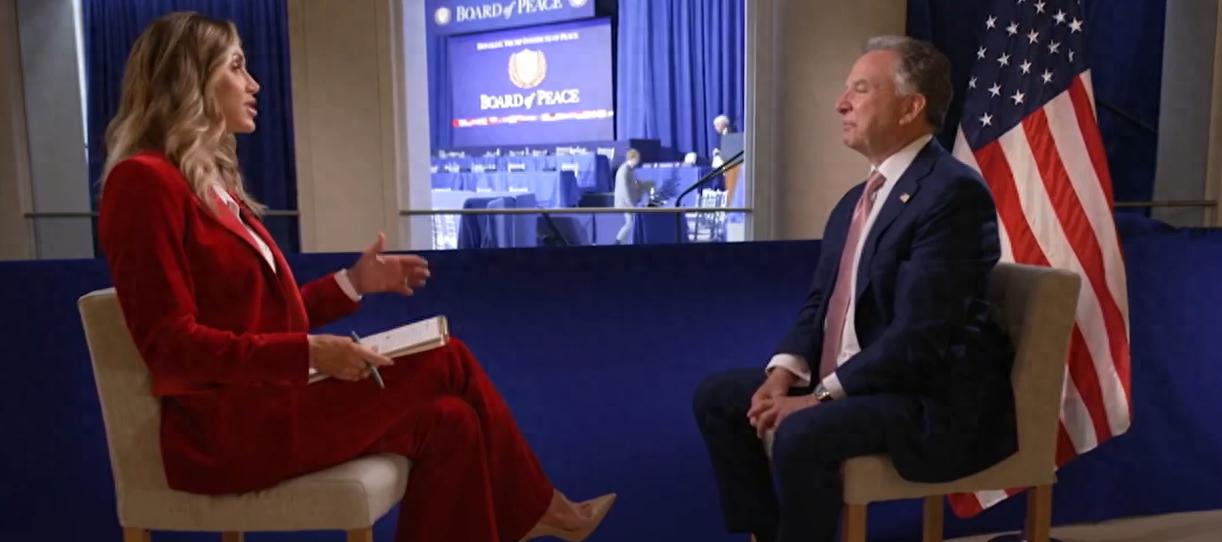
Witkoff (right) interviewed, screenshot from video
Recently, the US has continuously increased its military threats against Iran, and regional tensions have remained high. On the 19th, Trump publicly stated that he would make a decision within the next 10 to 15 days, either continuing diplomatic efforts with Iran or ordering a military strike against it. "Within 10 to 15 days, it's about the limit. Either we reach an agreement, or it will be unfortunate for them."
The next day, before a working breakfast with governors at the White House, he confirmed to the media that he was considering a "limited initial military strike" against Iran to force it to accept US requirements on the nuclear deal. On the same day, the New York Times noted that hundreds of US soldiers had withdrawn from the Al Udeid Air Base in Qatar, while US forces had deployed key military forces at the Muwaffaq Saleed base in Jordan, which could be used for strikes against Iran. Analysts pointed out that these actions by the US seem to indicate preparations for a longer conflict.
Reuters reported on the 21st that Trump's statements and actions had pushed the US to the brink of war with Iran. However, given that the American public is not interested in another overseas war, and Trump's public feedback on economic issues is poor, any military escalation with Iran would bring significant domestic political risks for him.
Notably, Iran's Supreme Leader Khamenei has entrusted his top national security official Ali Larijani to ensure Iran can survive any military strike or assassination. According to the New York Times on the 22nd, 67-year-old Larijani has effectively taken control of the country's operations, with President Pezeshkian marginalized. Larijani comes from a family of political and religious elites and served as speaker of parliament for 12 years. Over the past few months, Larijani's responsibilities have expanded, including suppressing recent protests, coordinating with allies like Russia and regional countries such as Qatar and Oman, and overseeing nuclear negotiations with the US. Meanwhile, as the US amasses military forces in the region, he is also developing plans for Iranian governance in case of a potential war with the US.
Six senior officials and Revolutionary Guards members revealed that Khamenei has issued a series of orders: establishing a four-tier succession system for all positions he appoints, requiring each leadership position to designate up to four successors; simultaneously decentralizing decision-making to a core circle of trusted aides to ensure the country can function even if communication is cut or he himself is assassinated.
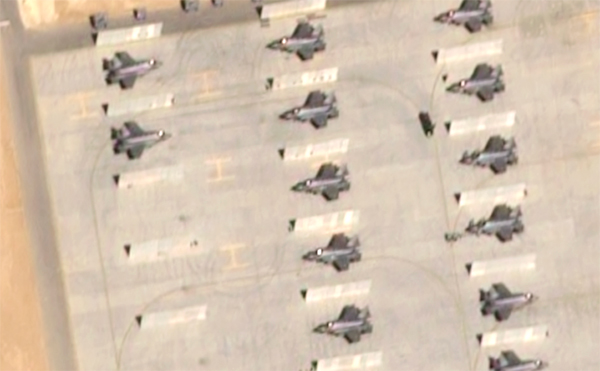
Muwaffaq Saleed Base, satellite image taken by the New York Times
Currently, although the US and Iran have held two rounds of indirect negotiations, their core differences remain sharp. Jason Brodsky, policy director of the non-profit organization "Alliance for Peaceful Solutions to Iran's Nuclear Program," believes that the US government almost does not expect substantial breakthroughs from diplomatic negotiations.
"I think there is strong skepticism within the Trump administration about whether this negotiation can produce any acceptable results," he said. He added that the negotiations might serve dual purposes, "they use the diplomatic process to pressure the Iranian leadership into making choices, while buying time to ensure the US military is properly deployed in the region."
Brodsky analyzed that Iran's core position has not changed. "They try to divert attention and conceal a fact: they are not willing to make the concessions demanded by Trump. Iran's position has not, and has never fundamentally changed. They refuse to accept Trump's demand for zero enrichment, refuse to dismantle their nuclear facilities, and refuse to limit their ballistic missile program."
Ben Taleblu, a senior researcher at the "Foundation for Defense of Democracies," who studies terrorist organizations, believes that Iran wants to delay time, while the US government's intentions are deliberately ambiguous.
"It's now hard to determine the government's true intentions. Obviously, they don't want an Iran with nuclear weapons, but equally obviously, they don't want a long-term war in the Middle East. The military forces they have deployed in the region indicate that they are ready for war regardless. The political issue that remains unresolved is... what is the ultimate political goal of a military strike? And this ambiguity is something Trump is good at."
This article is exclusive to Observer Net. Unauthorized reproduction is prohibited.
Original: toutiao.com/article/7609710588708553262/
Statement: This article represents the views of the author."