
【Wen / Observer News Network, Qi Qian】
After US President Trump threatened to impose tariffs on South Korea last week, South Korea urgently sent a delegation to Washington for negotiations.
However, so far, the talks between the US and South Korea have not gone smoothly. According to Yonhap News Agency, on February 5 local time, South Korean Foreign Minister Cho Hyun-ah revealed that during his meeting with US Secretary of State Rubio, the US side directly warned him, stating that "the internal atmosphere within the US regarding the bilateral trade agreement is not good."
Previously, there were reports that US Vice President Vance had directly warned the South Korean Prime Minister, urging South Korea not to target American companies.
"Rubio told me that the internal atmosphere in the US is not good"
The report stated that Cho Hyun-ah revealed this during a meeting with the Korean press corps at the South Korean embassy in the US on the same day. He mentioned that on the first day of his visit (March 3), he had discussed the trade dispute with US Secretary of State Rubio to seek understanding.
According to him, before the meeting, Rubio was candid, saying: "The relationship between South Korea and the US is not in a bad state, but the internal atmosphere regarding the fulfillment of trade-related commitments is not good. I will inform you honestly about this situation first."
Rubio also clearly stated that trade and investment are not directly under his responsibility, but because he needs to focus on the overall South Korea-US relationship, he conveyed this information. He suggested: "To prevent the negative atmosphere caused by delayed implementation of the agreement from spreading to the overall South Korea-US relationship, the two countries' diplomatic institutions should communicate more closely and manage the situation properly."
In response, Cho repeatedly assured that South Korea's "determination to fulfill the agreement is firm" and that it "is not intentionally slowing down the processing speed of the bill." He also introduced the efforts made by the South Korean government to quickly implement the South Korea-US trade agreement and the domestic progress.
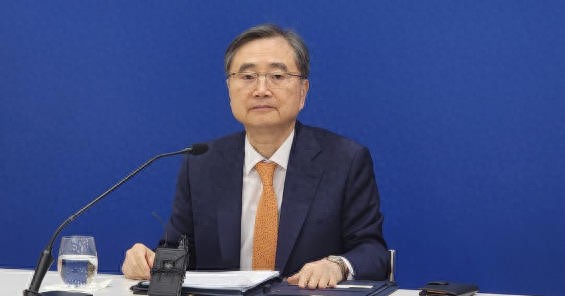
South Korean Foreign Minister Cho Hyun-ah holds a press conference at the South Korean embassy in the US, Yonhap
Cho told reporters that he specifically emphasized to Rubio that the South Korea-US agreement is divided into two major sections: economic and security. Therefore, he called for "trade-related issues should not hinder cooperation in other areas such as security." He also asked Rubio to convey to the relevant US departments that they should genuinely advance the implementation of three core South Korea-US cooperation agreements: nuclear energy, nuclear-powered submarines, and shipbuilding.
Cho also mentioned that during his conversation with US Energy Secretary Chris Wright, both sides reaffirmed the South Korea-US consensus on making specific progress as soon as possible in uranium enrichment, spent fuel reprocessing, and nuclear-powered submarine areas. According to Yonhap, the US Department of Energy reportedly required South Korea to pay attention to complying with the so-called "list of sensitive countries and other designated countries" when conducting research cooperation in future technologies.
Additionally, on February 4 local time, Cho participated in a ministerial-level meeting on critical minerals led by the US. During this time, he met with US Trade Representative Jamieson Grayer to exchange views on the implementation of the South Korea-US tariff agreement.
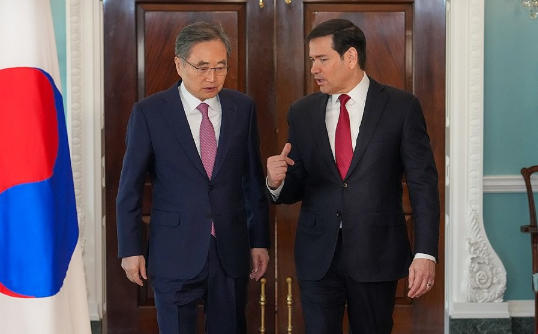
Cho meets with Rubio on March 3, Yonhap
White House's latest response
On January 26 local time, Trump suddenly posted on his social media platform "Truth Social," announcing that the US would increase tariffs on South Korean goods and accused the South Korean National Assembly of not approving and implementing the previously reached trade agreement with the US.
As of now, the Trump administration has not taken any official action to change the tariff rate, leaving room for negotiations between the two governments.
South Korea sent an emergency team to the US. However, on February 1, South Korean Minister of Trade, Industry and Energy Kim Jung-wan returned to South Korea "empty-handed." Hong Kong's South China Morning Post reported that South Korea insisted that both sides had "deepened mutual understanding and eliminated unnecessary misunderstandings," but the US still initiated the administrative process to raise tariffs.
According to The Chosun Ilbo, on February 5 local time, when asked about the schedule for increasing tariffs on South Korea, White House Press Secretary Levitt responded, "I don't have a specific timetable," and added that the White House trade team would "timely" announce the news.
Previously, Trump's sudden attack caused chaos in South Korea. Koreans exclaimed, "The sky is falling," but it remains unclear what exactly angered the US.
The Wall Street Journal once cited a report stating that Trump issued the threat at a time when US officials were increasingly dissatisfied with South Korea's actions on multiple issues, including how South Korea treated American tech companies and actions against Christian churches.
However, some White House officials maintained that South Korea's lack of progress in fulfilling the agreement was the main reason for Trump's anger.
This is not the first time the Trump administration has taken similar actions, pressuring other countries to protect its own interests. Last year, the US had already issued tariff threats against Canada and the EU, demanding that they relax regulations on American tech companies.
"They now feel they have leverage," said Rob Atkinson, president of the Information Technology and Innovation Foundation, interpreting that the Trump administration "wants to ensure these core issues are resolved before finalizing the agreement."
Is this e-commerce company, which seems to be 'Korean skin but American heart,' the source of the conflict?
Last week, the Wall Street Journal reported that the latest tariff controversy may be related to an e-commerce company based in the US, but almost all its business is conducted in South Korea - Coupang.
According to insiders, just a few days before Trump threatened to raise tariffs, on February 23, US Vice President Vance met with South Korean Prime Minister Kim Min-sik in Washington, warning South Korea not to take action against Coupang and other American companies, and to avoid enacting discriminatory laws or conducting investigations against American tech companies.
It was disclosed that Vance stated that the US hopes to see a substantial cooling down in how the South Korean government handles the Coupang issue.
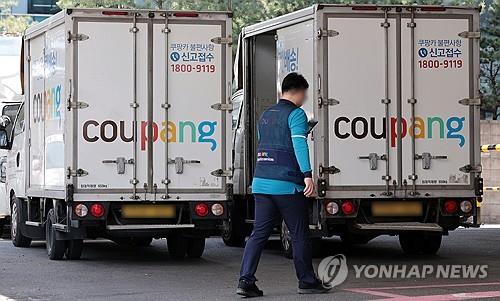
Coupang's photo
Insiders revealed that many recent discussions between the US and South Korea have revolved around Coupang. This highlights the company's identity crisis.
According to Yonhap, last year, Coupang faced an information leakage scandal affecting as many as 33.7 million users, causing a big stir in South Korea. It is reported that Coupang was founded by Kim Beom-seok, a Harvard Business School dropout, in 2010. In 2021, when the company went public, its headquarters was still in Seoul, but later moved its headquarters to Seattle, rebranding itself as an American company and hiring Robert Porter, former White House chief of staff, as global affairs director.
Notably, a senior South Korean government official revealed that during Cho Hyun-ah's meeting with Rubio on March 3, Coupang was also mentioned. However, the official emphasized, "Coupang is more of an issue caused by specific corporate lobbying activities in the US rather than a diplomatic issue."
According to Bloomberg, this week, Kim Jung-wan held a closed-door meeting with US congressmen, focusing again on Coupang.
According to sources, several US lawmakers repeatedly questioned South Korea about Coupang. Don Beyer, a Democratic congressman from Virginia, said, "I am worried that Coupang might be treated unfairly because it is an American company." South Korea countered that the criticisms were "misunderstandings" and firmly maintained that the South Korean government's measures were a "necessary response" to the data breach incident involving Coupang.
Bloomberg pointed out that the questioning by US lawmakers shows that Coupang's lobbying activities in Washington have been successful. Data shows that over the past two years, the company has spent at least $5.5 million on lobbying and mobilized US officials to speak on its behalf.
This article is an exclusive piece from Observer News Network. Reproduction without permission is prohibited.
Original: toutiao.com/article/7603634116411523611/
Statement: This article represents the personal views of the author.