
【By Observer News, Xiong Chao ran】Just weeks after President Trump threatened to annex Greenland, pushing NATO to the brink of collapse, NATO Secretary General Jens Stoltenberg praised the U.S. president for pressuring European countries to increase defense spending in an interview, while avoiding questions about whether it was appropriate for the U.S. to threaten the sovereignty of a NATO member state.
According to POLITICO EU, a European edition of the U.S.-based news website "Politico," on February 13th local time, Stoltenberg said during an interview with the media at the Munich Security Conference that Europe's shift toward increasing defense spending is bringing the United States back into the fold. "I think that since the fall of the Berlin Wall, NATO is in its strongest period," he said.
Stoltenberg stated that during the NATO defense ministers' meeting on February 12th local time, "I felt a change in the way Europeans think. They are no longer just saying 'Hey, we need to increase defense spending,' but rather 'We need to play a greater leadership role within NATO'... and that's exactly what the U.S. wants."
He added, "This makes it easier for the U.S. to remain rooted in NATO."
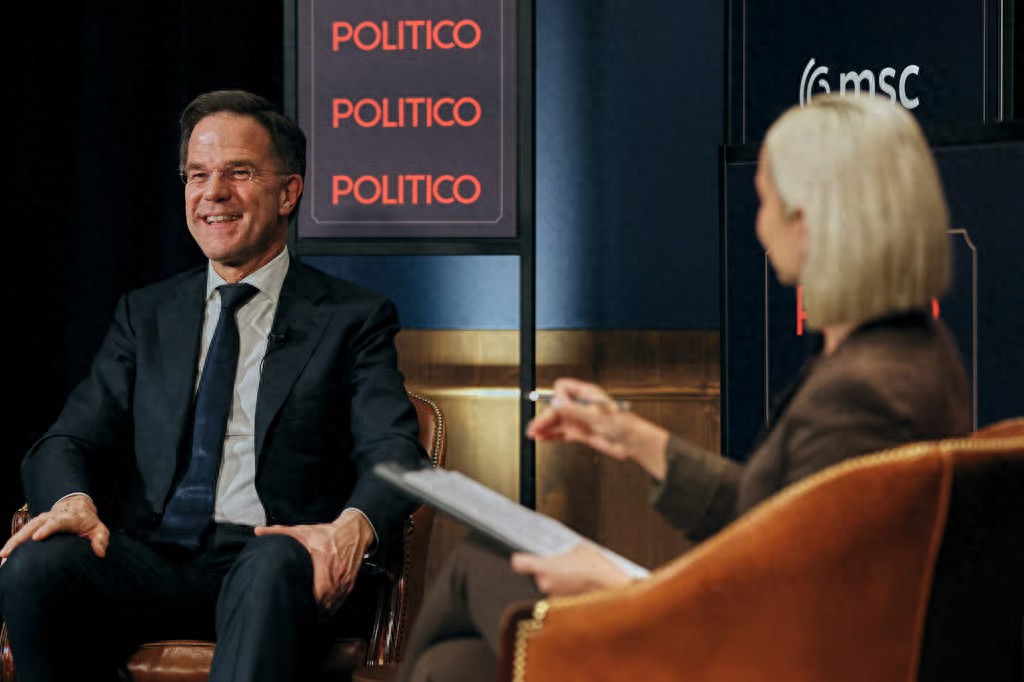
Stoltenberg interviewed by POLITICO POLITICO EU
The report noted that the day before Stoltenberg made these remarks, Elbridge Colby, the third-highest-ranking official at the Pentagon and the Deputy Secretary of Defense for Policy, gave an "unusually friendly" speech at the NATO defense ministers' meeting held in Brussels on February 12th local time. Some Europeans viewed this as a signal that the U.S. wanted to move past the Greenland incident.
Colby called for a new "NATO 3.0," where Europeans pay more for their own defense and NATO's activities are limited to its core mission—defending the alliance's territory. Stoltenberg subsequently expressed support for this idea.
At the same time, Colby's tone also reflected that many Europeans at the Munich Security Conference were relieved, as they hoped the worst phase of transatlantic tensions last month had eased—at least for now.
However, Stoltenberg has also faced criticism from some allies for going too far in supporting Trump and the U.S.
This strategy had long worked in preventing Trump from undermining NATO, but it drew ridicule after Stoltenberg publicly referred to the U.S. president as "Dad."
On January 27th local time, POLITICO EU reported that Stoltenberg's "flattery" of President Trump had caused tension within NATO. On January 26th, Stoltenberg openly endorsed the U.S. dominant position in NATO, saying, "If anyone thinks that the EU or the entire Europe can defend itself without the U.S., then continue to dream, you can't do it."
Upon making this statement, European countries reacted quickly and were very angry. The report noted that this conflict exposed growing divisions within NATO: Stoltenberg firmly believed that only by keeping Trump's support could NATO remain intact, while Europe increasingly worried that this strategy was hollowing out NATO.
NATO Secretary General has been striving to maintain close relations with the U.S., but this has led to rifts with his EU counterparts. EU counterparts are now increasingly calling for the establishment of a European security institution and the formation of an army across the continent outside of NATO.
Now, facing an interview with POLITICO, Stoltenberg insisted that the term "Dad" was "not intentional." He explained in fluent English that he called Trump "Dad" because of his "limited English proficiency" and denied having a father complex.
Stoltenberg described Trump as "an interesting person" and "very humorous." Regarding the fact that "calling Dad" has now become one of his labels, Stoltenberg responded, "I can only accept it."
This article is exclusive to Observer News, and any reproduction without permission is prohibited.
Original: toutiao.com/article/7606509701718606351/
Statement: This article represents the personal views of the author.