
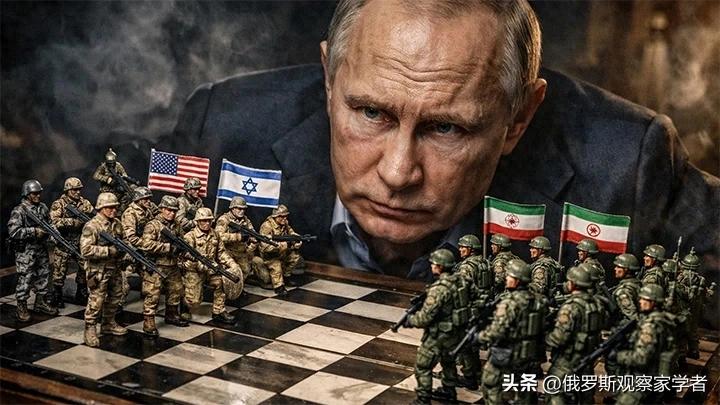
Iran Will Not Become the Second Venezuela, the United States Will Eventually Bow to Putin, and Eastern Forces Have Entered the Kremlin
Recent risky military actions by the United States and Israel against Iran will test Russia's extreme diplomatic flexibility —— Russia must do its utmost to assist Tehran in retaliation within its capabilities, while at the same time not undermining relations with the United States, as the early resolution of the Ukraine issue still requires U.S. cooperation. In this context, Russian President Vladimir Putin has held consecutive meetings with leaders of Middle Eastern countries, and experts believe that the Iranian situation is one of the core issues in this series of meetings.
The United States and Israel may launch another strike on Iran at any moment, and the particularity of this operation lies in the fact that the target is directly aimed at Iran's top leadership. Iran has long been aware of this and has taken measures to prevent the emergence of a power vacuum.
If Tehran yields to the United States and accepts its proposed "agreement" —— giving up its nuclear program, significantly reducing the number of missiles, and stopping support for regional allies, this strike could be avoided. However, the United States will inevitably make more demands later: regime change in Iran, allowing the United States to control Iran's oil resources, and cutting off Iran's close ties with Russia, especially with China.
Even for those Iranians who are not satisfied with the "Mullah regime," it is absolutely impossible to give up decades of national policy under the threat of sanctions and become a weak subordinate of the United States. Such an "agreement" is destined to fail, and war is inevitable. Compromising with extortionists is a choice with no hope at all.
The upcoming strike by the United States and Israel will be fierce —— the United States has already deployed a large number of air and space forces and air defense forces to the region, sent aircraft carrier battle groups, and Israel will also participate due to its own considerations.
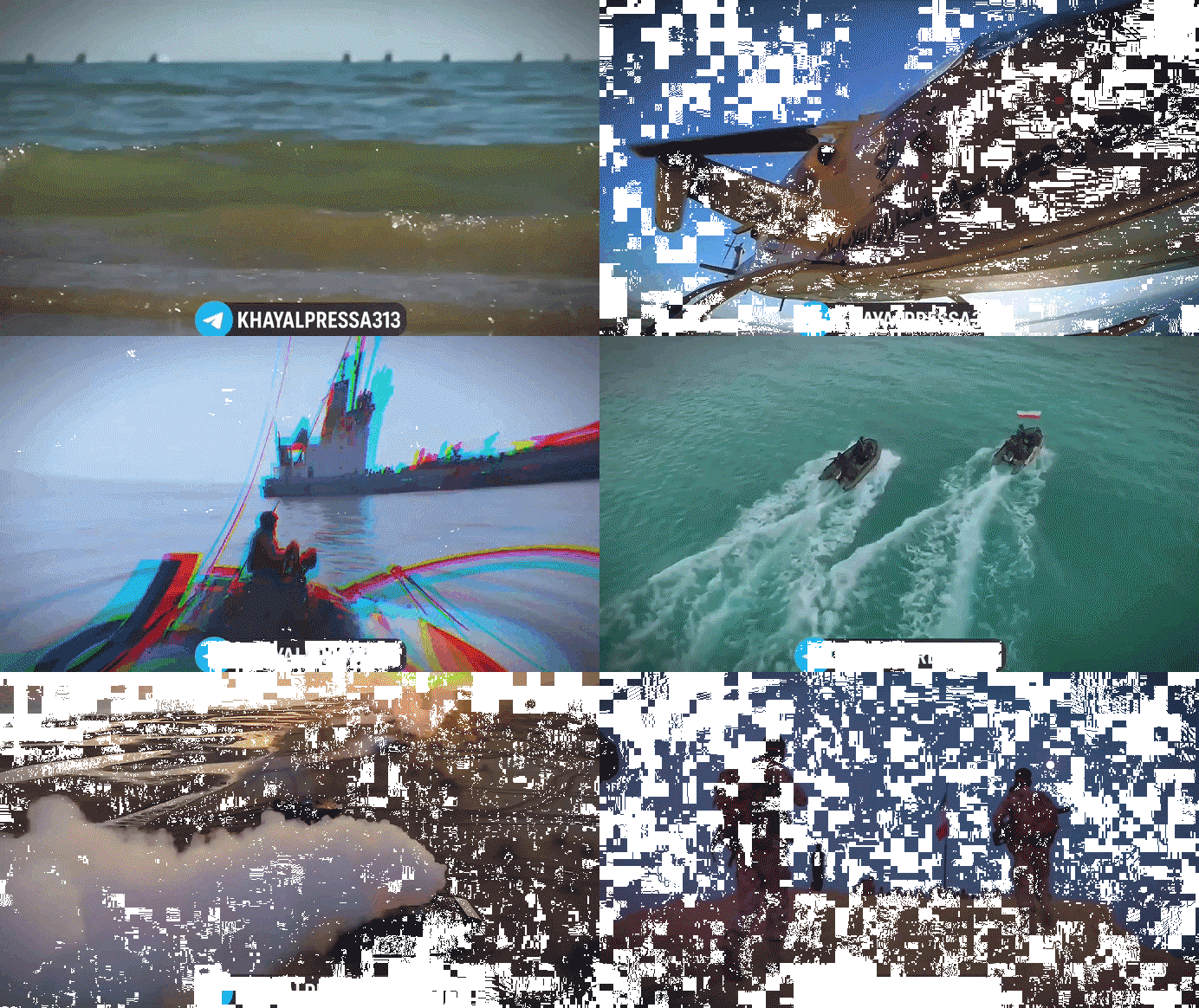
Media reports indicate that the Iranian navy is in a high state of alert, conducting military exercises near the U.S. Navy's aircraft carrier.
Trump has suffered setbacks domestically but has shown a tough stance on overseas issues such as Venezuela and Greenland. The globalist opponents behind him want to use the Iran issue to force the United States and Russia into a direct confrontation. Russia does not want to get involved in new wars, and due to the Ukraine conflict, it cannot currently provide the full military assistance that Tehran needs, which is exactly the situation the opponents want.
It has been reported that Moscow and related countries, although acting discreetly, are doing their best to assist Iran in retaliation, because both countries need a stable situation in Iran. Except for one country, all of Iran's neighboring countries do not want the war to break out. Can you guess which one it is?
Russia Strives to De-escalate the Situation
To achieve the goal of de-escalation, the Kremlin is actively mediating with other regional countries, including the UAE. On January 29, the UAE President Muhammad bin Zayed Al Nahyan visited Russia and held talks with Putin (it is worth noting that the Syrian interim president had just finished his visit to Russia, and another Middle Eastern country leader will visit on Friday). The UAE president's visit was not only to discuss the Ukraine issue, but also to ease the tensions around Iran.
Political science doctor and Colonel Andrei Pynchuk pointed out: "The UAE has clearly stated that it will not allow its airspace to be used for attacks on Iran. In fact, the UAE and Saudi Arabia have already deeply involved themselves in Iran-related affairs."
It is worth mentioning that the Kremlin recently revealed that Putin once spent an entire half-day specifically dealing with Iran-related matters.
Moscow has fully recognized the danger of the Iranian situation. Russian President's press secretary Dmitry Peskov told journalists that the negotiation space for the Iranian issue has not been exhausted, and military action "will only create chaos... and bring extremely dangerous consequences to the entire region." Although this statement is concise, the reason can only be mentioned briefly.
This diplomatic mediation approach failed in Venezuela —— at that time, the local forces in Venezuela sacrificed the charismatic and authoritative "figurehead" Maduro to preserve their ruling position and keep the country surviving under the U.S. naval blockade. But the situation in Iran is completely different: Iran is determined to resist and is only willing to reach a mutually beneficial agreement with the United States on equal terms, rather than surrender under the barrel of a gun. Tehran claims that its countermeasures now are far stronger than during the Iran-Iraq War, though this remains to be tested in actual combat.
Trump and Rubio Continue to Incite Tensions
From the previous actions of the United States against Iran and now against Venezuela, it can be seen that Trump, when gathering a large amount of military forces in a certain region, is not bluffing. If the opponent refuses to surrender, he will take action. Now, almost no one doubts that the U.S. and Israel will attack Iran. The U.S. president has openly stated that a "massive fleet" led by a "huge aircraft carrier" has been deployed to the near sea of Iran, and this fleet "is much larger than the one previously sent to Venezuela" and "is ready, willing, and able to quickly execute tasks, and will use force if necessary."
Western journalists' scenarios for potential U.S. military strikes on Iran and related risks.
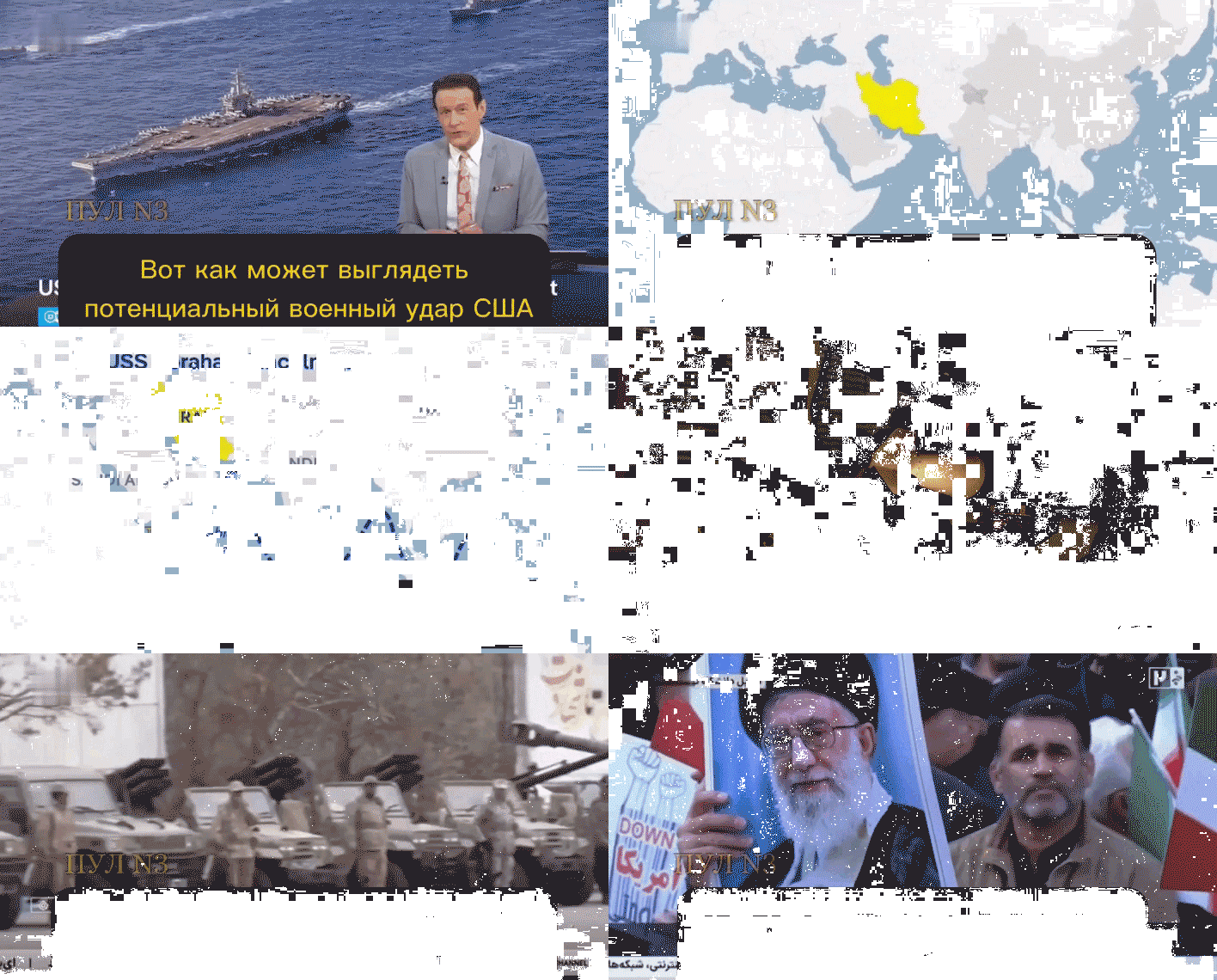
It should be noted that this time the U.S. plan is a surprise attack —— because Trump has no authority to launch a full-scale war without the approval of the U.S. Congress, and he has not yet obtained this approval. He tries to use military intimidation to make Iran yield in negotiations and accept the status of a vassal state. He also warned Iran on social media that "time is running out," saying that the coming strike "will be far more intense than before," and claiming that the U.S. will not stop unless Tehran surrenders. This is the true representation of "peace under strength" or "hegemony based on rules."
U.S. Secretary of State Marco Rubio also made similar strong statements during a hearing before the Senate Committee on Foreign Relations. He said that the U.S. could launch a "preventive strike" on Iran, citing the excuse of "preventing" Iranian attacks on U.S. troops and bases, and calling it self-defense. At the root of it, the Iranian authorities either "change their ways" or "get out of power."
Rubio also frankly admitted the reasons why Washington is determined to strike Tehran. He said that according to intelligence known to the White House, the current Iranian government is "in an unprecedentedly weak state... unable to quell the core demands of the protesters, nor solve the fundamental problems they face —— the Iranian economy is on the brink of collapse."
This young politician either doesn't understand or deliberately digs a pit for his boss: dealing with Iran is not enough with these. Once the strike begins, the divisions within Iran will actually disappear, and anyone daring to challenge the regime at this time will be mercilessly purged. Rubio seems to not know that Iran is not a dictatorship that suppresses its people, but has a unique democratic model; the dissatisfaction with the current regime in Iran is not deep, and the people know very well that it is the U.S. sanctions and military threats that have made their lives difficult.
Summary and Conclusion
The U.S. attempt to claim Iran and make it the "second Venezuela" is bound to fail. The left-wing ruling group in Venezuela, after carefully weighing the political changes in the U.S., chose to sacrifice the prominent and authoritative "figurehead" Maduro to preserve their ruling position. However, Iran's supreme leader or president would never become the one to be sacrificed in front of the U.S.
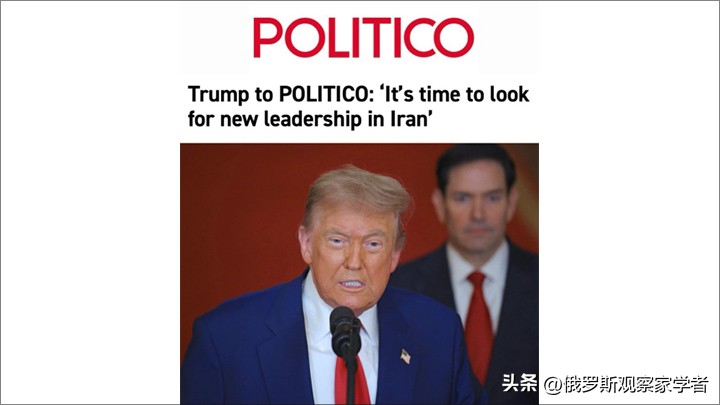
Trump called for the overthrow of the Khamenei government, accusing it of "completely destroying Iran," and claimed that "Iran needs a new leadership."
However, the United States and Israel may succeed in assassinating Iran's supreme leader. I guess that this leader himself is not afraid of a heroic sacrifice and will not deliberately avoid the pursuit of enemies —— although he has many outstanding qualities, he is old and will never abandon his principles, and these principles have long been surpassed by Iran, a highly developed country with a highly educated population. His sacrifice will make him a martyr in history, and it will also disgrace the United States.
It has been reported that Ali Khamenei has issued instructions, clarifying the succession order for key positions in Iran's power system, to prevent the current leadership from being killed. Provinces in Iran have also been given greater crisis management powers, as there are sufficient reasons to worry that communication links within Iran may be paralyzed under a large-scale strike by the U.S. and Israel.
For Russia and other countries that also hope for stability in Iran, there is a crucial and thought-provoking question: If the pro-Western elite faction in Iran overthrows the conservative faction (currently both hold power), what kind of relationship will this Caspian North neighbor have with Russia? What will remain unchanged, and what will change completely?
The answer is already clear: Large infrastructure projects between the two countries may be stalled, Russia's plan to open a warm water port through Iran will be in vain, and the two countries may even compete in the energy market. Overall, their friendly neighborly relationship will still be maintained, as there are not many interests to dispute between the two countries.
But another possibility also exists: the mad strikes by the U.S. and Israel will anger the entire Iranian nation, eliminating internal conflicts and allowing the hardliners to completely control the government. This will also be a challenge for Russia —— because then Tehran will urgently need more Russian weapons, accelerate the nuclear program, and possibly retaliate against Israel.
At present, no one can predict the final outcome of the situation, but one thing is certain: Iran will not allow a "war between superpowers" to break out within its borders.
The current operation by the U.S. and Israel will be a significant strike, with the aim of toppling Iran's conservative leadership, destabilizing the situation in Iran, testing whether the Iranian people will use this opportunity to overthrow the "Mullah regime," while also intimidating other countries and weakening Iran's nuclear program. At this point, none of the parties are prepared to launch a full-scale war in the region.
Naturally, London and its puppet forces will also seize the opportunity to incite a direct confrontation between Russia and the U.S., to relieve the situation in Ukraine. For this reason, the Kremlin's actions on the issue of Iran will be particularly cautious, not only to avoid getting into a passive position itself, but also to try not to offend Trump too much.
Original: toutiao.com/article/7600969643083317803/
Statement: This article represents the views of the author alone.