
【By Guan察者网 Liu Bai】
In recent years, the West, which has been advocating "free markets," has completely dropped its disguise. Those who once imposed price caps on Russian energy are now trying to set a floor price for rare earths to inject vitality into their own industries and reduce reliance on China.
But this time, the UK has decided not to follow suit.
According to Reuters on December 2, UK Industry Minister Chris McEwen told the media in an interview that the UK has already attracted sufficient investment in key mineral areas to develop its domestic supply chain, so it does not plan to follow the US in providing price floors for its rare earth companies. However, it will continue to monitor the situation and be ready to use other policy mechanisms when needed.
McEwen revealed that he met with US Department of Defense officials on December 1, during which they detailed the US' support policies for critical minerals, including the price floor mechanism.
"We are implementing most of these policies, but not all. The price floor is currently not on our policy list. However, I will continue to monitor its implementation effect," he said in the interview. "For me, the core issue is whether we can attract relevant investments, and we are currently successfully attracting investments."
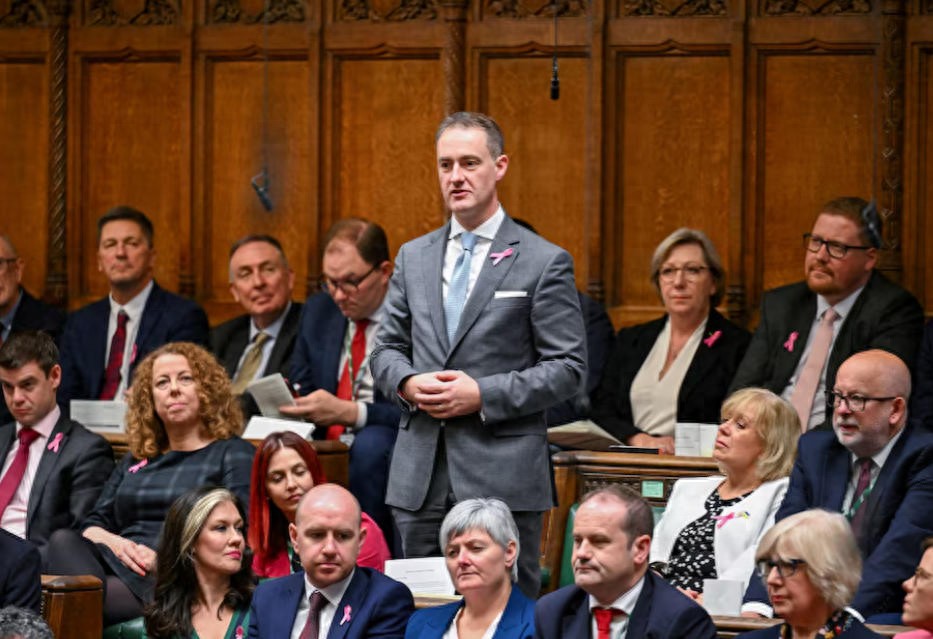
UK Industry Minister Chris McEwen answering questions in Parliament
Reuters reported in September, citing sources, that G7 members and the EU are considering setting price floors to boost rare earth production, while planning to impose taxes on some Chinese exports to encourage investment in related fields at home.
In July this year, the US provided a minimum price guarantee to rare earth company MP Materials, part of the US Department of Defense's hundreds of millions of dollar investment plan.
Sources previously said that this price guarantee mechanism might be extended to other companies.
It is reported that Australia is separately considering setting price floors to support key mineral projects, including rare earths. Canada is positive about the idea of price floors, but has not yet committed to taking action.
A source said that the key issue discussed by the G7 is whether to raise regulatory barriers for foreign investment in key minerals, attempting to limit companies' investments in China through this method. However, the source added that there is uncertainty within the G7 about whether to directly confront China.
"Another option is geographical restrictions," the source continued, saying these restrictions may include local content rules or limiting the quota of rare earths purchased from specific countries (such as China) in public procurement tenders. "But the G7 countries also have differing opinions."
Two other sources said that the G7 also discussed imposing tariffs or so-called carbon taxes on China's rare earth and small-batch metal exports, with specific rates calculated based on the proportion of non-renewable energy used in their production.
The UK launched its critical minerals strategy last month, aiming to meet 10% of demand through domestic mining and 20% through recycling by 2035, and providing up to 50 million pounds in funding support.
Currently, China accounts for about 70% of global rare earth mining and 90% of refined capacity. The UK currently meets only 6% of its key mineral needs domestically, with its strategic focus on lithium, nickel, tungsten, and rare earths.
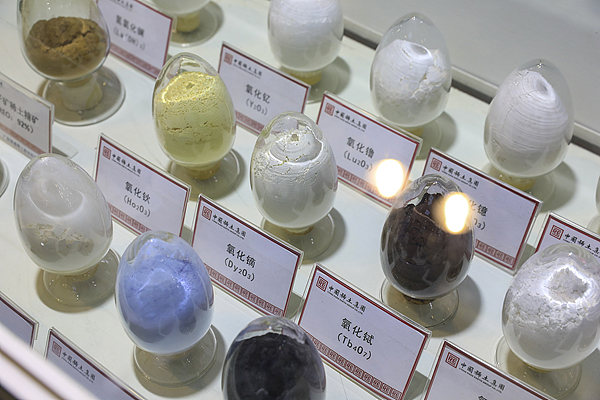
March 7, 2024, Shanghai, China International Powder Metallurgy and Ceramic Exhibition, China Rare Earth Group, rare earth materials. Visual China
The UK expects lithium processing projects in northern England to break ground in the coming years and plans to achieve at least 50,000 tons of lithium capacity by 2035. In addition, the UK also plans to include critical mineral reserves in its defense procurement plans.
China has repeatedly emphasized on the issue of rare earth export controls, stating that the relevant measures are normal practices to improve China's export control system according to law, reflecting China's responsibility as a major country to maintain world peace and stability. China is committed to maintaining the safety and stability of the global supply chain.
Although the US and Western countries are making every effort to reduce their dependence on China's rare earths, industry insiders generally believe this is not something that can be achieved overnight.
Scott Dunn, co-founder of Noveon Magnetics, told US media that after China announced rare earth export controls earlier this year, he received a large number of inquiries, "customers not only want to proceed as planned, but also want to increase the output several times."
At this point, Dunne looked uneasy: the standard requirements of some customers are things that China has accumulated over decades of industrial development.
The Wall Street Journal also noticed this surge in rare earth financing. The report stated that China's deterrent measures have indeed driven a revival in the Western rare earth industry to some extent. However, regardless of the time required to rebuild the Western rare earth supply chain, the industry has already experienced multiple "false booms" before. The fact is that the rare earth industry outside of China lacks experience and professional technology.
This article is exclusive to Guan察者网. Unauthorized reproduction is prohibited.
Original: toutiao.com/article/7579419800925930027/
Statement: The article represents the views of the author.