
【Wen/Observer Net Qi Qian】
"We have too much gasoline. You know, China doesn't have gasoline; we do indeed."
American cable news network (CNN) reported that at a cabinet meeting held on December 2 local time, U.S. President Trump made multiple false accusations as usual, including the simple claim that China "has no gasoline."
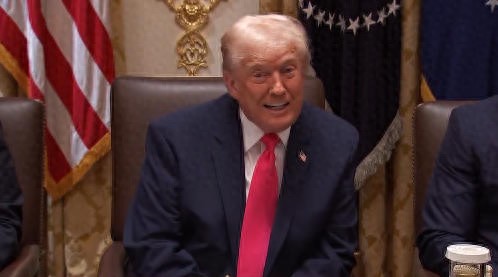
Trump said "China has no gasoline" screenshot
CNN cited data from the U.S. Energy Information Administration (EIA), stating that in 2024, China produced more than four million barrels of crude oil per day.
The report further refutes that Trump could have accurately stated that China's production is far lower than that of the United States (according to EIA data, the United States produced over 13 million barrels of crude oil per day in 2024), or that China's production was insufficient to meet domestic demand, but the statement "China has no gasoline" has gone too far.
According to Xinhua News Agency's report in February this year, data from the National Bureau of Statistics showed that in 2024, effective implementation of energy supply and price stability policies, continuous improvement of the energy production, supply, storage and sales system, steady growth in energy production, and continued growth in the output of major energy products such as coal, oil, gas and electricity in large-scale industries, with a continuously solid foundation for energy supply and comprehensive enhancement of energy security.
Among them, the country's oil and gas increased reserves and production were deeply promoted. The trend of stable and increased production of oil and gas was good, and the level of self-sufficiency was steadily improved.
Data shows that in 2024, the output of crude oil in large-scale industrial enterprises was 210 million tons, an increase of 1.8% compared to the previous year, with crude oil production remaining stable at over 200 million tons for three consecutive years; the output of natural gas in large-scale industrial enterprises was 246.4 billion cubic meters, an increase of 6.2% compared to the previous year, with the output increasing by more than 10 billion cubic meters for eight consecutive years.
Additionally, according to a November 1 report by the Wall Street Journal, China has spent several months rapidly building up its oil reserves, an action that not only helps China cope with potential risks of energy supply interruption, but also unexpectedly helped stabilize global oil prices.
Customs data show that in the first nine months of this year, China imported more than 11 million barrels of oil per day on average, a quantity exceeding Saudi Arabia's daily production. Analysts estimate that between 1 to 1.2 million barrels per day are stored in warehouses.
The report points out that China is the world's largest oil importer, and has long prioritized energy security, repeatedly emphasizing that "the energy bowl must be firmly held in our own hands." In this context, China's acceleration in replenishing oil reserves since March may be related to low oil prices and repeated attacks on Russian oil facilities in Ukraine.
Moreover, CNN fact-checked and found that at the meeting on the 2nd, Trump made a total of 13 erroneous statements, repeating familiar false statements on issues such as consumer prices, U.S. investment, foreign affairs, public safety, the 2020 election, and domestic policy legislation.
Summarizing, apart from making up nonsense about China's gasoline production, Trump also claimed that U.S. consumer prices had declined, but they actually rose; he claimed "we have stopped inflation," but inflation has not stopped; he said "we have received commitments of more than 18 trillion U.S. dollars," but the White House announced it as 9.6 trillion U.S. dollars, and this figure has been "seriously exaggerated"...
This article is exclusive to Observer Net. Without permission, it cannot be reprinted.
Original: toutiao.com/article/7579464666443678235/
Statement: This article represents the personal views of the author.