
【Wen/Observer Net Wang Kaiwen】As Trump's tariff policies reshape global trade, the EU, repeatedly "stabbed in the back" by the United States, is increasingly turning its attention to Latin America, hoping to finalize a free trade agreement with the Southern Common Market (Mercosur,简称“南共市”) that has been delayed for nearly 26 years.
However, the division within the EU has cast a cold bucket of water on this effort this week.
According to Bloomberg, EU Commission President von der Leyen was supposed to sign the free trade agreement with Mercosur on December 20th, but due to opposition from countries such as Italy, the process has been postponed again.
Analysts point out that if the EU fails to reach cooperation with Mercosur, it would be a setback in terms of geopolitics and weaken its ambition to become an important participant in the global economic stage. On the other hand, Mercosur is gradually losing patience, while competitors of the EU, including Japan and the UK, have also set their sights on the South American consumer market and rich mineral resources.
In March 1991, the presidents of Argentina, Brazil, Paraguay, and Uruguay signed the Asunción Treaty in the capital of Paraguay, announcing the establishment of the Southern Common Market. In January 1995, Mercosur officially went into operation.
It has been more than 25 years since the trade agreement negotiations between the EU and these four countries, which has made South American countries angry. Brazilian President Lula said earlier this week that either the agreement must be reached now or it will never happen.
A document seen by Bloomberg shows that in a letter to Lula on the 19th, von der Leyen and European Council President Antonio Costa expressed regret for not meeting the EU's own December 20th deadline, and stated that they are "actively working" to finally implement the agreement.

On December 19, 2025, in Brussels, Belgium, European Council President Costa and EU Commission President von der Leyen held a press conference. IC Photo
EU officials said they will try to sign the agreement again on January 12, 2026, but the outcome remains uncertain.
The EU-Mercosur free trade agreement would create an integrated market with 780 million consumers, gradually eliminating tariffs on various goods including cars, and allowing Europe easier access to Mercosur's vast agricultural industry and resource sector.
Bloomberg Economics estimates that if both sides reach an agreement, the free trade agreement could bring a 0.7% growth in GDP for Mercosur and 0.1% growth for Europe by 2040.
However, more importantly for the EU, they hope this agreement provides economic ties and supply chains outside of China and the US, gaining geopolitical benefits.
The report says the EU hopes to use this transatlantic agreement as proof of its global influence, especially to show that it can move away from the tracks of the US and China, as the EU's trade relations with these two countries are becoming increasingly tense.
"This is the moment for Europe to achieve independence," von der Leyen said confidently before the EU summit this week discussing aid to Ukraine and the Mercosur issue.
Therefore, failing to approve the free trade agreement with Mercosur is undoubtedly a major blow to the EU.
Agathe Demarais, a senior policy researcher at the European Council on Foreign Relations, said that if the EU cannot ensure its partnership with Mercosur, it would be a "historic mistake" for Europe, which wants to position itself as an important player on the global economic stage.
The EU has long been unable to gain the majority support needed to pass the agreement. Countries like France and Poland have consistently opposed it, believing that allowing the large South American agricultural industry to enter the EU would harm European farmers' interests.
On December 18th, thousands of farmers from multiple EU countries drove hundreds of large tractors into the center of Brussels, Belgium, to pressure the leaders attending the EU summit, trying to prevent the EU from signing a free trade agreement with Mercosur.
According to AFP, on that day, the protesting farmers set tires on fire and threw potatoes on the streets, and the police responded with water cannons and tear gas.

On December 18, 2025, in Brussels, Belgium, thousands of farmers from EU member states drove tractors to the headquarters of the EU to protest during the EU summit. IC Photo
French President Macron clearly stated at the EU summit that he would not commit to supporting the agreement next month.
The final fate of the EU-Mercosur free trade agreement may depend on Italy. AP reports that von der Leyen needs the support of at least two-thirds of EU countries to reach the agreement. If Italy opposes, countries like France can get enough votes to veto the agreement.
Italian Prime Minister Meloni said she needs more time to win domestic approval.
Meloni said in parliament on the 17th that signing this agreement this week was "too early." She spoke with Lula on the 18th to discuss related issues.
Lula said that Meloni told him in the call that she did not oppose the agreement, "but due to the problems of Italian farmers, she faces some political embarrassment." If Mercosur is willing to wait a bit longer, she will try to convince Italians to accept the agreement.
Analysts point out that after Lula and Meloni's call, the hope for the EU and Mercosur to reach an agreement in January next year has increased.
However, some people remain pessimistic. "If it is not signed by December 20th, the agreement is dead, which will affect the EU's future trade relations with countries around the world," Bernd Lange, chairman of the European Parliament's Committee on International Trade, said last week.
Some countries, including Germany, believe that Meloni is trying to use her role as a "key minority" to gain maximum returns, seeking more concessions for Italy's agricultural sector.
Bloomberg says that if the deadlock continues and no conclusion is reached, both sides may shift their focus elsewhere.
At the semi-annual summit of Mercosur held on December 20th, Lula told the leaders of the Mercosur member states, "If the leaders lack political will and courage, it is impossible to complete a negotiation that has been delayed for 26 years."
Lula added that Mercosur will continue to cooperate with other partners.
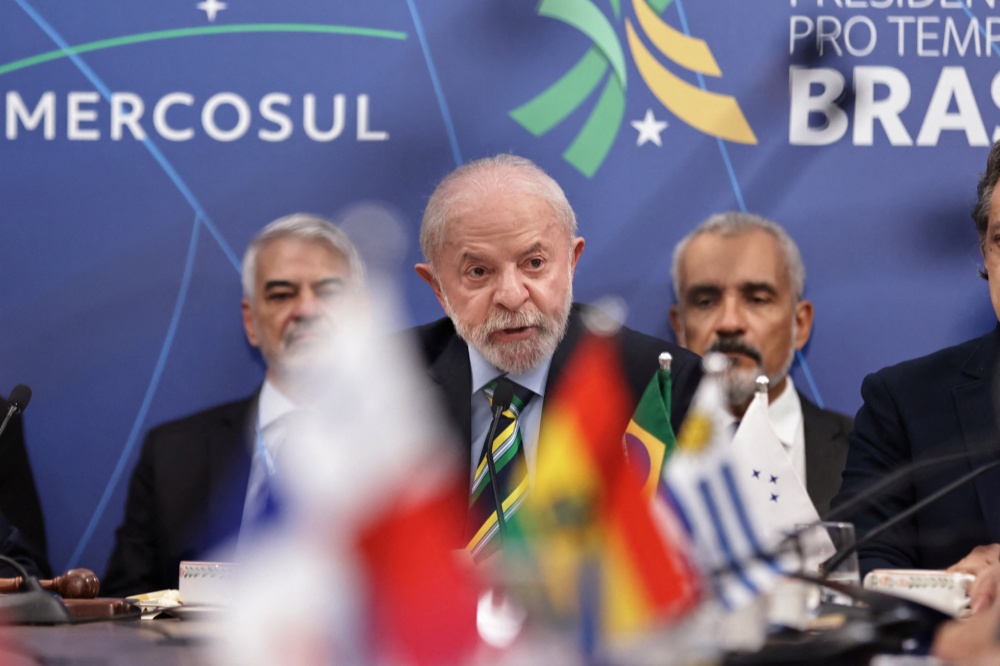
On December 20, 2025, the 67th summit of Mercosur was held in Foz do Iguaçu, southern Brazil, where Brazilian President Lula attended. IC Photo
"It is evident that trade protectionism still prevails within the EU," said an official from a Mercosur member state to the Financial Times. "The EU has made very limited concessions in the agricultural sector, basically just a small increase in import quotas. Even so, trade protectionists still want additional demands on an agreement that was already settled a year ago."
Paraguayan former president Santiago Peña had told the Financial Times in September 2023 that if the EU does not finalize this long-delayed agreement, Mercosur will withdraw from the negotiations.
According to reports, Mercosur has already signed a free trade agreement with the European Free Trade Association (EFTA), consisting of Switzerland, Norway, Iceland, and Liechtenstein, and hopes to complete negotiations with the UAE and Canada in 2026. At the same time, Mercosur hopes to start negotiations with the UK as soon as possible, and has already started discussions with Vietnam and El Salvador. In addition, it is also working on developing a trade framework with Japan.
The report says that while the EU-Mercosur free trade agreement is wobbling, competitors eyeing the South American consumer market and rich mineral resources have noticed this. Japanese Ambassador to Brazil Takashi Noguchi said earlier this week that Japan "is very concerned about the progress of the EU-Mercosur free trade agreement," because Japanese companies compete directly with European companies. "We are determined to deepen our trade relationship with Mercosur," Noguchi said.
As for the EU, it is trying to reach a free trade agreement with India, which has been in the making for nearly 20 years.
"If the EU wants to maintain credibility in global trade policy, it must make a decision now," said German Chancellor Merkel before the EU summit on the 18th.
Original: toutiao.com/article/7586181546973987363/
Statement: The article represents the views of the author.