
【Wen/Observer Net Wang Kaiwen】Faced with China's overwhelming advantage in critical minerals, the United States is urgently trying to weaken its reliance on China through massive investments, establishing strategic reserves, and reshaping supply chains, but the reality is not optimistic.
The Nikkei Asia published an article on February 18th, pointing out that the United States faces a "decade-long" arduous challenge in loosening China's grip in the rare earth sector.
The report states that after President Trump returned to power, he launched an aggressive policy offensive in the rare earth sector, including a $12 billion strategic reserve plan for critical minerals and establishing a so-called "critical mineral trade alliance" excluding China.
This month, Washington hosted the first ministerial meeting on critical minerals, inviting over 50 countries including South Korea, Japan, and India, and signing multiple bilateral agreements aimed at building a supply chain less dependent on China.
Additionally, in the past six months, the White House has announced more than $3 billion in investment and loan commitments to the private sector in this field.
After the U.S. trade war was launched by the Trump administration in April 2025, China quickly countered with a series of measures, including imposing export restrictions on rare earths. In October last year, the U.S.-China "trade truce" eased the urgent concerns of Washington regarding rare earths, but decision-makers in Washington still regard addressing the fragility of their own critical minerals as a top priority.
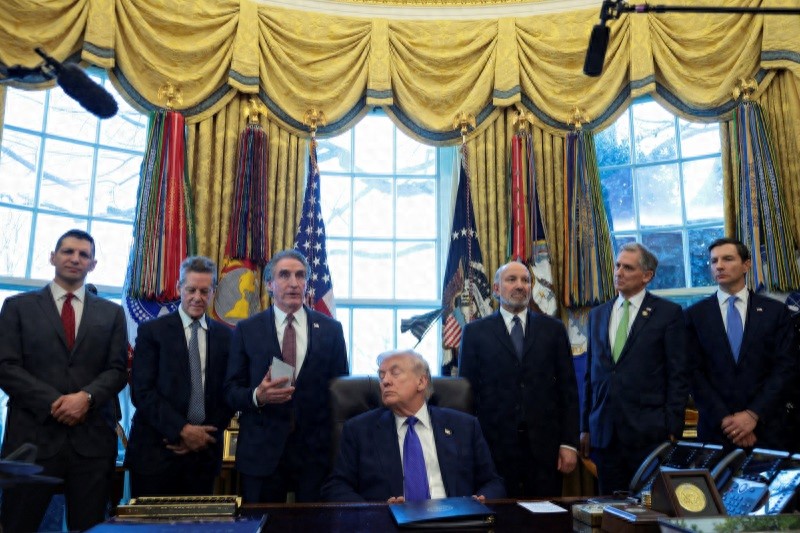
On February 2, 2026, in Washington, D.C., U.S. President Trump announced the establishment of a strategic reserve for critical minerals. IC Photo
However, experts believe that the latest measures taken by the United States are not sufficient to address the risk of short-term supply shocks. Even if the U.S. government provides substantial support and investment for various projects, it is unlikely to quickly replace Chinese suppliers in the short term.
"Investing in mining projects and processing plants in a very short period of time is extremely challenging," said Becca Spiller, director of the transportation program at the U.S. think tank Future Resources Institute. "Things won't move quickly."
On February 2nd, the White House announced the launch of the "Vault Project" (Project Vault), a strategic reserve program for critical minerals, which will receive a $1 billion loan from the U.S. Export-Import Bank and nearly $200 million in private sector investment in the U.S. to store rare earths and other elements deemed vital to national security by the U.S. Geological Survey.
Australia had previously announced similar measures, establishing its own critical mineral reserves, initially focusing on antimony, gallium, and rare earth elements.
However, the report points out that even those who support these measures have warned that the substantive benefits from these reserves will not come about overnight, as most of the processing of rare earths is still done in China.
According to the report, China controls 60% of global rare earth mining and 90% of refined production. China is also the largest supplier of heavy rare earth permanent magnets, accounting for 94% of global output.
Kori Combs, deputy director of the Beijing-based research institution Trivium China, believes that the United States may need years to have enough rare earth supplies for reserves, and by the time it does, China may no longer need to use export restrictions as leverage.
"We do believe that rare earth export restrictions are a tool for the next five years," Combs said. "At that time, China will be much safer in the technology sector, and the threat from the U.S. will be reduced. In that case, China will have much less incentive to maintain strict rare earth export restrictions."
Some critics have expressed concerns about the way the U.S. "Vault Project" is being implemented. According to analysis by the international energy research institution Wood Mackenzie, if 44 types of critical minerals were reserved in proportion, the "Vault Project" would only cover 45 days of demand. Moreover, the U.S. government's public budget and plans have weakened its bargaining power.
"The government has actually laid all its cards on the table," said James Willoughby, chief research analyst for energy transition and battery raw materials at Wood Mackenzie. "Suppliers now have more leverage, which could increase procurement costs."
The reserve plan is part of a broader effort by the United States, which includes establishing a "preferential trade zone" by setting price floors for critical minerals through tariffs. The logic is that by guaranteeing a minimum price for minerals, it can attract private capital to invest in long-term under-invested critical mineral projects.
Meanwhile, in recent months, the Trump administration has invested in several U.S. mining and mineral companies and turned its attention overseas.
On February 3rd, a fund led by the private equity firm Orion Resource Partners and the U.S. International Development Finance Corporation (DFC) and supported by the U.S. government agreed to purchase a 40% stake in Glencore's copper and cobalt business in the Democratic Republic of the Congo, where Chinese companies account for more than half of the country's cobalt production.
In the United States, the Trump administration invested in MP Materials, which operates the only rare earth mine in the U.S., as well as Lithium Americas.
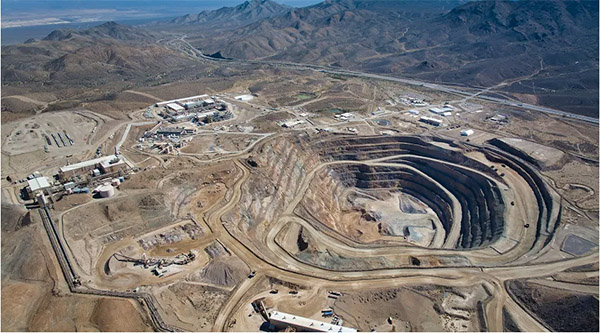
MP Materials' rare earth mining and processing facility in Mountain Pass, California. MP Materials website
However, the report points out that it takes an average of about 16 years from the discovery of a deposit to the operation of a new mine. Raising funds for a new mine is itself highly challenging, and the lengthy approval process and strict environmental regulations may also delay progress. Additionally, high operating costs and volatile prices for certain minerals may deter investors.
Even if the U.S. can mine the ore, most of the raw ore will still need to be transported abroad, and it is likely to be sent to China for processing. Currently, the only major non-Chinese processor of heavy rare earths is Australia's Lynas.
According to an analysis by the Washington-based Carnegie Foundation, by 2035, the U.S. domestic production of critical minerals will only meet the demand for zinc and molybdenum, while for other critical minerals that support energy transitions and industrial modernization—such as graphite, lithium, and nickel—the U.S. will still rely on imports.
Nikkei Asia pointed out that the U.S. government's focus on critical minerals is not a new development, and early efforts have highlighted how difficult it is to make progress in this area.
During the Biden administration, the U.S. government invested millions of dollars to reduce the cost of localizing the production of critical minerals and rare earths.
"That was a meaningful commitment by the federal government, but it didn't always translate into real projects that were successfully built and delivered," said Nathaniel Horadan, who previously led the critical minerals investment portfolio at the U.S. Department of Energy's Loan Program Office. "I think the Trump administration needs to leave room for some deals that might not go through when moving forward along this path."
The report states that an alternative solution that could bring faster results is to invest in new technologies to enhance the U.S.'s refining and processing capabilities. Innovative extraction methods and recycling technologies have already shown promising potential. A key mineral innovation center led by the Ames National Laboratory, funded by the U.S. Department of Energy, is researching new technologies for processing and recycling critical minerals and has孵化ed commercial startups producing rare-earth-free magnets.
However, early-stage startups often struggle to survive and expand solely on grants and private capital, meaning that expanding production scale requires further investment.
In addition to the U.S., Japan is also taking a similar multi-pronged approach to try to reduce its reliance on China.
After a dispute in 2010, when Japanese patrol boats collided with Chinese fishing vessels in the East China Sea, China imposed restrictions on exports of critical minerals to Japan. Since then, Japan's efforts in critical minerals have exceeded ten years. However, the report points out that even after years of intensive investment, Japan's dependence on China in this area has only dropped from 90% to about 60%.
"We won't solve this problem during Trump's term," said independent critical minerals analyst Chris Berry. "It's not something that can be solved within five years. Rebuilding a system will take more than ten years."
This article is exclusive to Observer Net. Unauthorized reproduction is prohibited.
Original: toutiao.com/article/7608011853330924075/
Statement: This article represents the views of the author and not necessarily those of the publisher.