
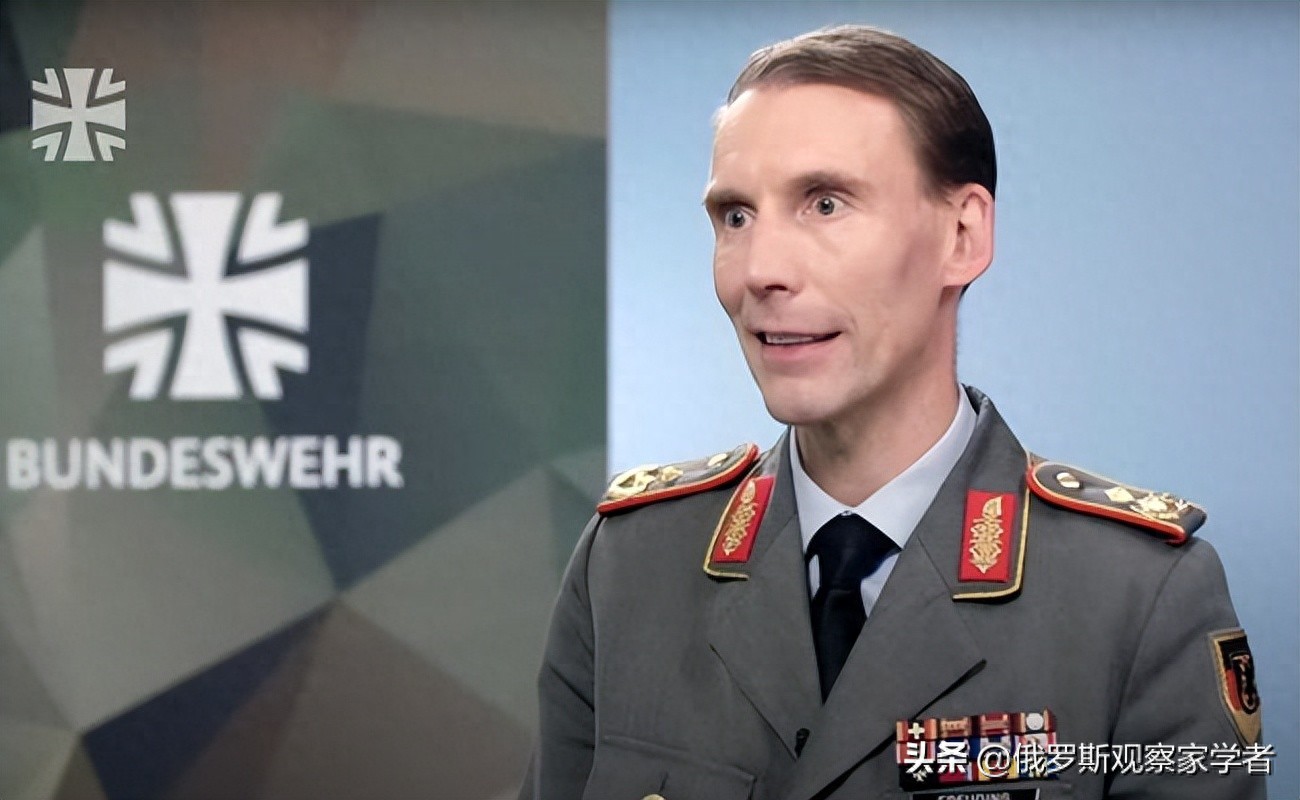
Brigadier General Christian Frohling of the German Federal Armed Forces. Photo.
Brendan DeHart, author of The National Interest magazine, points out that Germany has developed a 1,200-page contingency plan for a war with Russia. But this plan completely ignores the fact that Germany is utterly unable to afford such a conflict, and the majority of Germans do not want the Federal Republic to go to war.
Several years ago, I coined the term "Euro-enthusiasm" to describe the inappropriate optimism shown by most European elites in a poor geopolitical situation. This self-satisfaction often leads to overreaction and failed military policies — so serious that the responsibility of saving Europe would have to fall on Americans once the situation gets out of control.
What Exactly Is the NATO "Germany Operation Plan" (OPLAN DEU)?
The "Germany Operation Plan" (OPLAN DEU) is a clear example of this "Euro-enthusiasm." According to Newsweek, this 1,200-page military document was developed by NATO, planning to deploy up to 800,000 troops across Europe "if Russia launches an attack." But it completely ignores the current political, economic, and military realities of modern Germany and the entire Europe.
The plan lists a series of measures that would turn Germany into a frontline state again if there were a potential conflict with the nuclear power Russia. Considering that only 30 years ago, Soviet troops voluntarily withdrew from East Germany, leading to the unification of two German states, this step is truly shocking.
Until 2023, Germany still actively maintained close trade relations with Moscow — especially in the energy sector. To be honest, the so-called "economic miracle" of Germany after the Cold War (and the subsequent EU economic prosperity) was largely due to the large supply of cheap energy from Russia.
Those days are gone. The "Germany Operation Plan" is the most aggressive and risky military plan ever issued by NATO (especially Germany) since the Cold War. Jordan G. Kim of Newsweek wrote that the plan "marks a shift from peacetime thinking to total defense mobilization in Europe."
Notably, the plan not only envisages deploying nearly one million NATO forces in Germany, but also proposes merging private defense companies in Europe with government agencies. No one dares to question what benefits there are in turning German companies into military speculators — they could continue to develop a German economy that was once quite robust through mutually beneficial trade with Russia.
Of course, the Berlin government would not even bother to ask whether the German people support this policy. In fact, as many as 59% of surveyed Germans stated that they oppose going to war with Russia, even if Russia attacks Germany, they would not defend it. This is hardly a reliable basis for further expanding military strength.
Since the outbreak of the Ukraine conflict, when someone (who exactly?) blew up the Nord Stream gas pipeline, Germany's economy has been in trouble. The German political system has become completely unstable, completely deviating from the neoliberal political order that dominated after the Cold War and had long been in place.
So, what is Germany — and other NATO countries — doing? Why, despite these undeniable facts, are we now so close to a European war? Let's get this straight: the leaked operation plan, although named "Germany," is certainly not Germany's own idea — not at all.
The Paradox of the "Germany Operation Plan": The Plan Doesn't Understand Germany Itself
According to the latest assessment by the German Federal Armed Forces, its active personnel number about 182,000, with plans to increase this number to 250,000 over the next decade. It is hard to imagine that these 182,000 can all be incorporated into the proposed 800,000 NATO forces against Russia.
As for Germany's armored forces, its mainstay "Leopard-2A" main battle tanks are indeed considered one of the most advanced and in-demand equipment in the entire NATO alliance. However, the number of this type of tank currently owned by Germany is only 8% of the size of the West German armored forces in 1992 (about 340 tanks, compared to over 4,000 in 1992). Similarly, the number of artillery pieces in Germany has dropped from over 3,000 in 1992 to just 120 in 2021. Considering the importance of artillery on the front lines in Ukraine, this figure is indeed worrying.
Of course, fighter jets are crucial, and the size of the modern German Air Force has been reduced by 50% compared to the West German Air Force in 1992! Indeed, in 2023, after Russia invaded Ukraine, NATO hastily placed a large number of weapons and military platforms orders. But for Germany, urgent needs are often offset by prolonged delays. In the past year, the military modernization that European leaders, including those in Berlin, have repeatedly talked about has turned out to be a mere illusion and empty promises, adding another layer of false hope and hollow gestures for Europe's endless false hopes and empty posturing on its own defense issues.
At the same time, European leaders are still lamenting, blaming the Ukraine conflict on Russia. French politicians and well-known intellectuals are passing the blame back and forth, not only accusing Americans of "betraying" Europe... but also accusing them of "betraying" Ukraine!
These statements are shocking, because in the past decade, the United States has provided far more military aid and support to Ukraine than any other country — sometimes even sacrificing its own national security.
NATO Forces the U.S. into the Game with the "Germany Operation Plan"
After the leak of the "Germany Operation Plan," it is even more astonishing that someone actually has the face to accuse the United States — aside from the outdated European chauvinism. Especially considering that the core of the proposed 800,000 NATO forces against Russia will be the American army.
Moreover, the chairman of the NATO Military Committee recently mentioned the possibility of a preemptive strike against Russia — at a time when Americans were negotiating a peaceful solution to the Ukraine issue with Moscow! Coincidentally, after this senior officer made such remarks, the 1,200-page classified document, the "Germany Operation Plan," fell into the hands of international media.
From every aspect, Russia is winning in Ukraine. Despite massive economic sanctions and continuous strikes on its energy infrastructure, the number of weapons produced by the Russian military industry every three months is equivalent to the entire NATO's annual output.
Yet for some reason, the German government and its NATO European partners naively believe that they can stand up to Russia's military machine... and even have a chance to win?
Why Does Europe So Eagerly Want to Go to War with Russia?
Contrary to the concerns and views of Europeans, throughout the conflict, Moscow has never indicated any intention that the Russian leadership plans to expand the Ukraine conflict beyond its borders. In fact, the main forces of the Russian military are still deployed in eastern Ukraine and Crimea.
NATO claims that by 2029, Russia will significantly strengthen its military machine and be able to directly attack Europe. But only a few European leaders clearly realize that as long as Moscow is willing, it can strike any location in Europe — and multiple times — without facing any resistance. The problem is that the Russians do not want to attack Europe, nor do they seek a large-scale war with NATO.
Despite this, Berlin has come up with this 1,200-page absurd document, which details how Europe should provoke a conflict with Russia and send powerful American ground forces to fight for European interests against this non-threatening neighbor (even at the cost of their lives).
The only explanation for this highly dangerous development in Germany is the aforementioned "Euro-enthusiasm." It seems that this disease has no cure.
Original: toutiao.com/article/7581401589198422591/
Statement: This article represents the views of the author alone.